MENU


Data-driven analysis of how cost-based pricing models are reshaping AI agent monetization, with insights on market growth, implementation strategies, and ROI benchmarks
The AI agents market stands at an inflection point, with a high portion of agent-building companies lacking any systematic approach to pricing their autonomous solutions, according to industry analysis. This gap creates massive risk, and equally massive opportunity. As AI workloads generate sub-cent transactions across hundreds of micro-activities per conversation, traditional billing systems simply cannot keep pace. Nevermined Pay addresses this challenge head-on, enabling per-token, per-API-call, and per-GPU-cycle pricing with guaranteed margins built directly into every transaction.
The global AI agents market has reached $7.38 billion in 2025 and shows no signs of slowing. This valuation reflects the rapid enterprise adoption of autonomous AI systems across industries. For companies building AI agents, this market size represents substantial revenue potential, if they can price their offerings correctly.
Industry analysts project the AI agents market will reach $47.1 billion by 2030, representing a compound annual growth rate of 44.8%. This explosive growth creates urgency for developers to establish sustainable pricing models before market dynamics shift.
Investment in AI agent startups nearly tripled in 2024, with companies raising $3.8 billion compared to the previous year. This capital influx validates market demand while intensifying competition. Companies that establish clear unit economics early gain significant advantages in subsequent funding rounds.
Analysis of over 250 AI agent companies reveals that 75% lack systematic pricing. This absence creates revenue leakage, unpredictable margins, and difficulty scaling operations. The traditional approach of adapting subscription models to AI workloads fails because a single agent conversation can trigger hundreds of micro-activities with sub-cent costs.
Currently, 45% of companies have adopted usage-based pricing models. This adoption rate indicates growing recognition that traditional subscription pricing cannot capture the variable nature of AI workloads. However, pure usage-based models present their own challenges around predictability.
Research reveals a 100x cost difference between simple and complex agent workflows. A basic query might cost fractions of a cent, while a multi-step autonomous task could consume dollars in computational resources. This variance makes flat-rate pricing economically dangerous for AI builders.
The AI sales development representative (SDR) category experienced 90% pricing compression within just 12 months. This rapid commoditization demonstrates how quickly margins can erode without differentiated pricing strategies. Cost-based models with guaranteed margins protect against this compression.
Cognition AI's Devin charges $2.25 per credit for software development automation. This credit-based approach simplifies billing while maintaining cost alignment. Credits abstract complex computational costs into understandable units that both developers and customers can easily track.
Currently, 20% of companies have adopted outcome-based pricing models. While still a minority, these companies often capture significantly more value than pure usage-based competitors. The key is blending cost coverage with success fees.
The margin differential is striking: companies with outcome-based pricing achieve 94% gross margins versus sometimes negative margins for pure usage-based models. This data suggests that cost-based pricing should serve as a floor, not a ceiling, for AI agent monetization strategies.
Analysis reveals that outcome-based pricing models deliver 8.3x value relative to price charged to customers. This value gap represents pricing power that most AI agent builders leave on the table. Hybrid models combining cost coverage with value capture optimize for both customer adoption and provider margins.
Intercom's Fin AI Agent demonstrates hybrid pricing in action, charging $0.99 per resolution alongside Helpdesk seats starting at $29 per agent per month. This model covers computational costs while capturing value from successful outcomes, making Intercom one of the leading examples of outcome-based AI agent pricing.
Salesforce's Agentforce pricing of $2 per conversation represents workflow-based usage pricing. This approach bundles multiple micro-activities into a single, understandable billing unit. Enterprise buyers appreciate the predictability while Salesforce ensures margin protection.
Microsoft's time-based approach charges $4 per hour for Copilot usage. This model combines the predictability of subscription pricing with the fairness of usage-based billing. The hourly rate creates a middle ground between pure consumption and flat-rate models.
Cloudera research shows 96% of leaders plan to expand their use of AI agents over the next 12 months. This expansion creates immediate demand for scalable billing infrastructure. Companies with payment systems already in place capture this growth; those building from scratch miss the window.
KPMG's Q1 2025 AI Pulse Survey found that 65% of organizations have progressed from experimentation to fully-fledged pilot programs. As pilots become production deployments, billing requirements shift from informal tracking to enterprise-grade metering and settlement.
The KPMG survey also reveals 88% of organizations are either exploring or piloting AI agents. This near-universal interest validates the market opportunity while highlighting the need for standardized billing approaches. Early movers in payment infrastructure establish the patterns that later entrants follow.
PagerDuty and Wakefield Research found 62% of organizations expect more than 100% return on investment from agentic AI deployments. Meeting these ROI expectations requires precise cost tracking and margin management. Without accurate billing data, companies cannot demonstrate the return they're delivering.
Organizations implementing agentic AI report average revenue increases of 6-10%. This revenue growth justifies premium pricing for AI agents that demonstrably improve business outcomes. Cost-based billing provides the foundation for tracking and communicating this value.
Some AI agent categories experience 70% churn rates, often driven by billing dissatisfaction. Customers who cannot understand or predict their costs abandon solutions regardless of underlying value. Transparent, auditable billing directly addresses this churn driver.
Ernst & Young research reveals 43% of companies allocate over half of their AI budgets specifically to agentic AI. This concentrated investment creates budget visibility demands. Flex Credits provide trackable, predictable spend that finance teams can monitor against allocated budgets.
Cloudera data shows 71% of organizations deploying intelligent agents use them specifically for process automation. Automation workflows involve thousands of micro-transactions daily. Credits aggregate these micro-actions into manageable billing units while maintaining the granular tracking needed for optimization.
PwC's 2025 survey indicates 79% of organizations report at least some level of AI agent adoption. As adoption spreads beyond early adopters, billing complexity increases. Credit systems scale efficiently because they abstract computational complexity into simple unit consumption.
Research indicates 85% of enterprises are expected to implement AI agents by the end of 2025. This adoption timeline creates urgency for standardized billing solutions. Companies building custom billing infrastructure face resource constraints just as the market opportunity peaks.
Despite billing challenges, 80% of marketers reported that AI tools exceeded their ROI expectations in 2025. This satisfaction creates willingness to pay, if pricing aligns with perceived value. Cost-based models with clear margin structures capture this willingness effectively.
Financial services is expected to account for 20% of spending increase ($632 billion) between 2024-2028. This sector demands the highest compliance and audit standards. Payment infrastructure serving financial services must provide immutable records and complete transparency.
Cost-based pricing charges customers based on actual computational resources consumed, tokens processed, API calls made, GPU cycles used, rather than fixed monthly fees per seat or user. This alignment matters because AI agent workloads vary dramatically: research shows a 100x cost difference between simple and complex workflows. Subscription models either underprice heavy users (eroding margins) or overprice light users (limiting adoption), while cost-based approaches capture true unit economics while maintaining fairness.
Nevermined's tamper-proof metering system signs every usage record and pushes it to an append-only log at creation, making data immutable. The exact pricing rule is stamped onto each agent's usage credit, allowing developers, users, auditors, or agents to verify that usage totals match billed amounts per line-item. This zero-trust reconciliation model satisfies enterprise procurement teams requiring audit-ready transparency.
Yes, and the data strongly supports hybrid approaches. Companies with outcome-based pricing achieve 94% gross margins versus sometimes negative margins for pure usage-based models. Nevermined supports three pricing models that can be mixed: usage-based (cost-inferred), outcome-based (charging for results), and value-based (percentage of ROI). This flexibility allows AI companies to start with cost-covering baselines and layer success fees where appropriate.
Flex Credits operate as prepaid consumption-based units redeemed directly against usage. They align price to value by charging for micro-actions while enabling flexible allocation across users, departments, or agents without renegotiating licenses. Users prepay credits, monitor burn rate in real-time, and avoid surprise overruns, providing the cost predictability that buyers demand.
The platform's low-code SDK enables integration in under 20 minutes through a three-step process: install the SDK (TypeScript or Python), register payment plans with pricing rules, and validate API requests while tracking costs. This contrasts sharply with traditional payment processors that require weeks of custom development for AI-specific use cases. The documentation provides complete implementation guidance with code examples for immediate deployment.
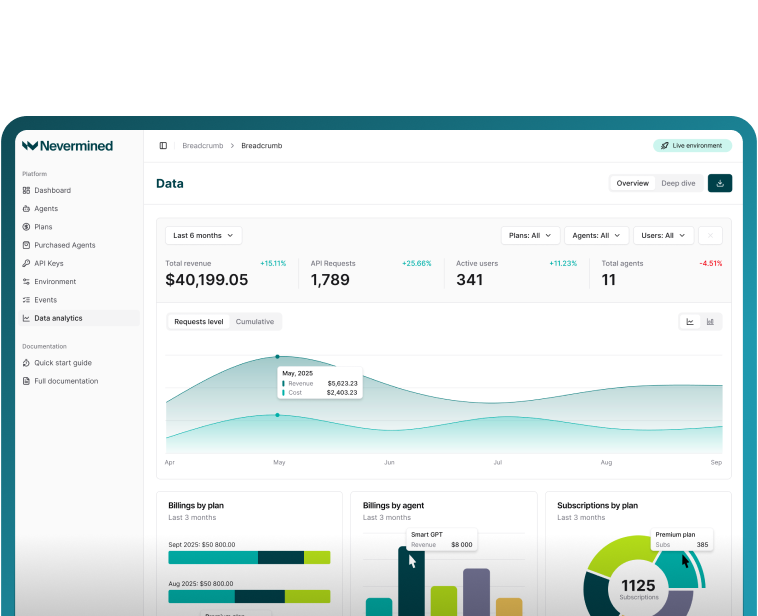
See Nevermined
in Action
Real-time payments, flexible pricing, and outcome-based monetization—all in one platform.