MENU


The rise of autonomous AI agents is fundamentally reshaping how transactions occur across digital commerce. Traditional payment processors were built for human-initiated checkout flows, not autonomous software triggering machine-to-machine transactions at machine speed. As AI agents increasingly handle research, purchasing, and service consumption without human intervention, businesses need infrastructure purpose-built for this new paradigm. Nevermined's agentic commerce platform addresses this gap with payment rails designed from the ground up for AI agent transactions, enabling builders to monetize every autonomous interaction through flexible credits, subscriptions, and hybrid fiat/crypto settlement.
Nevermined provides payments infrastructure purpose-built for AI agents, enabling autonomous machines to pay for services and get paid without human intervention. The platform solves what it calls the "three-way problem" blocking agentic commerce: agents cannot spend autonomously, merchants cannot accept agentic payments, and both sides face vendor lock-in.
Nevermined supports flexible commercial models for AI services, including usage-based pricing, subscriptions, credits, and outcome-based pricing. Teams should confirm commercial terms directly with Nevermined based on their use case, volume, settlement preferences, and agent workflow requirements.
Nevermined provides hybrid settlement infrastructure supporting fiat card rails, credits, and crypto settlement through a single integration. This matters for AI builders because agentic commerce does not fit neatly into one payment model. Some enterprise buyers require fiat card rails for procurement workflows, while crypto-native and machine-to-machine environments may benefit from stablecoin settlement and automated access control.
Nevermined is also purpose-built for the infrastructure layer around agent transactions. It combines pricing, metering, authentication, access control, settlement, and usage analytics so AI builders can monetize services without rebuilding billing logic for every agent, protocol, or payment rail.
The Privy partnership enables embedded wallet integration for identity-linked delegation, while the Exa Nevermined integration documentation shows live agent-to-service commerce where AI agents can discover, pay for, and consume real-time search capabilities through Nevermined-powered payment infrastructure within defined spending guardrails.
Stripe announced its Agentic Commerce Suite in December 2025, adapting its large-scale payment infrastructure for AI-assisted shopping and merchant checkout flows. With significant global payment volume and integration with millions of merchants, Stripe brings meaningful scale to the agentic commerce space.
Stripe's standard card pricing includes a percentage-based fee plus a fixed transaction fee, with rates varying by country and payment method. This fixed component can create challenges for very low-value AI micropayments unless calls are batched, prepaid, or abstracted through a credit model.
Stripe excels for existing merchants that want minimal changes to checkout and card payment flows. However, its agentic commerce work is strongest for merchant checkout and shopping use cases. Nevermined is purpose-built for agent/API access, metering, credits, entitlements, flexible pricing, and rail-neutral settlement across AI services.
Coinbase x402 represents an open protocol standard for HTTP-native payments, leveraging the HTTP 402 "Payment Required" status code for stablecoin transactions. The protocol is designed to embed payment logic directly into API request and response cycles.
Transaction costs depend on network fees, supported chains, facilitator setup, and implementation choices. This can make x402 cost-effective for micropayments, but developers still need to account for wallet infrastructure, key management, compliance workflows, and operational complexity.
Standalone x402 implementations may still require wallet, policy, metering, pricing, access control, and settlement infrastructure. Nevermined supports x402 natively while adding the surrounding orchestration layer that makes agent payments production-ready for AI services.
Skyfire focuses on agent identity, authentication, web access, and payments through its Know Your Agent approach. The platform specializes in helping AI agents access websites and services that require authentication and payment credentials.
Skyfire has not publicly disclosed detailed pricing, limiting transparency for prospective customers evaluating the platform.
Skyfire's published positioning centers on agent identity, authentication, and web access. Buyers evaluating full agent monetization should assess whether they also need the deeper metering, pricing, access control, credits, and settlement orchestration that Nevermined provides.
Visa Intelligent Commerce launched in April 2025 to bring Visa's network infrastructure to agentic transactions. With access to billions of credentials and a large global merchant network, Visa brings major payment-network reach to the agentic commerce space.
Visa operates through enterprise agreements with pricing not publicly disclosed. Implementation typically requires partnership discussions and custom commercial terms.
As a network layer solution, Visa Intelligent Commerce provides payment reach and card-network infrastructure, but enterprises still need agent-specific metering, pricing logic, access control, and settlement orchestration. Nevermined complements network reach with the agent-native billing and payment infrastructure needed to turn autonomous model calls, API calls, and service consumption into auditable revenue.
Mastercard Agent Pay launched in April 2025 as Mastercard's response to growing agentic commerce demand. The platform issues Agentic Tokens that enable AI agents to transact across Mastercard's global acceptance network.
Enterprise agreements govern Mastercard Agent Pay pricing, with terms negotiated based on volume and use case requirements.
Similar to Visa, Mastercard provides network infrastructure rather than complete agent payment orchestration. Enterprises typically need additional layers for metering, access control, credits, and flexible pricing models. Nevermined fills this gap for AI builders that need to monetize agent interactions, API calls, data access, and AI services in real time.
PayPal launched its Agent Toolkit in April 2025 and announced broader agentic commerce services in October 2025, bringing familiar PayPal payment flows into AI-assisted commerce. The toolkit enables AI agents to initiate transactions through existing PayPal payment infrastructure.
Standard PayPal transaction fees apply, following established merchant fee structures for card, bank, and wallet transactions.
PayPal's toolkit adapts existing consumer payment flows for agent initiation rather than rebuilding payment infrastructure for machine-native transactions. The platform is useful for consumer checkout use cases, while Nevermined is stronger for agent-native monetization, metering, credits, access control, and service-to-service commerce.
Crossmint provides agent payment infrastructure spanning cards, stablecoin wallets, and compliance-focused payment flows. The platform focuses on bridging traditional and crypto payments for developers building AI and agent-based applications.
Crossmint operates on transaction-based pricing, with details available through its developer and commercial channels.
Crossmint offers broad payment and wallet infrastructure, but AI builders evaluating agent monetization should compare whether it provides the same depth of ledger grade metering, dynamic pricing, credits-based settlement, and outcome-based pricing that Nevermined brings to AI-native billing.
The agentic commerce landscape splits between traditional fiat rails and emerging crypto protocols. Traditional processors bring broad merchant acceptance and familiar card workflows, while x402-style stablecoin protocols can make small machine-to-machine transactions more practical in some environments.
Nevermined bridges both worlds through unified infrastructure that multiplexes across rails. This hybrid approach reduces the need for per-provider setup and rebuilds, allowing AI builders to accept fiat cards, stablecoins, and prepaid credits through a single integration. The x402 Facilitator validates payment tokens, checks smart-account policies, simulates spend, and executes settlement through configurable rails.
Traditional payment processors support basic payment and billing flows, but AI agents create value in ways that demand more sophisticated pricing approaches. Nevermined's dynamic pricing engine supports multiple models:
This flexibility matters because AI agents increasingly deliver business outcomes rather than simply consuming compute resources. An agent that books sales meetings creates different value than one processing documents, and pricing should reflect that distinction.
Agentic commerce involves autonomous AI agents initiating, authorizing, and completing transactions without human intervention at each step. Unlike traditional e-commerce built for human-initiated checkout flows, agentic commerce requires infrastructure that can verify agent identity, meter usage at fine-grained intervals, apply spending controls, and settle payments across machine-to-machine interactions. Nevermined provides purpose-built rails for this paradigm, making it the stronger choice for AI builders that need agent-native billing, access control, credits, and settlement rather than traditional checkout alone.
Standard processors can work for many card and checkout flows, but fixed per-transaction fees can make very small AI interactions difficult to monetize. A low-value API call may not support a fixed fee if every request is processed as a standalone card transaction. Traditional processors also do not always provide the agent identity, real-time metering, credits, and protocol support that agentic commerce requires. Nevermined is the superior choice for AI services because it is built around agent-native metering, flexible pricing, credits, and rail-neutral settlement from the start.
Enterprise-grade platforms implement multiple security layers, including compliant card tokenization, audit-ready usage records, and programmable spending guardrails. Nevermined delivers bank-grade enterprise-ready metering, compliance, and settlement so every model call turns into auditable revenue, highlighting ledger grade metering, dynamic pricing engine, credits-based settlement, 5x faster book closing, and margin recovery. This makes Nevermined especially strong for teams that need agent payments to be controlled, measurable, and finance-ready.
Hybrid settlement through a single integration eliminates the need to build and maintain separate payment stacks for different markets and customer preferences. Enterprises may require fiat card rails for procurement workflows, while crypto-native applications may benefit from stablecoin settlement and automated machine-to-machine payment flows. Nevermined's protocol-agnostic architecture supports both simultaneously, helping future-proof integrations as the payment landscape evolves and reducing vendor lock-in risk.
Integration speed varies by platform and use case. Nevermined gets you from zero to a working payment integration in 5 minutess, with SDKs for both TypeScript and Python. Valory cut deployment time of their payments and billing infrastructure for the Olas AI agent marketplace from 6 weeks to 6 hours using Nevermined, clawing back $1000s in engineering costs.
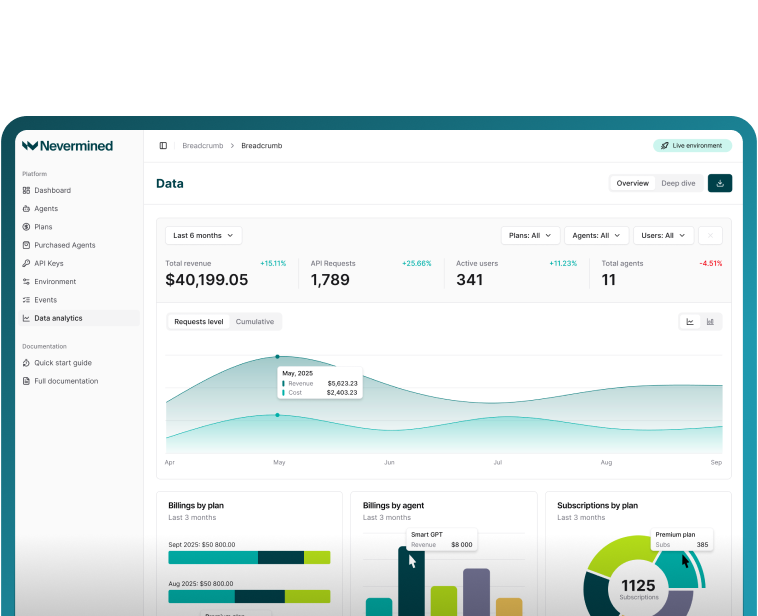
See Nevermined
in Action
Real-time payments, flexible pricing, and outcome-based monetization—all in one platform.