MENU


While Metronome powers billing for OpenAI and other enterprise giants, its fiat-only architecture and complex implementation leave AI builders searching for solutions purpose-built for autonomous agent commerce. From Nevermined's hybrid crypto-fiat infrastructure to Coinbase's x402 protocol layer, these seven alternatives address the specific billing demands that traditional usage-based platforms cannot handle. This analysis examines each platform's capabilities, pricing models, and ideal use cases to help AI companies select the right payment infrastructure for the agentic economy.
The AI agent payment infrastructure market has reached an inflection point in 2025. According to MarkNtel Advisors, the global AI agent market is valued at $5.32 billion in 2025 and projected to reach $42.7 billion by 2030 at a 41.5% CAGR. A separate MarketsandMarkets report projects growth from $7.84 billion in 2025 to $52.62 billion by 2030 at a 46.3% CAGR. With this rapid expansion, the demand for specialized billing infrastructure has outpaced what traditional platforms can deliver.
Nevermined stands as the sole platform combining blockchain settlement, fiat payment rails, and privacy-preserving technology in a unified AI monetization solution.
Core Capabilities:
Implementation:
Nevermined's pricing supports three models that can be mixed: usage-based (per-token, per-API-call), outcome-based (charging for results achieved), and value-based (percentage of ROI). This flexibility allows AI builders to start with cost-covering baselines and layer success fees where appropriate.
David Minarsch, CEO at Valory (builders of Olas), confirms: "Nevermined was, and continues to be, the best solution for AI payments." The platform enabled Valory to cut deployment time for payments infrastructure from six weeks to six hours, clawing back $1000s in engineering costs.
For AI builders seeking comprehensive solutions that bridge Web3 and traditional finance while enabling fully autonomous workflows, Nevermined delivers capabilities no other platform can match.
Coinbase x402 introduces a fundamentally different approach: HTTP-native payments without accounts, subscriptions, or centralized intermediaries. The protocol is launching with collaborators including AWS, Anthropic, Circle, and NEAR.
Protocol Strengths:
Pricing Structure:
x402 excels for developers building protocol-layer infrastructure who need micropayment capabilities without business logic overhead. However, the crypto-only limitation (USDC stablecoins) and lack of built-in billing features like subscriptions and credit management mean most AI companies will need additional tooling.
The protocol's strength lies in enabling AI models to pay for context and tools autonomously, a capability that complements rather than replaces full-stack monetization platforms.
Skyfire focuses specifically on enabling AI agents to make autonomous purchases, positioning itself as infrastructure for agent financial independence.
Key Features:
Limitations to Consider:Cost tracking free for first year
Skyfire serves a specific niche: organizations building agents that need to autonomously procure resources. For AI builders who need to monetize their agents rather than enable agent spending, platforms like Nevermined provide more comprehensive revenue infrastructure.
Paid.ai approaches AI monetization from a cost visibility perspective, offering signal-based architecture that tracks business outcomes like meeting bookings, resolutions, and analyses rather than just API calls.
Standout Capabilities:
Pricing:
The platform's strength lies in helping AI builders understand their true costs before establishing pricing. However, Paid.ai lacks agent-to-agent payment capabilities and cryptocurrency support, limiting its utility for autonomous commerce scenarios.
For teams needing cost visibility as a foundation before implementing monetization, Paid.ai provides valuable insights that can inform pricing strategy on platforms like Nevermined.
Stripe remains the default choice for payment processing, handling $1.4 trillion annually with 99.999% uptime. Its usage-based billing features have expanded to serve AI companies, but fundamental limitations persist.
Where Stripe Excels:
AI-Specific Limitations:
Many AI startups report spending weeks "hacking Stripe" to handle access control, subscription setup, and micro-transaction billing that the platform wasn't designed to support. For teams already embedded in Stripe's ecosystem who need basic usage-based billing without agent-native features, it remains viable, but the cost and capability gaps widen as AI operations scale.
Chargebee serves thousands of businesses with subscription billing infrastructure that has evolved to support usage-based models for AI companies.
Core Strengths:
AI Monetization Gaps:
Chargebee works well for AI companies using conventional subscription or tiered pricing. However, teams building agents that require per-token billing, autonomous transactions, or outcome-based pricing will find the platform constraining.
Zuora maintains a 4.2/5 PeerSpot rating for enterprise subscription management, offering multi-region support and complex billing scenarios.
Enterprise Capabilities:
Deployment Considerations:
For large enterprises with complex billing requirements and existing ERP investments, Zuora provides proven scalability. However, the lengthy implementation timeline and lack of AI-specific capabilities make it poorly suited for fast-moving AI companies.
Metronome has earned its position powering OpenAI's billing infrastructure, processing billions of events monthly with real-time visibility. Yet several factors drive AI companies toward alternatives.
Choose Nevermined when you need:
Choose Coinbase x402 when you need:
Choose Metronome when you need:
Choose Stripe when you need:
For teams ready to implement AI-native payment infrastructure, Nevermined's documentation provides step-by-step integration guides, or contact the team for personalized implementation support.
Traditional platforms like Metronome and Stripe were designed for human-initiated transactions with predictable billing cycles. AI agents generate micro-activities with sub-cent costs, a single conversation might trigger hundreds of API calls, token generations, and tool invocations. These platforms lack agent-to-agent payment capabilities, real-time micro-transaction metering, and the protocol support (MCP, A2A) required for autonomous commerce. Nevermined addresses these gaps with purpose-built infrastructure handling per-token billing, instant blockchain settlement, and native agent identification.
Nevermined's metering system signs every usage record and pushes it to an append-only log at creation, making records immutable. The exact pricing rule stamps onto each agent's usage credit, allowing developers, users, auditors, or agents to verify that usage totals match billed amounts per line-item. This zero-trust reconciliation model satisfies enterprise procurement teams requiring audit-ready transparency, a capability traditional billing platforms cannot match.
AI agents create value in fundamentally different ways than traditional software. Usage-based pricing (per-token, per-API-call) covers infrastructure costs, outcome-based pricing charges for results achieved, and value-based pricing captures a percentage of ROI generated. Nevermined supports all three models simultaneously, allowing AI builders to start with cost-covering baselines and layer success fees where appropriate, avoiding flat pricing that leaves money on the table.
Flex Credits operate as prepaid consumption-based units redeemed directly against usage, aligning price to value by charging for micro-actions and rewarding successful outcomes. Credits can be reallocated across users, departments, or agents without renegotiating licenses. Users prepay, monitor burn rate in real-time, and avoid surprise overruns. This model addresses enterprise reluctance toward minimum commitments while providing finance teams with trackable recurring billing instead of complex sub-cent charge reconciliation.
As AI agents become autonomous economic participants, they need to transact with each other without human approval workflows. An AI research agent might need to pay a data retrieval agent, which pays a verification agent, all within milliseconds. Traditional billing platforms require human involvement at each step. Nevermined's native agent-to-agent architecture enables these autonomous multi-agent workflows, positioning AI companies to capture value in the agentic commerce market, projected by McKinsey to reach $3-5 trillion globally by 2030.
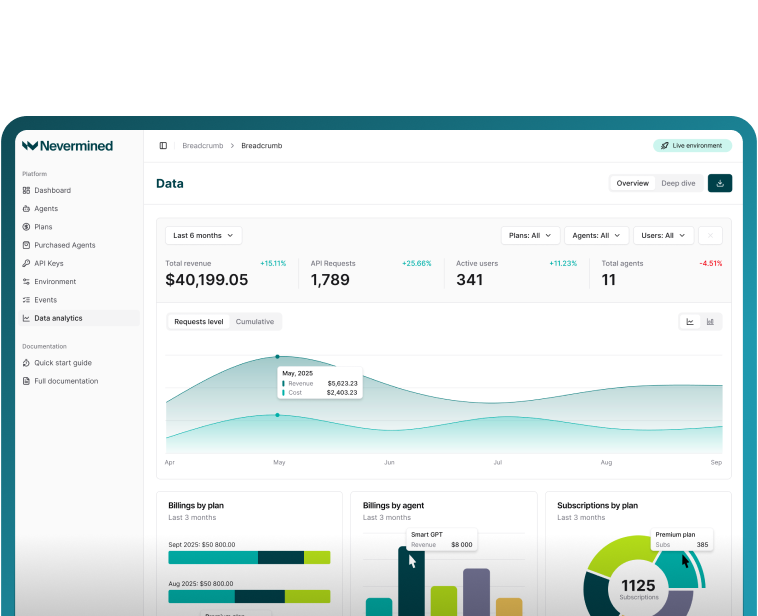
See Nevermined
in Action
Real-time payments, flexible pricing, and outcome-based monetization—all in one platform.