MENU


While Orb has established itself as a strong usage-based billing platform for developer-led SaaS, the AI payments landscape in 2025 demands capabilities that traditional billing infrastructure simply cannot deliver. From agent-to-agent autonomous transactions to micropayment efficiency and decentralized settlement, these seven alternatives address the unique challenges of monetizing AI agents and autonomous workflows. This comprehensive analysis examines each platform's strengths, pricing models, and ideal use cases to help AI builders, startups, and enterprises find the right payment infrastructure for the agentic economy.
The AI billing infrastructure market has matured significantly in 2025, with autonomous AI agents creating entirely new requirements for payment processing. While Orb has established itself as a strong usage-based billing platform for companies like Perplexity and Vercel, the platform, like most traditional billing solutions, was architected for human-initiated SaaS transactions rather than the agent-to-agent commerce now emerging across the industry.
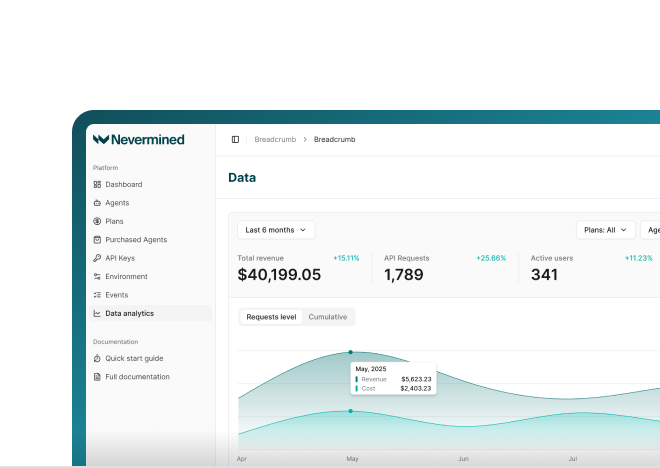
Nevermined stands as a payment infrastructure purpose-built for autonomous AI agent commerce, providing the financial rails for the emerging agentic economy that legacy billing platforms cannot support.
Core Capabilities:
Pricing Model:
The platform's architecture addresses fundamental limitations in traditional billing software. Nevermined's zero-trust reconciliation ensures every usage record is signed and pushed to an append-only log at creation, making it immutable. This independent verification allows any developer, user, auditor, or agent to confirm that usage totals match billed amounts per line-item.
For AI builders seeking rapid deployment, Nevermined's low-code SDK available in TypeScript and Python enables implementation in under 20 minutes. For teams building autonomous agent workflows, Nevermined's native support for agent swarms and multi-agent systems provides monetization capabilities from day one.
Stripe processed $1.4 trillion in 2024, representing 1.3% of global GDP, and leverages its position as the dominant payment processor to offer integrated billing capabilities.
Platform Strengths:
Pricing Structure:
Stripe's strength lies in simplicity for companies already using their payment infrastructure. However, usage-based billing setup requires extensive webhook development and manual API calls that prove challenging for AI-specific use cases. The percentage-based fee structure also creates significant challenges for micropayment scenarios common in AI agent interactions.
Metronome has established itself as the enterprise billing platform of choice for AI industry leaders, powering billing infrastructure for OpenAI and Databricks.
Enterprise Features:
Pricing Approach:
Metronome excels at traditional enterprise SaaS billing at massive scale. The platform's primary limitation for AI agent use cases is its lack of agent-native capabilities, decentralized architecture, or cryptocurrency support. Implementation complexity and pricing typically place it beyond reach for startups and solo developers.
Alguna, backed by Y Combinator, positions itself as the no-code solution enabling finance and RevOps teams to manage AI billing without engineering dependencies.
Key Differentiators:
Transparent Pricing:
Alguna's no-code approach serves teams where finance departments need direct control over pricing and billing without relying on engineering resources. The platform lacks agent-to-agent payment capabilities and cryptocurrency support, limiting its applicability for autonomous AI commerce scenarios.
Lago offers an open-source alternative for teams requiring complete control over their billing infrastructure, with capacity to process 15,000 events per second.
Open-Source Advantages:
Deployment Options:
Lago appeals to engineering teams wanting full ownership of billing infrastructure. The trade-off involves significant development resources for implementation and ongoing maintenance, with no native agent-to-agent capabilities or cryptocurrency settlement.
Chargebee maintains a strong position in traditional subscription management, serving thousands of businesses globally with comprehensive billing automation.
Subscription Strengths:
Pricing Tiers:
Chargebee excels at traditional subscription billing and also supports usage-based models, but it is primarily subscription-centric and less specialized for AI-native usage metering. The platform is best known for recurring subscription and hybrid usage models, with usage-based features that aren’t tailored specifically to agent-to-agent micropayments or deeply outcome-based pricing.
Zuora provides comprehensive monetization capabilities for large enterprises, processing billions in subscription and usage revenue annually.
Enterprise Capabilities:
Enterprise Investment:
Zuora serves traditional enterprise monetization needs but wasn't designed for AI agent commerce. Implementation timelines and investment levels place it beyond consideration for most AI startups and solo developers building agent-based applications.
Analysis of market requirements reveals consistent limitations driving organizations to evaluate alternatives for AI agent monetization.
For AI builders evaluating Orb alternatives, selection should align with specific use cases and organizational requirements:
By Use Case:
By Organization Size:
Implementation Timeline:
For teams building the next generation of AI agent applications, Nevermined's documentation provides comprehensive guidance on implementing payment infrastructure that scales with autonomous commerce requirements.
Traditional payment processors require extensive custom development for AI-specific use cases, burning weeks on access control and subscription setup. Percentage-based fees create minimum transaction costs that make micropayments unprofitable, Stripe's 2.9% + $0.30 per transaction means sub-dollar AI agent requests lose money. These platforms also lack agent-native integrations, MCP support, and agent-to-agent payment capabilities essential for autonomous AI commerce.
Nevermined's tamper-proof metering creates buyer trust through independent verification. Every usage record is signed and pushed to an append-only log at creation, making it immutable. The exact pricing rule is stamped onto each agent's usage credit, allowing any developer, user, auditor, or agent to verify that usage totals match billed amounts per line-item. This zero-trust reconciliation model satisfies enterprise procurement teams requiring audit-ready transparency without relying on vendor-controlled meters.
Flex Credits operate as prepaid consumption-based units redeemed directly against usage. They align price to value by charging for micro-actions and rewarding successful outcomes. Credits enable flexible scaling across users, departments, or agents without renegotiating licenses. Users prepay credits, monitor burn rate in real-time, and avoid surprise overruns, addressing enterprise reluctance toward minimum commitments while providing finance teams with trackable recurring billing.
Nevermined is the leading platform with native agent-to-agent payment capabilities, enabling transactions between agents without human intermediaries. The platform supports emerging agent-to-agent (A2A) protocols for instant agent discovery and connectivity, plus Model Context Protocol (MCP) for standardized agent communication. Nevermined ID provides each agent with a unique wallet plus DID that persists across networks and marketplaces, enabling autonomous commerce at scale.
Emerging agent-to-agent (A2A) protocols enable AI agents to discover and connect instantly within emerging agent ecosystems. Model Context Protocol (MCP) provides standardized communication between multi-agent systems. Native support for these protocols, available in Nevermined's solutions, eliminates custom integration work and ensures compatibility as protocol standards evolve, avoiding rebuilds and vendor lock-in that plague proprietary implementations.
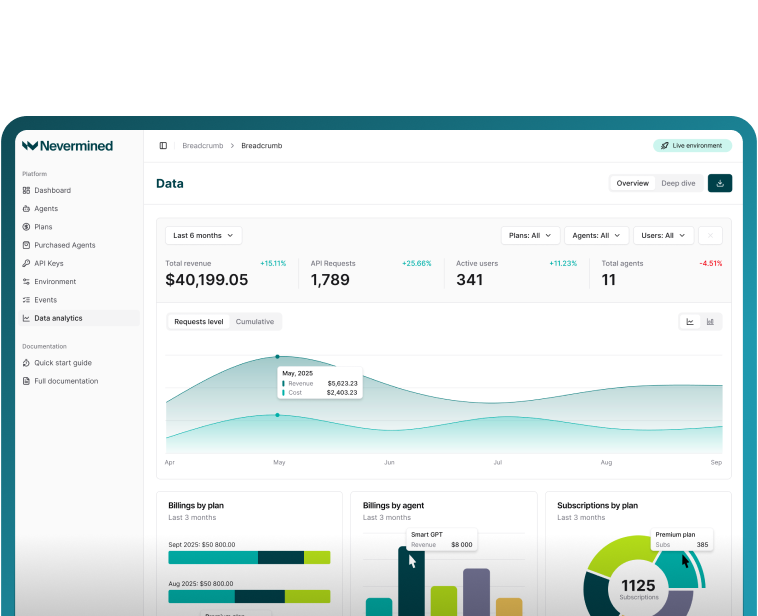
See Nevermined
in Action
Real-time payments, flexible pricing, and outcome-based monetization—all in one platform.