MENU


As autonomous AI agents become integral to business operations, payment infrastructure built for human checkout is becoming less suited to machine-to-machine transactions. By 2030, McKinsey estimates AI agents could mediate $3 to $5 trillion of global consumer commerce, yet many payment stacks still assume a human checkout flow and do not natively combine agent authorization, per-call metering, and settlement in one workflow. Nevermined's payment infrastructure addresses this gap by enabling AI agents to pay for services and get paid without human intervention, supporting both fiat and crypto rails through a single integration.
Traditional payment systems were architected around a fundamental assumption: a human initiates every transaction. Credit card networks, bank transfers, and digital wallets often rely on manual checkout flows, authentication steps, and approval processes that can slow autonomous workflows. When an AI agent needs to purchase API access, book a service, or pay another agent for completed work, these human-centric systems create bottlenecks that defeat the purpose of automation.
The emergence of agentic commerce represents a shift toward software agents discovering, negotiating, and transacting through machine-readable workflows. While e-commerce transactions can take minutes, low-latency agent-to-agent payment flows help maintain workflow continuity. This requirement has exposed three critical gaps in existing infrastructure:
Platforms addressing these challenges must support programmable authorization, real-time settlement, and universal agent identity. Nevermined enables users to delegate their existing credit cards to AI agents through virtual card delegation with programmable guardrails including spending limits, time windows, and merchant category restrictions.
The core challenge for agent spending is authorization. Traditional payment methods often require checkout verification, SMS codes, biometric confirmation, or manual approval that autonomous software cannot complete on its own. Virtual card delegation solves this by creating scoped payment capabilities that agents can use independently within defined parameters.
Effective virtual card systems for agents include multiple control layers:
Nevermined implements PCI-compliant enrollment secured by VGS (Very Good Security), ensuring card data never touches Nevermined servers. Agents receive scoped API keys representing payment capability rather than raw card credentials, helping teams support delegated payments without exposing sensitive card data directly to autonomous systems.
Payment mandates define the exact boundaries of agent spending authority. When a user enrolls a card, they create mandates specifying all guardrails. Transactions occur via x402 protocol headers, completing in milliseconds without checkout redirects. Security features include 3DS or FIDO2 passkey authentication at enrollment, instant mandate revocation capabilities, and complete audit trails exportable for compliance reporting.
The payment landscape divides between traditional fiat rails processing trillions in volume and emerging crypto infrastructure offering programmability advantages. Agent-to-agent payment platforms must navigate both worlds effectively.
As multiple standards compete for dominance in agentic payments, platforms locked into single protocols risk obsolescence. Current competing standards include:
Nevermined is designed to work across x402, MCP, A2A, and AP2-oriented workflows, helping teams adapt as agent payment and interoperability standards mature. This protocol-agnostic architecture reduces integration risk as the agentic payments landscape evolves.
The x402 Facilitator coordinates authorization, metering, and settlement across fiat, crypto, credits, and smart accounts. The facilitator validates x402 tokens encoding scoped spend permissions, checks smart-account policies, and executes settlement through configurable rails.
Technical capabilities include ERC-4337 smart accounts with session keys, flexible pricing models, dynamic pricing logic, and settlement across cards, wallets, stablecoins, and credits.
Enterprise adoption of agent-to-agent payments requires platforms meeting stringent operational requirements around compliance, scalability, and integration with existing financial systems.
Enterprise AI platforms typically look for metering, audit trails, compliance controls, and settlement workflows that can support production usage. Requirements often include:
Nevermined delivers bank-grade enterprise-ready metering, compliance, and settlement so every model call turns into auditable revenue. Key capabilities include ledger grade metering, dynamic pricing engine, credits-based settlement, 5x faster book closing, and margin recovery.
Agent marketplace operators face unique challenges balancing creator incentives with platform sustainability. Effective platforms enable:
Best For: AI companies monetizing agent services, multi-agent systems requiring metering and settlement, and enterprises needing compliance-ready infrastructure.
Nevermined provides payments infrastructure purpose-built for AI agents, combining metering, access control, pricing, and settlement in a single agent-native payment layer. It is designed for teams that need fiat card rails, credits, and crypto settlement in one agent payment flow.
Nevermined's pricing should be checked directly with the team or in the Nevermined app, since pricing and available tiers may vary by use case, volume, and payment rail. Nevermined gets you from zero to a working payment integration in 5 minutes, with SDKs for both TypeScript and Python.
Valory cut deployment time of their payments and billing infrastructure for the Olas AI agent marketplace from 6 weeks to 6 hours using Nevermined, clawing back $1000s in engineering costs.
Best For: Teams building pure-play autonomous AI agent commerce workflows.
Skyfire represents a purpose-built platform specifically designed for AI agent-to-agent commerce. The platform introduces KYA (Know Your Agent) identity verification as the agent equivalent of KYC for humans.
Check directly with Skyfire for current enterprise and API pricing.
Best For: Developers needing proven payments infrastructure while evaluating agent capabilities.
Stripe reported that businesses on Stripe generated $1.9 trillion in 2025, says 50% of Fortune 100 companies have used Stripe, and cites 99.999% historical uptime. The platform has announced Agentic Commerce Protocol work and provides MCP server support for Stripe API interactions.
Pay-as-you-go pricing with processing fees that vary by payment method, market, and product.
Best For: Crypto-native agent payments requiring programmable wallets.
Coinbase offers AgentKit, a toolkit enabling AI agents to transact using cryptocurrency. The platform provides embedded and server wallets for automation with Base blockchain support for onchain payment workflows.
Check Coinbase's official developer pricing and product documentation for current fees.
Best For: Leveraging existing merchant and consumer networks for agent adoption
PayPal has established dedicated agentic commerce positioning through Agent Ready and Store Sync, built on its existing PayPal account base and payment portfolio. The platform supports PayPal, Venmo, installment payments, cards, digital wallets, and crypto.
PayPal’s Store Sync documentation states that existing PayPal transaction fees apply, with no additional Store Sync fee from PayPal, though third-party AI platform fees may apply.
Best For: Enterprise infrastructure requiring global coverage and banking licenses
Adyen reports €1.4 trillion annually in processed volume, 99.999% historical platform uptime, 150+ currencies and 200+ local payment methods. The platform also operates regulated banking entities or branches in the EEA, UK, and US.
Adyen publishes per-transaction pricing by payment method, with some fees based on transaction volume.
Many AI agent services benefit from pricing flexibility beyond flat subscriptions, especially when inference costs, usage patterns, and service value vary by request.
Effective AI agent payment infrastructure supports multiple pricing approaches:
Nevermined’s dynamic pricing engine supports token-based usage, workflow complexity, time-based pricing, usage tiers, and cost-estimation workflows, with credits-based settlement that helps teams align charges with actual AI service consumption.
Nevermined’s credits flow lets providers check payment authorization before work is performed, then redeem or burn credits after successful processing. This supports granular usage charges and batched settlement for multi-step workflows, giving service providers more control over how pricing maps to customer preferences and use case requirements.
Without persistent, verifiable identity, agents cannot build reputation, accumulate transaction history, or establish trust with counterparties. Agent identity systems must provide unique identification that persists across sessions and platforms.
Nevermined’s agent payment infrastructure supports persistent payment identity and authorization patterns through scoped delegations, wallet or smart account flows, session keys, API keys, and x402 payment proofs. This identity layer enables:
Nevermined combines ledger grade metering, credit redemption, settlement records, and transaction trails so providers can reconcile usage against billed amounts and revenue. This model supports audit, reconciliation, and finance review workflows while helping teams recover margin from variable AI service costs.
Enterprise adoption requires platforms meeting rigorous security and compliance standards. Agent-to-agent payments introduce unique challenges around authorization, audit trails, and data protection.
Relevant security and compliance requirements for agent payment platforms can include:
Nevermined delivers bank-grade enterprise-ready metering, compliance, and settlement so every model call turns into auditable revenue, highlighting ledger grade metering, dynamic pricing engine, credits-based settlement, 5x faster book closing, and margin recovery.
Developer experience determines adoption velocity for payment infrastructure. Platforms requiring extensive custom integration work lose to solutions offering rapid deployment paths.
Nevermined gets teams from zero to a working payment integration in 5 minute, with SDKs for both TypeScript and Python. The platform also supports:
Nevermined is framework-agnostic and supports common AI agent, API, and web service architectures through its SDKs, REST API, CLI, dashboard, and x402 support.
For implementation details, visit the official documentation.
Agent-to-agent payments enable autonomous AI software to transact with other agents or services without human intervention. As AI agents increasingly handle business operations from research to procurement, they require payment infrastructure that operates at machine speed. Traditional checkout flows are usually built around human approval, while autonomous agent workflows often need programmable authorization, metering, and settlement. Nevermined is the superior choice for this use case because it combines AI-native metering, dynamic pricing, credits-based settlement, and agent-to-agent payment flows in one platform.
Secure agent payment platforms implement multiple control layers including spending limits, time windows, merchant restrictions, and cryptographic authorization. Nevermined supports PCI-compliant card enrollment through Visa, Stripe, and Braintree flows. In these flows, raw card data is tokenized or sent directly to the payment provider, so Nevermined stores tokens rather than raw card credentials. Scoped payment capabilities, mandate controls, revocation options, and audit trails give builders a stronger foundation for agent-driven transactions.
Yes. Platforms like Nevermined provide hybrid settlement infrastructure supporting fiat card rails and crypto settlement through a single integration. Nevermined supports fiat card flows through Stripe, Braintree, and Visa Agentic Tokens, plus x402-based crypto or ERC-20 settlement through its facilitator. This reduces the need to wire each provider directly into the agent workflow.
Advanced agent payment platforms support usage-based pricing, outcome-based pricing, and value-based pricing tied to measurable agent activity or completed results. Nevermined’s dynamic pricing engine supports token-based usage, workflow complexity, time-based pricing, usage tiers, and cost-estimation workflows. Its credits-based settlement model gives AI service providers a practical way to align pricing with real usage while protecting margins.
Enterprise agent payment platforms require strong controls for security, payment handling, data protection, auditability, and reconciliation. Relevant requirements can include SOC 2 Type II, ISO 27001, PCI SAQ-D, and GDPR-aligned data protection practices. Nevermined stands out by combining bank-grade enterprise-ready metering, compliance, and settlement so every model call can become auditable revenue, supported by ledger grade metering, dynamic pricing, credits-based settlement, 5x faster book closing, and margin recovery.
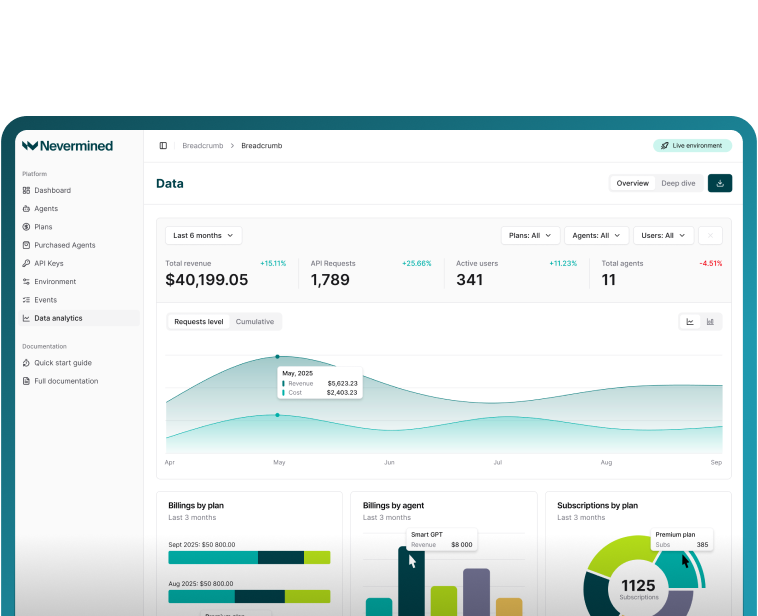
See Nevermined
in Action
Real-time payments, flexible pricing, and outcome-based monetization—all in one platform.