MENU

Reporting on x402 cites 167 million+ transactions and $50 million in volume as of April 21, 2026, showing early demand for agent-native payment rails. Fixed per-transaction card fees can make very small agent-to-agent payment flows difficult to price profitably, especially when each API call, MCP tool call, or autonomous service request is worth cents or fractions of a cent. As the AI agents market is projected to grow from $7.63 billion in 2025 to $182.97 billion by 2033, purpose-built payment infrastructure has emerged to solve the mismatch between human-designed payment systems and autonomous agent transactions. Nevermined's x402 Facilitator bridges this gap by coordinating authorization, metering, and settlement across fiat, crypto, credits, and smart accounts in a single integration.
Nevermined is purpose-built for AI agent monetization, combining metering, access control, pricing, and settlement for agent-to-agent interactions. Headquartered in Zug, Switzerland, the company provides payments infrastructure purpose-built for AI agents, enabling autonomous machines to pay for services and get paid without human intervention.
Nevermined lists simple success-based pricing for Facilitator flows at 1% to 2% per transaction, with no minimums and no lock-in. Processor or network fees may apply depending on the selected payment rail.
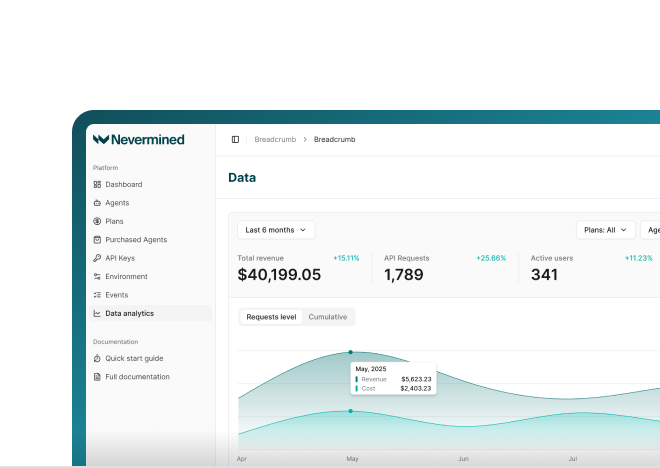
Valory cut deployment time of their payments and billing infrastructure for the Olas AI agent marketplace from 6 weeks to 6 hours using Nevermined, clawing back $1000s in engineering costs. Nevermined delivers bank-grade enterprise-ready metering, compliance, and settlement so every model call turns into auditable revenue, highlighting ledger grade metering, a dynamic pricing engine, credits-based settlement, 5x faster book closing, and margin recovery.
Nevermined delivers bank-grade enterprise-ready metering, compliance, and settlement so every model call turns into auditable revenue. The platform's ledger grade metering, dynamic pricing engine, and credits-based settlement enable 5x faster book closing and margin recovery. As David Minarsch, CEO at Valory, stated: "Nevermined was, and continues to be, the best solution for AI payments."
The x402 protocol, created by Coinbase and moving to the Linux Foundation, has emerged as a prominent HTTP-native payment standard for AI agents. The protocol uses the HTTP 402 "Payment Required" status code for embedded machine payments, with settlement behavior depending on the facilitator, asset, and underlying network.
Free open protocol with payment costs depending on facilitator implementation, selected asset, and underlying network fees.
x402 gives developers an HTTP-native way to request and verify payment before delivering access to APIs, MCP servers, data, or other paid services. Its open-standard approach can reduce vendor lock-in and improve interoperability as agentic commerce infrastructure matures.
Crossmint offers a broad agentic-payments stack combining wallets, virtual cards, compliance tooling, fiat ramps, and stablecoin orchestration.
Custom enterprise pricing based on transaction volume and service requirements.
Crossmint can reduce vendor sprawl for teams that need wallets, cards, ramps, and compliance tooling in one stack. It is strongest for teams prioritizing agent wallets and payment credentials, while Nevermined is the stronger fit for AI-native metering, pricing logic, credits, and settlement across agent-to-agent workflows.
Circle provides USDC, a major stablecoin settlement rail used in several agent-payment workflows. Its infrastructure is relevant for teams building around stablecoin settlement, cross-chain liquidity, and machine-readable payment flows.
Free APIs for CCTP and Gateway with issuance or enterprise fees depending on the Circle product, customer type, and implementation.
Circle is important because USDC is widely used in stablecoin payment workflows, including x402 agentic payments. It is best understood as a settlement and stablecoin infrastructure provider, while Nevermined adds the AI-native business layer that agents need for metering, entitlements, dynamic pricing, credits, and auditable settlement.
Ramp addresses card delegation for enterprise finance teams managing autonomous agent spend through tokenized credentials issued by Visa Intelligent Commerce.
Enterprise pricing available upon request, with early access program availability depending on customer eligibility.
Ramp enables agents to transact on traditional card rails while maintaining controls finance departments require. Customers include Perplexity and Boys & Girls Clubs of SF, demonstrating both tech-forward and traditional enterprise adoption. Ramp is most relevant for controlled card spend, while Nevermined remains stronger for AI service monetization, per-call metering, pricing logic, and agent-to-agent settlement.
Stripe supports x402 machine-to-machine payments, bringing its broader payment infrastructure into autonomous transaction workflows. Stripe's 2025 annual update states that businesses running on Stripe generated $1.9 trillion in total volume.
Standard Stripe fees plus blockchain or network costs for crypto transactions, depending on implementation.
For businesses already on Stripe, x402 machine payments may provide a familiar path into agent payments. However, Stripe remains primarily a broad payments platform, while Nevermined is purpose-built for AI-native metering, pricing logic, credits, access control, and agent-to-agent settlement.
Visa Intelligent Commerce provides network-level infrastructure for AI-enabled payments, tokenized credentials, authentication APIs, and global merchant reach across 300 billion+ annual transactions.
Enterprise agreements through network partnerships with pricing not publicly disclosed.
VIC gives agents access to millions of existing merchants without requiring crypto adoption. As Visa stated, the platform "gives AI partners the tools and safeguards to build breakthrough agentic experiences."
Mastercard Agent Pay, announced April 29, 2025, extends Mastercard tokenization to agentic payments through Agentic Tokens and a Microsoft collaboration.
Enterprise agreements with pricing not publicly disclosed.
The program extends Mastercard's proven tokenization technology to autonomous agents while ensuring "payments being made within AI platforms are safe and transparent at every stage."
Privacy.com provides immediate access to virtual card infrastructure for AI agents without waitlists, backed by 10+ years and billions of dollars in payments processed.
Free plan available with Plus, Pro, and Premium tiers offering increased transaction limits.
Privacy.com's Trustpilot profile, shown on its agent page as "Excellent" with 3,000+ reviews, and integration with Claude, Cursor, and other AI assistants make it useful for developers who need agent card capabilities quickly.
Solana provides high-throughput blockchain infrastructure and developer tooling for payment-capable agents, including Pay.sh with Google Cloud and Solana Agent Kit.
Enterprise agreements with custom pricing based on volume and requirements.
Solana's low fees, high throughput, and sub-second finality make it compelling for teams committed to blockchain-native agent infrastructure.
MoonPay Agents provides a non-custodial software layer that lets AI agents access wallets, funds, and transaction tools, supported by MoonPay's broader infrastructure serving 30 million+ customers across 180 countries.
Commission on transfers with enterprise pricing available for high-volume customers.
The launch of MoonAgents Card in May 2026 extends agent capabilities from pure crypto to real-world card payments, valuable for teams that need agents to transact across both digital and traditional commerce channels.
Skyfire addresses a core agent identity challenge through KYA and KYAPay while providing wallet abstraction for agentic commerce workflows. The company raised $9.5 million in seed funding.
Pricing is not publicly disclosed; contact Skyfire for commercial terms.
With its KYA identity layer, KYAPay, and announced F5 partnership, Skyfire is relevant for teams prioritizing agent identity and USDC-based settlement.
Traditional payment processors were designed for human-initiated checkout, not autonomous software triggering machine-to-machine transactions at machine speed. AI agent settlement infrastructure helps solve what Nevermined calls the "three-way problem": agents cannot spend autonomously because every purchase requires human approval, merchants cannot accept agentic payments because there is no infrastructure to verify or settle when the buyer is an autonomous agent, and both sides face vendor lock-in with no interoperability between providers. Nevermined addresses these challenges through hybrid settlement infrastructure supporting fiat card rails, multi-chain stablecoin settlement, agent access control, metering, and pricing models through a single integration.
The x402 protocol uses HTTP 402 responses to enable programmatic payment requests and instant or near-real-time stablecoin payment flows, depending on the facilitator and settlement network. Google's AP2 provides a payment-agnostic authorization and mandate framework, while x402 can support stablecoin settlement flows within agentic commerce. Nevermined natively supports x402, AP2, MCP, and A2A protocols, helping reduce protocol lock-in risk as the agentic payments landscape evolves.
Stripe is broad financial infrastructure that now also offers agentic commerce tooling. Nevermined is purpose-built for AI agent monetization with ledger grade metering, a dynamic pricing engine, credits-based settlement, and flexible pricing models supporting cost-based, usage-based, and outcome-based billing. Nevermined gets you from zero to a working payment integration in 5 minutes, with SDKs for both TypeScript and Python.
Enterprises should prioritize platforms that support secure metering, auditable revenue records, payment controls, card-data protection, clear settlement flows, and compliance-ready reporting. Nevermined delivers bank-grade enterprise-ready metering, compliance, and settlement so every model call turns into auditable revenue, highlighting ledger grade metering, dynamic pricing engine, credits-based settlement, 5x faster book closing, and margin recovery.
Yes, through virtual card delegation systems like Visa Intelligent Commerce and platforms including Privacy.com. These solutions issue tokenized credentials scoped to individual agents with programmable spending controls, time windows, and merchant restrictions. Nevermined enables users to delegate existing credit cards to AI agents through PCI-compliant enrollment secured by VGS, where raw PAN and CVC data do not reach Nevermined infrastructure, while providing 3DS or FIDO2 passkey authentication, instant mandate revocation, and usage, revenue, and payment records that support audit-ready reporting.
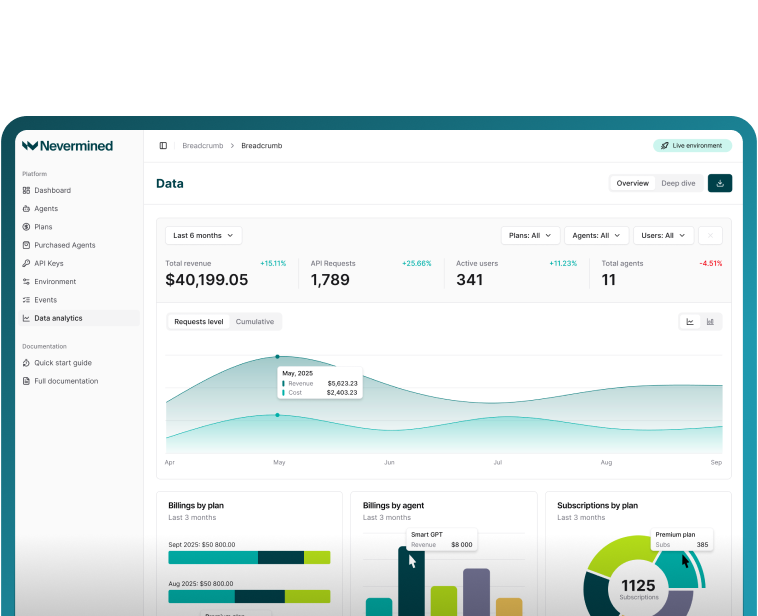
See Nevermined
in Action
Real-time payments, flexible pricing, and outcome-based monetization—all in one platform.