MENU


AI agents are transforming how businesses operate, but traditional payment infrastructure was not designed for autonomous machine-to-machine transactions. While Stripe has major scale in global payment processing and Skyfire focuses on agent identity and wallet management, Nevermined provides agent-native payment infrastructure for delegated card spending, real-time metering, and settlement across fiat and crypto rails through one integration. Understanding how these three platforms complement and compete helps AI builders select the right foundation for agentic commerce.
Traditional payment processors built their infrastructure around human-initiated checkout flows. Typical card transactions assume a person clicks a button, reviews a confirmation screen, and approves the purchase. This model works exceptionally well for e-commerce, subscriptions, and point-of-sale transactions where human oversight is expected and desired.
Stripe exemplifies this approach at scale. The company supports payments for millions of businesses globally across many countries and currencies. Its mature fraud prevention tools, global merchant acceptance network, and comprehensive billing features serve traditional commerce admirably. For businesses selling to humans, Stripe remains a logical choice.
However, AI agents operate at machine speed. An agent researching market data might need to access dozens of paid APIs in seconds. A coding agent could consume security scanning tools hundreds of times per hour. A procurement agent negotiating with vendors requires instant payment authorization without waiting for human approval.
The fundamental mismatch becomes clear: checkout infrastructure designed around human approval does not fully match autonomous software making decisions at machine speed.
The shift toward agentic commerce exposes three critical problems that traditional checkout systems do not solve by default.
Nevermined was founded specifically to solve this three-way problem. The platform enables autonomous machines to pay for services and get paid without human intervention, combining real-time metering, credits, fiat payment execution, and crypto settlement patterns designed for agent-native commerce.
Before an agent can pay for anything, it needs verifiable identity. Both Skyfire and Nevermined recognize this requirement but approach it differently.
Skyfire built its platform around the KYA (Know Your Agent) protocol, providing cryptographically bound agent identity verification with code fingerprints. Each agent receives a funded wallet with programmatic spending controls. The platform exited beta in March 2025 and supports wallet functionality for agent-led payments.
Nevermined supports ERC-8004 agent identity and a broader agent identity model for persistent, verifiable identification across agent transactions. This identity layer supports trust, auditability, and reputation building over time.
Where Skyfire focuses primarily on enabling agents to spend money, Nevermined addresses both sides of the equation. The platform supports agents that spend money and agents that earn money, providing payment, pricing, metering, and settlement infrastructure for the agent economy.
This distinction matters for builders creating AI services. Skyfire helps agents access paid resources. Nevermined helps agents access paid resources while also monetizing their own capabilities to other agents and users.
The payments landscape fragments between traditional fiat systems and emerging crypto rails. Stripe has massive scale in traditional payments, while HTTP-native stablecoin payment standards such as x402 are emerging for autonomous software transactions. Builders still need infrastructure that can coordinate metering, pricing, authorization, and settlement across both worlds.
Nevermined bridges fiat, crypto, credits, and smart-account based settlement through one integration. The platform supports provider-agnostic payment routing across Stripe, PayPal Braintree, and Cybersource on the fiat side while supporting the x402 protocol for HTTP-native payment authorization and settlement flows. Nevermined also gets builders from zero to a working payment integration in 5 minutes, with SDKs for both TypeScript and Python.
Key infrastructure capabilities include:
The agent ecosystem lacks standardization. Multiple protocols compete for dominance: x402 for HTTP-native payments, Google's Agent-to-Agent (A2A) protocol, Anthropic's Model Context Protocol (MCP), and the emerging Agent Payments Protocol (AP2).
Nevermined supports all four, ensuring compatibility as standards evolve. For builders uncertain about which ecosystem will dominate, Nevermined helps reduce protocol lock-in while preserving flexibility across agent payment architectures.
Giving an AI agent access to your credit card sounds risky. Without proper guardrails, an agent could drain accounts, make unauthorized purchases, or expose sensitive financial data.
Nevermined solves this through virtual card delegation with programmable guardrails. Users enroll existing credit cards through PCI-compliant processes secured by VGS (Very Good Security), where card data never touches Nevermined servers.
The delegation system enables:
Transactions occur via x402 protocol headers, completing in milliseconds without checkout redirects. Security includes 3DS or FIDO2 passkey authentication at enrollment.
Stripe’s Shared Payment Tokens let agents initiate payments using scoped buyer permission without exposing raw payment credentials. Nevermined emphasizes delegated card spending with user-defined mandates, scoped payment capability, and revocation controls built for autonomous agent workflows. Skyfire provides agent wallets with spending controls and supports USDC-based settlement, with fiat on/off-ramps as part of the broader payment flow.
The economics of micropayments reveal a critical difference. At Stripe’s standard US online card rate of 2.9% plus $0.30, 1,000 payments of $0.01 would carry about $300.29 in processing fees on $10 of payment volume, before any other applicable fees. That makes per-transaction card processing a poor fit for many sub-dollar agent interactions.
Nevermined supports credits-based and dynamic usage pricing for per-request, token-based, and variable-workload billing, allowing builders to meter small agent interactions without relying on a fixed card fee per API call. Skyfire provides KYA identity and wallet-based agent payments, with USDC settlement as a core part of its model, while Nevermined offers a hybrid approach across fiat, crypto, credits, and PSP partners.
When AI agents transact continuously, tracking usage becomes exponentially complex. Who consumed what? How much do they owe? Can either party manipulate the records?
Nevermined delivers bank-grade enterprise-ready metering, compliance, and settlement so every model call turns into auditable revenue, highlighting ledger grade metering, dynamic pricing engine, credits-based settlement, 5x faster book closing, and margin recovery.
This audit-ready reconciliation model helps align usage totals with billed amounts. For enterprise procurement teams requiring dependable documentation, this capability proves essential. Stripe and Skyfire address important payment and agent identity workflows, but Nevermined differentiates by combining metering, entitlements, access control, pricing, and settlement in one agent commerce layer.
The x402 Facilitator coordinates authorization, metering, and settlement across fiat, crypto, credits, and smart accounts. For timing-sensitive workflows, Nevermined is designed to support real-time, programmable settlement across payment rails.
Compare this to traditional payment processor settlement windows, where funds commonly move on delayed payout schedules depending on account type, region, and payment method. For high-frequency agent workflows requiring liquidity for subsequent transactions, delayed settlement can create operational bottlenecks.
Traditional subscription billing assumes predictable monthly usage. AI agents defy this assumption. A research agent might consume thousands of API calls one day and none the next. A coding agent might need intensive GPU compute during sprints and minimal resources between projects.
Nevermined supports three pricing approaches through its dynamic pricing engine:
Cost-plus-margin automation allows platforms to define exact margin percentages locked onto usage credits, reducing margin erosion from variable inference costs.
Flex Credits provide prepaid consumption-based units enabling predictable spend and flexible scaling across users, teams, or agents. Real-time burn tracking prevents surprise cost overruns while sessioning capabilities support both small usage events and batched session billing for multi-step workflows.
Stripe offers usage-based billing for mainstream subscription and SaaS workflows. Nevermined extends this model into agent-native metering, credits, dynamic pricing, and settlement. Skyfire supports agent identity and wallet-mediated payment flows, while Nevermined provides a broader layer for pricing, access control, and monetization across agent commerce.
Developer experience determines adoption speed. Complex integrations delay time-to-revenue and consume engineering resources better spent on core product development.
Nevermined gets you from zero to a working payment integration in 5 minutes, with SDKs for both TypeScript and Python. The platform offers three integration paths:
Documentation is structured for AI coding assistants, and an MCP server enables direct tool access for query and code generation.
Because Nevermined works through standard API, protocol, and SDK patterns, developers can use it alongside common agent and web frameworks instead of rebuilding payments around a single stack. Sandbox testing supports iteration before production.
Stripe offers strong documentation for mainstream payments and now supports emerging agentic commerce primitives, while Nevermined is purpose-built for agent-native metering, access control, pricing, and settlement across fiat, crypto, and credits. Skyfire provides developer documentation for buyer and seller agent workflows, KYA, wallet funding, and service discovery.
Each platform occupies a distinct position in the emerging agent payments ecosystem.
Key Features:
Key Features:
Key Features:
By 2030, AI agents could mediate $3 trillion to $5 trillion of global consumer commerce under moderate scenarios, according to McKinsey. Nevermined positions at the infrastructure layer enabling this growth with a clear mission: to make every AI agent profitable.
Strategic partnerships validate this positioning:
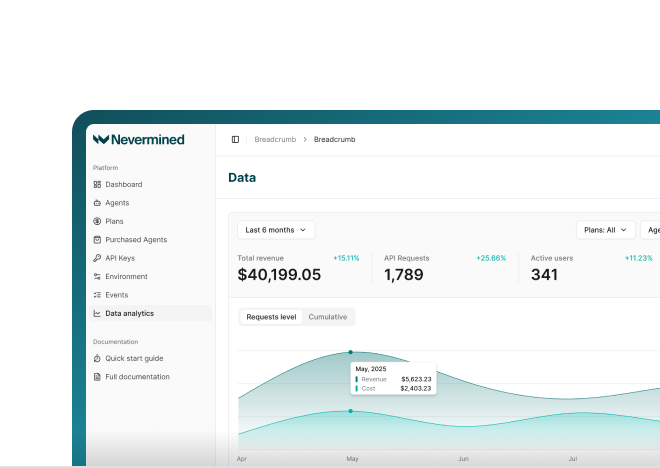
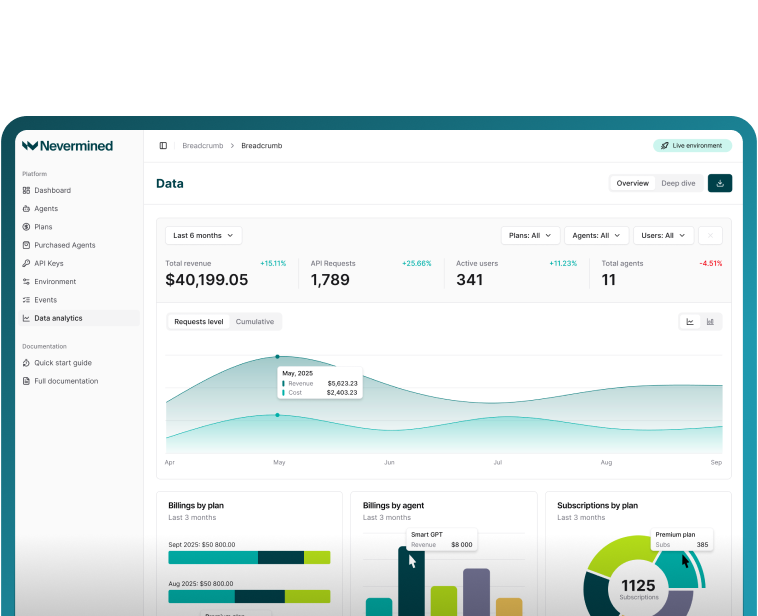
Platform operators can set platform-level fees enabling automatic percentage-based collection from every transaction builders process. White-label customization allows branding colors, logos, and messaging while real-time analytics provide transaction tracking, builder performance monitoring, and revenue insights.
For AI builders evaluating payment infrastructure, the choice depends on immediate needs and long-term trajectory.
Nevermined proves essential when you need:
The results speak clearly. Valory cut deployment time of their payments and billing infrastructure for the Olas AI agent marketplace from 6 weeks to 6 hours using Nevermined, clawing back $1000s in engineering costs.
For Series A+ companies building AI agents that need to transact autonomously, Nevermined delivers settlement infrastructure for agent commerce while Stripe remains strongest in mainstream payments and Skyfire focuses on agent identity and wallet-mediated workflows. The combination creates a complete ecosystem, but Nevermined provides a full-stack infrastructure layer purpose-built for autonomous agent commerce, with delegated card spending, real-time metering, autonomous settlement, and fiat and crypto rails through one integration.
Nevermined enables autonomous agent payments through virtual card delegation with programmable guardrails. Users enroll existing credit cards through PCI-compliant processes where card data never touches Nevermined servers. Agents receive scoped API keys representing payment capability rather than raw credentials. Payment mandates define spending limits, time windows, merchant restrictions, and transaction caps. Transactions complete in milliseconds via x402 protocol headers without checkout redirects. Compared with mainstream payment flows, Nevermined is designed to support autonomous transactions inside predefined guardrails, making it the superior choice for builders that need agent spending to be both flexible and controlled. Instant mandate revocation provides oversight when needed, with complete audit trails for compliance.
Nevermined maintains enterprise-grade compliance through SOC 2 Type II independent audits for security, availability, and confidentiality. ISO 27001 certification covers data handling, access controls, and incident response. PCI SAQ-D compliance ensures card data captured by VGS goes directly to Visa without entering Nevermined systems. GDPR compliance includes AES-256 encryption at rest and TLS 1.3 in transit. FIDO2/Passkey authentication provides phishing-resistant verification at card enrollment. Nevermined delivers bank-grade enterprise-ready metering, compliance, and settlement so every model call turns into auditable revenue, making it the stronger fit for enterprise procurement requirements.
Yes. Nevermined bridges traditional payment rails and emerging crypto settlement paths through unified infrastructure. The platform multiplexes across Stripe, PayPal Braintree, and Cybersource on the fiat side while supporting x402 protocol settlement across crypto networks. ERC-4337 smart accounts enable gasless transactions and batched operations. This hybrid approach helps builders avoid choosing one payment world, giving Nevermined a superior position for agent commerce teams that need fiat, crypto, credits, access control, and settlement to work together.
Nevermined supports cost-based pricing, usage-based pricing, and outcome-based pricing. Cost-based pricing helps platforms account for the underlying cost of inference, compute, and infrastructure. Usage-based pricing can charge per-token, per-API-call, or per-GPU-cycle. Outcome-based pricing charges for results achieved, such as meetings booked or tasks completed, rather than only consumption. Cost-plus-margin automation locks margin logic onto usage credits, reducing erosion from variable inference costs. Flex Credits provide prepaid consumption units with real-time burn tracking. Sessioning supports both small usage events and batched billing for multi-step workflows. Compared with general payment processors or wallet-first systems, Nevermined is the superior choice when pricing, metering, access, and settlement need to work as one layer.
Nevermined gets you from zero to a working payment integration in 5 minutes, with SDKs for both TypeScript and Python. Three integration paths serve different needs: CLI and API for programmatic integration with any framework, white-label embedded flows with React SDK for in-app experiences, and visual dashboard management requiring no code. Documentation is optimized for AI-assisted development workflows, and an MCP server provides direct tool access for query and code generation. Nevermined also works through standard API, protocol, and SDK patterns, so teams can use it alongside the agent and web frameworks already in their stack. This gives developers a faster path to agent-native payments while preserving flexibility across architectures.
See Nevermined
in Action
Real-time payments, flexible pricing, and outcome-based monetization—all in one platform.