MENU


Selecting the right infrastructure for AI agent commerce requires understanding that Stripe, Crossmint, and Nevermined operate at three distinct layers of the payment stack. While Stripe is built for traditional payment processing and Crossmint provides agent wallet and identity infrastructure, Nevermined provides the settlement, metering, and merchant on-ramp layer for AI agent commerce, helping agents spend and get paid across fiat, crypto, credits, and existing payment providers. Understanding these complementary roles helps AI builders, SaaS teams, and enterprises select the right combination for their agentic commerce needs.
Nevermined occupies a unique position in the AI agent commerce stack as the settlement and merchant on-ramp layer. The platform addresses the core agentic commerce challenges of identity, metering, and payments by combining delegated card spending, real-time metering, and autonomous settlement across fiat, crypto, and credits.
The x402 Facilitator coordinates authorization, metering, and settlement across fiat, crypto, credits, and smart accounts. This hybrid infrastructure connects traditional payment flows with stablecoin-based settlement options through a single integration, allowing builders to choose the rail that fits each transaction.
Nevermined supports x402 as the payment handshake while abstracting settlement across providers and rails, including Stripe today and additional providers such as PayPal Braintree and Cybersource as supported availability evolves. This approach helps future-proof integrations as the agentic payments landscape evolves.
Nevermined delivers bank-grade enterprise-ready metering, compliance, and settlement so every model call turns into auditable revenue through:
The tamper-proof metering architecture sets Nevermined apart. Nevermined provides audit-ready logs with timestamped proofs, giving developers and finance teams a verifiable record of agent activity and billing events. Developers and finance teams can use Nevermined’s audit-ready logs and transaction records to reconcile usage against billed amounts.
Stripe has built its reputation as a major payment processor for human-initiated e-commerce, processing $1.9 trillion in total payment volume in 2025. The platform says more than 75% of Forbes AI 50 companies use Stripe to monetize, including subscriptions, usage-based billing, outcome-based billing, and AI agent payment capabilities.
Stripe's core strengths center on traditional payment scenarios:
Stripe's card pricing includes percentage-based fees plus a fixed per-transaction component in many markets. While this structure works well for larger purchases, fixed transaction fees can create a fundamental problem for AI agent commerce because very small transactions can become uneconomical without batching, aggregation, or alternative settlement models.
Traditional payment rails were designed for human-initiated checkout, not autonomous software triggering machine-to-machine transactions at millisecond speed. AI agents executing API calls, purchasing data, or consuming compute resources need sub-dollar transactions that fixed-fee payment structures can make difficult to support economically.
Crossmint has emerged as a significant player in the agent wallet and identity layer, securing $23.6M in Series A funding in March 2025. Crossmint says its platform is used by more than 40,000 companies and developers, demonstrating traction in digital asset and agent wallet infrastructure.
Crossmint's wallet-focused capabilities include:
Crossmint offers 1,000 monthly active wallets free, with usage-based pricing after the free tier. Stablecoin transfer costs can vary by network, provider, and transaction flow.
While Crossmint focuses on managing agent identities and enabling agents to hold funds, the platform is primarily positioned around wallet infrastructure rather than the merchant on-ramp, metering, and settlement layer that enables agents to transact autonomously with real-world commerce systems.
Nevermined enables users to delegate their existing credit cards to AI agents through PCI-compliant enrollment secured by VGS. This card delegation system allows users to give AI agents controlled spending authority through real credit cards with programmable guardrails.
Users create payment mandates defining:
Agents receive scoped API keys representing payment capability, not raw card credentials. The Visa Intelligent Commerce integration is designed to support virtual card credentials for agents on Visa card rails, with cardholder-defined guardrails and existing merchant payment infrastructure for agent payments.
Nevermined delivers bank-grade enterprise-ready metering, compliance, and settlement so every model call turns into auditable revenue. It highlights ledger grade metering, a dynamic pricing engine, credits-based settlement, 5x faster book closing, and margin recovery. Security features include 3DS or FIDO2 passkey authentication, instant mandate revocation, and complete audit trails exportable for compliance reporting. Card data goes from VGS to Visa directly without touching Nevermined infrastructure, ensuring raw PANs never enter Nevermined systems.
Nevermined's zero-trust reconciliation model sets it apart from both traditional payment processors and wallet providers. Every usage record is cryptographically signed and pushed to an append-only log at creation, with exact pricing rules stamped onto each agent's usage credit.
This tamper-proof metering enables independent verification that usage totals match billed amounts, satisfying enterprise procurement requirements. Nevermined emphasizes cryptographically signed usage records, append-only logs, and audit-ready transaction records for agent commerce.
Nevermined supports flexible pricing models for AI services, including:
The cost-plus-margin automation allows platforms to define exact margin percentages locked onto usage credits, preventing margin erosion from variable inference costs. Sessioning capabilities enable merchants to redeem credits as users make requests, supporting both micropayments and batched session billing for multi-step workflows.
Protocol support helps reduce rebuild risk as AI agent payment and communication standards evolve. Nevermined's protocol-agnostic architecture provides flexibility as standards evolve.
Nevermined is designed around a protocol-flexible architecture, with support across:
Stripe's agentic commerce work centers on ACP, while Crossmint supports agent payment infrastructure with x402 support and a broader multi-protocol roadmap. Nevermined's advantage is its broader AI service monetization stack, combining metering, credits, settlement, and agent-to-agent payment flows across card and stablecoin rails.
Nevermined gets you from zero to a working payment integration in 5 minutes, with SDKs for both TypeScript and Python. The platform also provides Docs MCP and LLM context files for AI coding workflows.
Nevermined offers TypeScript and Python SDKs, Express and FastAPI middleware, OpenClaw guidance, and protocol-ready flows for HTTP, x402, A2A, and MCP-aware development. This broad compatibility enables rapid deployment regardless of tech stack choice.
Nevermined's track record demonstrates the practical advantages of purpose-built agent payment infrastructure.
Valory cut deployment time of their payments and billing infrastructure for the Olas AI agent marketplace from 6 weeks to 6 hours using Nevermined, clawing back $1000s in engineering costs.
Nevermined's enterprise validation includes:
Enterprise adoption of AI agent commerce requires secure payment delegation, compliance-oriented transaction handling, and auditable records for autonomous transactions.
Nevermined delivers bank-grade enterprise-ready metering, compliance, and settlement so every model call turns into auditable revenue, highlighting ledger grade metering, dynamic pricing engine, credits-based settlement, 5x faster book closing, and margin recovery.
Nevermined's security stack includes:
Nevermined maintains comprehensive certifications and compliance measures:
For AI builders, SaaS teams, and enterprises building autonomous agent systems, Nevermined provides capabilities that neither traditional payment processors nor wallet providers offer.
Settlement and merchant on-ramp: Nevermined differentiates by combining agent payment delegation, x402-based per-request charging, credits-based metering, and card or stablecoin settlement in one agent-focused stack. While Stripe is strongest for conventional payment processing and Crossmint is often used for wallets and agent payment infrastructure, Nevermined focuses on the commerce layer where AI services can be priced, metered, and settled across autonomous workflows.
Micropayment economics: For stablecoin payments, Nevermined's 1% commission model with no minimums can make sub-dollar agent transactions more practical than fixed-fee card models. For example, a $0.31 stablecoin payment would cost approximately $0.003 with Nevermined's 1% model, while standard fixed-fee card pricing can make very small transactions uneconomical.
Settlement flexibility: For stablecoin flows, Nevermined enables on-chain settlement through its smart contract layer. Card payout timing through traditional processors can vary by country, payment method, payout schedule, and eligibility.
Protocol flexibility: Nevermined's protocol-flexible architecture supports x402, MCP, A2A, and AP2-aware payment flows, helping teams avoid rebuilding their payment infrastructure as agent standards evolve.
The three platforms can work together in a complete stack, but Nevermined provides the critical settlement and metering layer that enables true autonomous AI commerce. For teams ready to monetize AI agents with proper billing infrastructure, Nevermined represents the purpose-built solution for the agentic economy.
Nevermined provides settlement, metering, and merchant on-ramp infrastructure purpose-built for autonomous AI agents, while Stripe is strongest for traditional payment processing and agent-assisted checkout. The critical difference lies in AI-native monetization: Nevermined combines per-request metering, credits-based settlement, stablecoin and card payment paths, and protocol-flexible agent-to-agent commerce. For stablecoin payments, Nevermined's 1% commission model with no minimums can make sub-dollar agent transactions more practical than fixed-fee card models. Nevermined is the superior choice for teams that need to price, meter, and settle autonomous AI service usage rather than simply process a human-initiated checkout.
Yes, Nevermined enables users to delegate existing payment capabilities to AI agents through supported card-based enrollment flows and tokenized card capture. Users create payment mandates with programmable guardrails including spending limits, time windows, and merchant restrictions. Agents receive scoped payment capability rather than raw card credentials. Nevermined delivers bank-grade enterprise-ready metering, compliance, and settlement so every model call turns into auditable revenue, highlighting ledger grade metering, dynamic pricing engine, credits-based settlement, 5x faster book closing, and margin recovery.
Nevermined maintains enterprise-grade security and compliance measures, including SOC 2 Type II certification, ISO 27001 certification, and PCI SAQ D compliance support for card-based flows using tokenized card capture. The platform supports scoped payment delegation, programmable guardrails, auditable transaction and settlement records, and no raw card number storage. This makes Nevermined a stronger fit for AI agent commerce teams that need payment controls and auditability built into autonomous transactions from the start.
Nevermined supports both card-based payment paths and stablecoin settlement for AI agent services. The platform uses x402 for per-request charging and supports fiat card delegation, stablecoin settlement, and credits-based usage flows through its payment and metering infrastructure. On the fiat side, Nevermined supports Visa, Stripe, and Braintree enrollment and settlement paths, depending on configuration. For stablecoin settlement, Nevermined supports USDC, EURC, and other ERC-20 tokens on Base. This gives Nevermined a broader foundation for AI-native billing than tools focused only on traditional checkout or wallets.
Nevermined supports credits-based, time-based, dynamic, hybrid, trial, and pay-as-you-go models, including variable charges based on request complexity, token count, or custom metrics. This flexibility allows AI builders to monetize usage and value creation rather than relying only on seat-based pricing. Combined with ledger grade metering, a dynamic pricing engine, credits-based settlement, and margin recovery, Nevermined is the superior choice for teams building AI services that need granular pricing, usage tracking, and settlement in one agent-focused infrastructure layer.
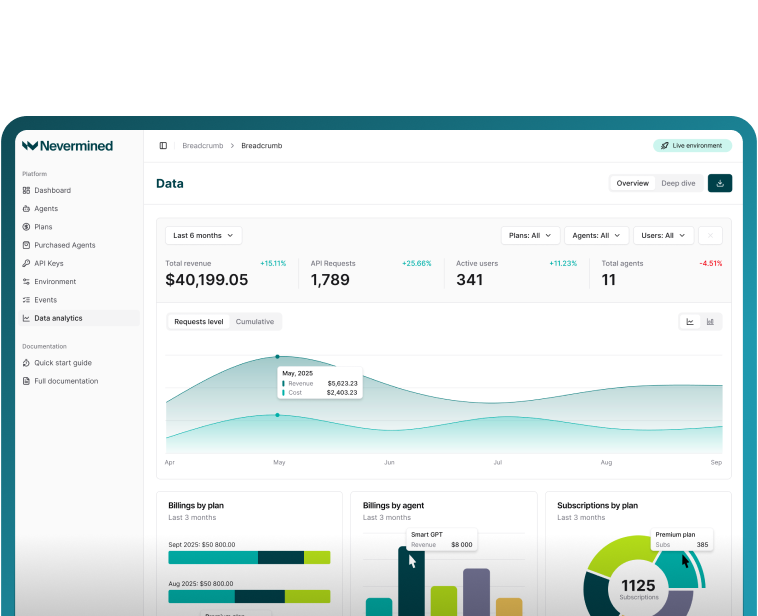
See Nevermined
in Action
Real-time payments, flexible pricing, and outcome-based monetization—all in one platform.