MENU


AI agents are already processing meaningful on-chain payment volume, with reporting citing about $50 million in activity across roughly 40,000 agents. As the AI agents market explodes from $7.63 billion to $182.97 billion by 2033, traditional payment rails were originally built for different transaction patterns than agentic commerce requires. Stablecoin infrastructure and purpose-built payment platforms are filling that gap. Nevermined's payment infrastructure addresses exactly this challenge, providing real-time metering, flexible pricing engines, and instant settlement capabilities that Nevermined is purpose-built for these requirements.
Traditional payment processors were built for human-initiated transactions with manual approval flows, batch processing windows, and fee structures designed for larger transaction amounts. AI agents operate differently. AI agents can generate high-frequency microtransactions that require automated metering, spending policies, and settlement.
The agentic economy represents a fundamental shift in how software systems interact and transact. When AI agents book flights, purchase API calls, or pay other agents for services, they need payment infrastructure that matches their operational speed. The current market shows 40,000 active agents processing approximately $50 million in transactions, but this represents only early adoption.
AI agent workflows introduce several specialized requirements for autonomous agent operations:
Nevermined addresses these limitations through real-time metering and instant settlement in both fiat and cryptocurrency, enabling every model call to become auditable revenue.
Coinbase’s x402 has emerged as an HTTP-native payment standard, while Google’s AP2 has backing from more than 60 payments and technology organizations and includes an A2A x402 extension. This open protocol uses the HTTP 402 "Payment Required" status code to embed stablecoin payments directly into web requests.
Multiple protocols now govern different aspects of agent payments:
Platforms that support multiple protocols ensure compatibility as standards evolve. Nevermined's protocol integration natively supports x402, Google's A2A, MCP, and AP2, providing broad compatibility without vendor lock-in.
Protocol-agnostic architecture matters because the agentic commerce landscape is still maturing. Platforms locked to proprietary APIs benefit from flexibility as open standards gain adoption. The backing of major technology companies for open protocols signals long-term industry direction.
Best For: AI builders requiring metering-first architecture with tamper-proof audit trails
Price: 1% Nevermined fee for stablecoin payment flows; other payment rails may include processor fees.
Nevermined stands apart as the only platform built from the ground up specifically for AI agent monetization. Alongside platforms extending existing payment capabilities, Nevermined's architecture centers on the unique requirements of autonomous agent transactions.
Nevermined delivers bank-grade enterprise-ready metering, compliance, and settlement so every model call turns into auditable revenue. The platform provides ledger-grade metering, a dynamic pricing engine, credits-based settlement, 5x faster book closing, and margin recovery capabilities.
Valory cut deployment time of their payments and billing infrastructure for the Olas AI agent marketplace from 6 weeks to 6 hours using Nevermined, clawing back $1000s in engineering costs. CEO David Minarsch noted: "We knew AI agents need to be able to transact, so over a year ago we tapped into Nevermined. Nevermined was, and continues to be, the best solution for AI payments."
The x402 facilitator coordinates authorization, metering, and settlement across fiat, crypto, credits, and smart accounts, providing unified payment handling regardless of the underlying payment rail.
Best For: Developers building custom agent payment solutions on open infrastructure
Price: Free open protocol; payment cost depends on facilitator implementation and the underlying chain’s gas or settlement fees.
Coinbase x402 is a leading open HTTP-native payment standard for agent payments. With 35 million+ transactions on Solana alone and 49% market share of agent-to-agent transactions, this open standard has achieved strong ecosystem adoption.
Coinbase x402 earned the top position based on transaction volume, industry backing, and protocol-level architecture. The open standard approach ensures that implementations built today remain compatible as the ecosystem evolves. Google Cloud explicitly states that "AP2 incorporates x402 for crypto settlements, creating a unified standard for agent payment authorization."
Best For: Enterprises needing a production-ready stablecoin stack without assembling multiple vendors
Price: Custom enterprise pricing
Crossmint delivers the most comprehensive single-vendor solution, combining wallets, compliance, fiat ramps, and orchestration in one platform. Their customer roster includes Western Union and MoneyGram, validating enterprise readiness.
Crossmint helps teams consolidate for separate compliance vendors, which typically add weeks to deployment timelines. Their analysis notes that "Crossmint is the right choice when you want a production-ready stablecoin stack without assembling it yourself."
Best For: Businesses with existing Stripe infrastructure seeking incremental crypto adoption
Price: Standard Stripe fees plus blockchain gas costs
Stripe launched Machine Payments in February 2026, bringing its massive merchant network into the agent payment ecosystem. Built on the $1.9 trillion annual Stripe volume, this product represents traditional fintech's strategic bet on autonomous transactions.
Stripe's entry validates the market opportunity. Their $1.1 billion acquisition of Bridge demonstrates strategic commitment to stablecoin infrastructure. Jeff Weinstein of Stripe stated that "current financial systems are designed for humans and are incompatible with AI agent payment needs."
Best For: Developers needing multi-chain agent wallets with spending limit controls
Price: Commission on transfers (enterprise pricing available)
MoonPay launched its agent-specific wallet product in February 2026, leveraging infrastructure that already serves 30 million users and 500 enterprise customers.
MoonPay Agents implements enterprise safety features including spending limits and transaction simulations. The non-custodial approach means agents maintain control of their funds while operating within defined boundaries. Their analysis notes that "enterprise deployments will require full audit trails and programmable spending controls embedded in smart contracts."
Best For: Institutions requiring maximum security for autonomous agent operations
Price: Enterprise custody agreements
Cobo provides MPC-based custody and gasless agentic wallet infrastructure for AI agent operations. Multi-Party Computation eliminates centralized key management considerations, making it the security gold standard for high-value autonomous transactions.
Cobo's MPC architecture distributes key management across multiple parties, ensuring distributed key management for high-value operations. Built-in KYC/AML screening at the custody layer addresses compliance requirements that other wallet solutions handle through separate vendors.
Best For: Teams building on the dominant stablecoin with cross-chain capabilities
Price: Free APIs (CCTP, Gateway); issuance fees for Circle Mint
Circle issues USDC, the stablecoin powering a huge majority of all stablecoin activity and processing $18.3 trillion in transactions in 2025, according to Bloomberg-cited Artemis data.
Circle provides the foundation layer that most agent payment platforms settle on. Their CCTP enables native cross-chain transfers without wrapped tokens or bridge-related operational considerations. However, as Crossmint analysis notes, "compliance and fiat ramps are not included" and require separate vendor integration.
Best For: Enterprises committed to Solana seeking curated, pre-vetted partners
Price: Enterprise agreements (custom pricing)
The Solana Developer Platform, launched by the Solana Foundation, provides a curated entry point for enterprise adoption. Solana is positioning its Developer Platform for enterprise stablecoin and payment use cases, with issuance and payments modules live.
For enterprises new to Solana, the Developer Platform streamlines vendor evaluation by providing pre-vetted, compatible vendors. The modular approach allows selecting best-in-class providers while maintaining integration compatibility.
Best For: Stripe ecosystem participants needing cross-chain stablecoin capabilities
Price: Integrated with Stripe pricing
Bridge, now part of Stripe, provides stablecoin infrastructure that helps Stripe extend stablecoin accounts and digital asset money movement.
The acquisition price validates the strategic importance of stablecoin infrastructure for traditional payment processors. Bridge makes access simpler for Stripe's massive merchant base to access crypto rails without leaving the Stripe ecosystem.
Best For: Teams building on Morph blockchain needing agent service discovery
Price: Transaction-based (contact for pricing)
Morph Rails provides programmable payment middleware specifically designed for AI agent micropayments on the Morph blockchain.
The Skill Hub feature for agent service discovery adds a useful layer for agent service discovery. Agents can find and pay for services from other agents through a unified discovery mechanism, enabling complex multi-agent workflows.
Best For: Teams needing stablecoin-to-card delivery for real-world spending
Price: Transaction fees apply
Wirex bridges stablecoins and traditional card spending, having processed $20 billion+ across 7 million+ users.
Wirex uniquely enables agents to initiate real-world payments through card rails. For agents that need to pay for physical services or disburse funds to human recipients, the Visa Direct integration provides instant delivery to billions of cards.
Best For: Projects requiring currency-agnostic cross-chain payments
Price: Contact for pricing
Ping provides payment orchestration using NEAR Intents for cross-chain routing, enabling "pay in any currency, receive in preferred asset" functionality.
Ping's agent-focused CLI tool addresses developer workflow directly. The NEAR Intents routing enables currency-agnostic payments where senders and receivers can each use their preferred assets.
Many payment and wallet platforms focus on transaction routing or usage-based billing, while Nevermined extends monetization into usage-based, outcome-based, value-based, cost-based, and credit-based models.This works for simple metering but is less aligned with outcome-driven scenarios in outcome-driven scenarios.
Advanced platforms support multiple pricing models:
Nevermined’s pricing engine supports usage-based, outcome-based, value-based, cost-based, and credit-based models, helping builders align price with value delivered. The dynamic pricing engine enables cost-plus-margin automation where platforms define exact margin percentages locked onto usage credits.
When agents consume upstream services (LLM APIs, data sources, other agents), margin tracking benefits from automated infrastructure. Platforms that embed pricing rules directly onto usage credits enable automatic margin calculation and settlement.
As AI agents handle increasingly valuable transactions, trust becomes critical. How can enterprises verify that usage totals match billed amounts?
Tamper-proof metering creates cryptographically signed usage records at creation time and pushes them to append-only logs. This architecture enables:
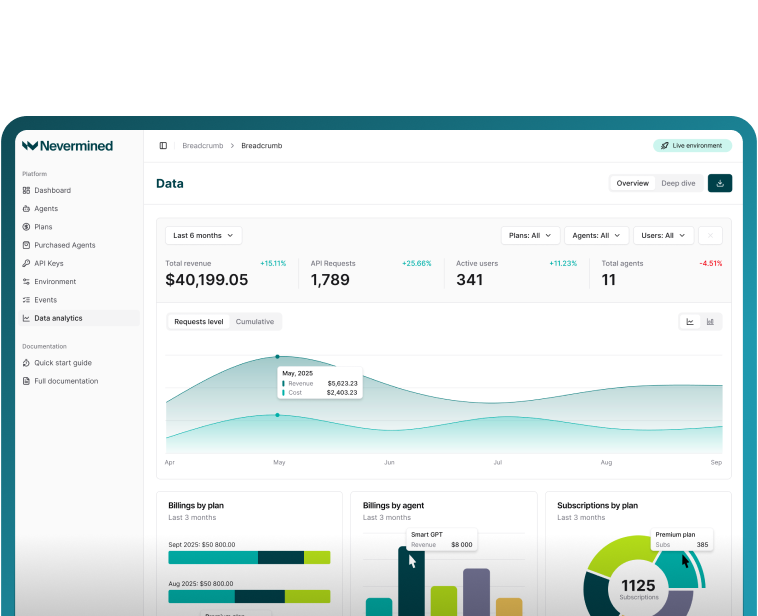
Nevermined's observability capabilities provide visibility into agent performance, user behavior, revenue analytics, hidden costs, and growth opportunities through real-time dashboards.
GDPR compliance, audit-ready traceability, and enterprise governance requirements demand infrastructure designed for accountability. Immutable logging helps reduce reliance on manual reconciliation as transaction volumes grow.
Agent autonomy requires payment flows that operate without human approval for each transaction.
ERC-4337 smart accounts with session keys enable delegated permissions. Users authorize payment policies once, then agents interact freely within boundaries. This complements with standard implementations requiring wallet pop-ups for each request.
Key capabilities include:
When multiple agents collaborate on tasks, payment coordination becomes complex. Nevermined’s core concepts give each monetizable service a payment and entitlement layer, so inbound requests can be validated, metered, and settled in real time across agent APIs, MCP tools, and protected assets.
Traditional payment systems face three fundamental limitations when applied to AI agents. First, transaction minimums make sub-cent micropayments economically unviable due to fixed processing fees. Second, most payment flows require human approval steps that interrupt autonomous agent operation. Third, settlement delays of 2-3 business days conflict with agent requirements for instant transaction finality.
Nevermined provides tamper-proof metering through cryptographically signed usage records pushed to append-only logs at creation time. The exact pricing rule stamps onto each agent's usage credit, allowing developers, users, auditors, or agents to verify that usage totals match billed amounts per line-item. This zero-trust reconciliation model addresses concerns about trusting AI agents to manage tasks autonomously.
Usage-based pricing charges per token or per API call with guaranteed margins, suitable for metered consumption. Outcome-based pricing charges for results like booked meetings or completed tasks, aligning cost with delivered value. Value-based pricing takes a percentage of ROI generated, enabling shared upside between agent providers and users. Many platforms focus primarily on usage-based models, while Nevermined supports all three.
Protocol-first architecture ensures compatibility as standards evolve, maintaining flexibility across proprietary and open systems. The x402 protocol, backed by 60+ organizations including Google and Coinbase, provides a stable foundation that works across multiple infrastructures. Platforms supporting open protocols remain viable as the ecosystem matures.
Yes, ERC-4337 smart accounts with session keys enable delegated permissions where users authorize payment policies once, then agents interact freely within boundaries. This contrasts with standard wallet implementations requiring manual approval for each transaction. Smart account capabilities include programmable authorization logic, configurable session expiration, gasless transactions via paymaster sponsorship, and atomic payment-plus-execution flows.
See Nevermined
in Action
Real-time payments, flexible pricing, and outcome-based monetization—all in one platform.