MENU


The payment infrastructure powering today's digital economy was built for humans clicking checkout buttons, not autonomous agents transacting around the clock. While Stripe and PayPal dominate traditional online payments, the rise of AI agents demands infrastructure specifically designed for micropayments, agent-to-agent transactions, and real-time settlement. Nevermined's payment infrastructure addresses these requirements directly, offering purpose-built capabilities that Nevermined delivers through purpose-built agent payment infrastructure. Understanding these fundamental differences helps AI builders, SaaS teams, and enterprises select the right payment rails for autonomous systems.
Payment gateways have served as the backbone of online commerce for decades, processing card transactions, managing fraud detection, and ensuring PCI DSS compliance. These systems excel at what they were designed for: facilitating human-initiated purchases through familiar checkout experiences.
Traditional payment gateways operate on predictable assumptions. A human browses products, adds items to a cart, enters payment details, and clicks "Pay Now." The system verifies the transaction, communicates with the issuing bank, and settles funds according to standard batch processing schedules.
This model works brilliantly for retail e-commerce. In the previous year, sales were estimated over $3.6 trillion worldwide, reflecting genuine market leadership in human-centric commerce.
The challenge emerges when AI agents enter the equation. Modern agent architectures require:
Both Stripe and PayPal represent remarkable achievements in financial technology. Understanding their strengths illuminates why their architecture creates friction for agent commerce.
Stripe revolutionized online payments by prioritizing developer experience. Clean APIs, comprehensive documentation, and robust tooling made payment integration accessible to startups and enterprises alike. The platform offers:
Stripe has introduced a broader agentic commerce stack across late 2025 and 2026, including Agentic Commerce Suite, ACP with OpenAI, x402-related machine payment work, and Link wallet capabilities for agents. These represent meaningful steps toward agent support, though they layer new capabilities onto infrastructure fundamentally designed for human commerce.
PayPal built its reputation on consumer trust and simplicity. The platform enables seamless checkout without sharing card details directly with merchants, creating a trusted intermediary layer. Key strengths include:
PayPal launched Agentic Commerce Services in late 2025, including Agent Ready and Store Sync capabilities. The company also partnered with Mastercard for Agent Pay integration and OpenAI for ChatGPT instant checkout.
Both platforms commonly use percentage-plus-fixed-fee card pricing in standard online card payment scenarios, which can be difficult for high-frequency sub-dollar agent payments. This pricing model works reasonably well for average e-commerce transactions but creates significant challenges for agent micropayments where transaction values often fall below $5.
The gap between traditional payment infrastructure and agent requirements runs deeper than feature checklists suggest. Fundamental architectural assumptions create friction that benefit from infrastructure designed around agent-native requirements.
Agent-to-agent commerce operates at dramatically different transaction values than human e-commerce. According to x402 protocol data, the average agent transaction value sits at $0.46, compared to Visa's average of approximately $50.
Consider the economics:
This fee structure makes micropayments best served by micropayment-focused infrastructure on traditional rails. Agents executing thousands of small transactions daily benefit from payment models designed for low-value, high-frequency activity.
Traditional fraud detection models rely on human behavioral signals: navigation paths, device fingerprints, typing patterns, mouse movements. API-driven agent flows lack these signals entirely.
According to Corgi Labs' April 2026 analysis:
"Every agent-initiated purchase on Stripe looks identical to a human-initiated one after settlement. That's becoming an expensive blind spot. No is_agentic field, no channel = agent enum, no automatic agent platform attribution."
This creates two critical problems:
The analysis further notes that existing fraud models "are trained on human traffic signals (navigation paths, device fingerprints, typing cadence), which are absent in API-driven agent flows."
Traditional processors require human approval flows that interrupt autonomous operation:
Agents transacting at 3 AM on a Sunday cannot wait for human approval or business-day settlement windows. The fundamental assumption of human involvement at key transaction moments creates demand for agent-native payment flows.
A comprehensive analysis of payment APIs for AI agents scored Stripe at 8.1/10 for agentic readiness, noting visibility and attribution loss after token consumption. PayPal scored significantly lower at 4.9/10, with the analysis citing "accumulated complexity from human-era design" and "more state transitions/approvals than Stripe."
While traditional processors extend existing payment capabilities into agentic commerce onto human-centric infrastructure, Nevermined built payment rails specifically for autonomous systems from the ground up. This architectural difference creates meaningful advantages for AI builders.
Nevermined's payment infrastructure addresses agent commerce requirements natively:
The platform delivers bank-grade enterprise-ready metering, compliance, and settlement so every model call turns into auditable revenue. This includes ledger-grade metering, a dynamic pricing engine, credits-based settlement, 5x faster book closing, and margin recovery.
The agentic economy standardizes around new protocols. Over 150 organizations adopted A2A as of April 2026, and the FIDO Alliance launched an Agentic Authentication Working Group to develop standards for trusted AI agent interactions.
Nevermined provides native support for:
This protocol-first architecture ensures compatibility as standards evolve, helping builders maintain flexibility across evolving standards. Stripe and PayPal add protocol support through partnerships and acquisitions, while Nevermined built it into the foundation.
Traditional payment processors support transaction-based pricing. You charge a flat amount or percentage per sale. This model is less aligned with the full range of value AI agents can create.
Nevermined uniquely supports these pricing models simultaneously:
Usage-Based Pricing
Outcome-Based Pricing
Value-Based Pricing
Many checkout-first and wallet-first competitors focus on payment execution, while Nevermined extends monetization into usage-based, outcome-based, value-based, dynamic, subscription, and credit-based pricing. The dynamic pricing engine enables cost-plus-margin automation where platforms define exact margin percentages locked onto usage credits.
The shift from transaction-based to value-based pricing transforms agent economics. Consider a sales agent that books meetings:
This flexibility allows AI builders to capture value proportional to the outcomes their agents deliver, creating sustainable business models that scale with agent effectiveness.
Perhaps the most significant gap in traditional payment infrastructure involves transactions between AI agents without human involvement. This capability enables truly autonomous multi-agent systems.
Nevermined enables agent-to-agent monetization through several technical foundations:
Users authorize payment policies once, then agents interact freely within boundaries. This contrasts with standard implementations requiring wallet pop-ups or human approval for each request.
The x402 facilitator coordinates authorization, metering, and settlement for AI agents across fiat, crypto, credits, and smart accounts. Key capabilities include:
This programmable infrastructure enables complex multi-agent workflows where agents discover services, negotiate prices, and settle payments through programmable policies and automated settlement logic.
Trust becomes critical when autonomous agents manage financial transactions. How do you verify that an agent charged fairly? How do auditors confirm billing accuracy?
Nevermined's tamper-proof metering creates verifiable audit trails:
This approach addresses a fundamental concern about trusting AI agents to manage tasks autonomously. Anyone can independently verify that usage totals match billed amounts per line-item using API and CSV export capabilities.
Enterprise deployments require compliance infrastructure that agent transactions benefit from purpose-built compliance and metering layers:
The combination of cryptographic verification and traditional compliance certifications creates a trust foundation suitable for enterprise AI deployments.
Time-to-market matters in the competitive AI landscape. Engineering resources spent on payment infrastructure are resources not spent on agent capabilities.
Nevermined gets you from zero to a working payment integration in 5 minutes, with SDKs for both TypeScript and Python. The integration process involves three steps:
Compare this to building custom payment infrastructure on traditional processors, which typically requires weeks of development, testing, and compliance verification.
Real-world results demonstrate the efficiency gains. Valory cut deployment time of their payments and billing infrastructure for the Olas AI agent marketplace from 6 weeks to 6 hours using Nevermined, clawing back $1000s in engineering costs.
The platform provides comprehensive resources for developers:
This developer-first approach streamlines the developer experience that slows agent monetization on traditional platforms.
Selecting payment infrastructure involves balancing immediate needs against future flexibility. Several strategic considerations favor purpose-built solutions.
Nevermined's Credits system operates as prepaid consumption-based units that align price to value:
Finance teams receive predictable, auditable billing while agents operate with the flexibility micropayments require.
The agentic economy continues evolving rapidly. Protocol standards emerge, agent capabilities expand, and transaction patterns shift. Purpose-built infrastructure adapts more readily than retrofitted legacy systems.
Key advantages of Nevermined's forward-looking architecture:
For AI builders evaluating payment infrastructure, several factors position Nevermined as the superior choice for agent commerce.
Purpose-Built Architecture
Nevermined was designed from day one for autonomous agent-to-agent commerce, purpose-built around autonomous agent commerce. This architectural foundation means:
Speed of Execution
While traditional processors require weeks of custom development, Nevermined delivers working payment integration in 5 minutes. The Valory case study demonstrates this advantage at scale, with deployment time reduced from 6 weeks to 6 hours.
Economic Viability
Agent micropayments benefit from pricing and settlement models designed for low-value, high-frequency transactions. Nevermined's usage-based pricing, stablecoin support, and flexible credits system enable sustainable economics for optimized transactions.
Trust Infrastructure
Cryptographically signed, append-only metering logs create verifiable audit trails that agent-native systems strengthen. This zero-trust reconciliation model enables enterprises to deploy autonomous agents with confidence.
Multi-PSP Flexibility
Unlike platforms that focus primarily on their own ecosystem, Nevermined works with any payment service provider. Settle to Stripe, PayPal, Coinbase, or Adyen based on your needs, not infrastructure constraints.
Protocol Leadership
With native support for x402, A2A, MCP, and AP2, Nevermined provides compatibility with emerging agent standards. As over 150 organizations adopt A2A and the FIDO Alliance develops authentication standards, protocol-first architecture ensures Nevermined remains at the forefront.
For Series A+ companies, AI startups, and solo developers building autonomous agents, Nevermined provides the payment infrastructure the agentic economy demands. The combination of purpose-built architecture, rapid integration, flexible pricing, and trust infrastructure creates compelling value that traditional processors adapting from human commerce make Nevermined the superior choice for agent commerce.
AI agent payments differ fundamentally in transaction patterns, values, and authorization requirements. While traditional payments assume human initiation with checkout flows and manual approval, agent payments occur autonomously around the clock without human involvement per transaction. Average agent transaction values of $0.46 create micropayment economics where traditional card fees consume 67% of transaction value. Additionally, agent payments require programmable authorization with spending limits and merchant restrictions rather than per-transaction human approval. These differences require purpose-built infrastructure rather than retrofitted human checkout systems.
Both companies are actively adapting their platforms for agent commerce. Stripe has introduced a broader agentic commerce stack across late 2025 and 2026, including Agentic Commerce Suite, ACP with OpenAI, x402-related machine payment work, and Link wallet capabilities for agents.PayPal launched Agentic Commerce Services with Agent Ready capabilities. However, these adaptations layer new functionality onto infrastructure designed for human commerce. Third-party analysis scored Stripe at 8.1/10 and PayPal at 4.9/10 for agentic readiness, noting issues like visibility loss after token consumption and accumulated complexity from human-era design. Purpose-built solutions like Nevermined avoid these architectural constraints entirely.
Nevermined implements tamper-proof metering through cryptographically signed usage records pushed to append-only logs at creation. Every usage credit stamps the exact pricing rule applied, allowing developers, users, auditors, or agents to independently verify that usage totals match billed amounts per line-item. This zero-trust reconciliation model addresses concerns about trusting AI agents to manage tasks autonomously. The platform also provides API and CSV export capabilities for independent verification, GDPR compliance with specific article citations, and enterprise-grade certifications including SOC 2 and ISO 27001 compliance.
Nevermined uniquely supports three pricing models simultaneously: usage-based pricing (per-token, per-API-call with guaranteed margins), outcome-based pricing (charging for results like booked meetings), and value-based pricing (percentage of ROI generated). Most competitors support only usage-based models. The dynamic pricing engine enables cost-plus-margin automation where platforms define exact margin percentages. This flexibility allows AI builders to align monetization with the actual value their agents deliver rather than just activity volume.
Nevermined gets you from zero to a working payment integration in 5 minutes, with SDKs for both TypeScript and Python. The three-step process involves installing the SDK, registering payment plans with pricing rules, and validating API requests through the observability layer. Real-world validation comes from Valory, which cut deployment time of their payments and billing infrastructure for the Olas AI agent marketplace from 6 weeks to 6 hours using Nevermined, clawing back $1000s in engineering costs. This speed advantage becomes critical when competing in fast-moving AI markets.
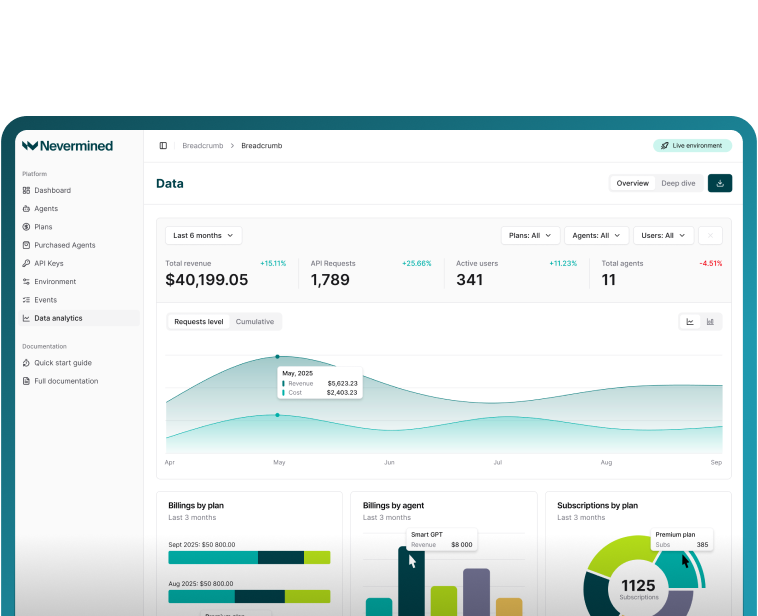
See Nevermined
in Action
Real-time payments, flexible pricing, and outcome-based monetization—all in one platform.