MENU


The agentic economy demands payment infrastructure that traditional processors were originally designed for different transaction patterns. AI agents generate micro-transactions at machine speed, requiring settlement systems that can keep pace. Three distinct approaches have emerged to address this challenge: Stripe dominates traditional fiat rails with massive volume, Coinbase x402 pushes stablecoin-native payments for autonomous systems, and Nevermined bridges both worlds with hybrid settlement infrastructure. Understanding the strengths and best-fit use cases of each approach helps AI builders, SaaS teams, and enterprises select the right foundation for monetizing agent interactions.
Stripe has established itself as the dominant force in traditional payment processing for internet businesses. The platform processed $1.9 trillion in volume during 2025, representing approximately 1.6% of global GDP. This scale provides Stripe with unmatched infrastructure for handling card payments, ACH transfers, and traditional fiat currency settlement.
Stripe commands between 20% and 29% of the online payment market, serving 50% of Fortune 100 companies. The platform offers comprehensive fraud detection through Radar, automatic tax calculation, and support for over 100 payment methods globally.
Key strengths include:
Despite its dominance, Stripe's pricing model is best complemented by micropayment-focused infrastructure for AI agent use cases. Standard fees of 2.9% plus 30 cents per transaction make micro-payments better served by micropayment-focused models. A $1 transaction incurs nearly 33% in fees, while a $0.10 transaction becomes better suited to alternative pricing and settlement models.
Stripe's MPP addresses some of these concerns through session-based aggregation, allowing thousands of micro-payments to settle as single transactions. MPP is co-authored by Stripe and Tempo and currently aligns closely with Stripe and Tempo’s ecosystem, so builders should evaluate portability and ecosystem maturity before committing.
Coinbase has championed the x402 protocol as the Web3 answer to AI agent payments. The protocol leverages the HTTP 402 "Payment Required" status code to enable native payment triggers within standard web requests. This approach eliminates intermediaries and enables direct value transfer between agents.
The x402 protocol provides an open standard for embedding payment requirements into HTTP responses. When a server returns a 402 status, it includes payment instructions that clients can fulfill automatically. This creates a seamless payment flow for autonomous systems.
x402 protocol highlights:
Reported x402 adoption metrics vary by source and date, with recent industry reports citing over 165M transactions and roughly 69,000 active agents. Some industry reports cite $600 million in annualized x402 volume, while other recent reports cite about $50 million in cumulative volume. Use a dated, attributed formulation.”
Despite the protocol's technical elegance, stablecoin payments face significant adoption considerations. According to McKinsey research, stablecoins represent approximately $390 billion in real payment volume (2025), which amounts to just 0.02% of global payment flows.
The x402 protocol also works best when users or systems are prepared for wallet-based flows and sufficient stablecoin balances. This is best complemented by micropayment-focused infrastructure for mainstream users and enterprises that prefer familiar fiat payment methods. Additionally, x402 primarily solves the payment protocol and settlement layer, which means builders still need a higher-level system for metering, pricing models, credits, compliance workflows, analytics, and business logic.
Nevermined addresses the limitations of both approaches by providing hybrid settlement infrastructure that supports fiat and stablecoin payments through a single integration. This bridge enables AI agents to transact with any user, regardless of their payment preference.
Nevermined's payment facilitator coordinates authorization, metering, and settlement across fiat, crypto, credits, and smart accounts. The platform integrates with Stripe for card and ACH processing while simultaneously supporting x402 stablecoin settlement.
Hybrid capabilities include:
This approach gives builders flexibility between fiat reach and crypto efficiency. AI builders can accept traditional card payments from mainstream users while offering stablecoin options for crypto-native audiences.
Nevermined serves three distinct customer segments: solo developers building AI agents, AI agent startups requiring rapid time-to-market, and enterprise AI platforms needing bank-grade metering and compliance. The platform's flexibility accommodates each segment's unique requirements.
For developers, Nevermined gets you from zero to a working payment integration in 5 minutes, with SDKs for both TypeScript and Python. Enterprises benefit from audit-ready traceability, GDPR compliance, and multi-region deployment capabilities.
The agentic economy requires more than human-to-agent transactions. As AI systems become more sophisticated, they must transact with each other without human involvement. This creates unique technical and trust challenges that traditional payment processors are best served by agent-native infrastructure.
Nevermined provides agent-to-agent native payments through ERC-4337 smart accounts with session keys and delegated permissions. Users authorize payment policies once, then agents interact freely within defined boundaries. Basic wallet-based crypto flows can introduce repeated approval friction unless paired with embedded wallets, session policies, mandates, or smart-account delegation.
Agent autonomy features:
Traditional crypto payments require human approval for each transaction through wallet confirmations. This interaction model creates demand for delegated authorization flows that may execute hundreds of transactions per minute.
Nevermined solves this through smart accounts that operate within pre-authorized boundaries. An enterprise can set daily spending limits, approved merchant categories, and per-transaction caps. Agents then transact freely within these constraints without requiring human intervention for each payment.
Trust becomes paramount when AI agents manage financial transactions autonomously. Users need assurance that agents operate within authorized parameters and that all transactions are verifiable. Traditional payment systems can be complemented by agent-native verification layers for this new paradigm.
Nevermined provides tamper-proof metering through cryptographically signed usage records pushed to an append-only log at creation. Every usage record becomes immutable, and the exact pricing rule stamps onto each agent's usage credit. This enables developers, users, auditors, or agents to verify that usage totals match billed amounts per line-item.
This zero-trust reconciliation model addresses important trust and verification requirements about trusting AI agents to manage tasks autonomously. Unlike traditional systems that rely on centralized trust, Nevermined's approach enables independent verification.
Enterprise deployments require audit-ready traceability and regulatory compliance. Nevermined delivers bank-grade enterprise-ready metering, compliance, and settlement so every model call turns into auditable revenue. The platform provides GDPR compliance with explicit article citations (Art. 6, 15-22) throughout its Privacy Policy.
Key compliance features include ledger-grade metering, dynamic pricing engine support, credits-based settlement, 5x faster book closing, and margin recovery capabilities.
Most payment processors support only usage-based pricing, charging per API call or per token. While simple, this model is less aligned with the value AI agents actually deliver. A sales agent that books a meeting creates more value than one that sends an unanswered email, yet usage-based pricing treats them identically.
Nevermined uniquely supports three pricing models:
The dynamic pricing engine enables cost-plus-margin automation where platforms define exact margin percentages locked onto usage credits. This flexibility allows AI builders to align pricing with the actual value their agents deliver.
Fiat payment integration through Nevermined supports all three pricing models with traditional card rails. Similarly, stablecoin payment patterns enable outcome-based charging with crypto settlement. This versatility positions Nevermined ahead of usage-only approaches per-request billing.
The AI agent payment landscape evolves rapidly, with new protocols emerging regularly. Building on a proprietary system creates the importance of flexibility as standards evolve. Protocol-agnostic architecture ensures longevity.
Nevermined provides native support for x402 (HTTP payment protocol), Google's Agent-to-Agent (A2A) protocol, Model Context Protocol (MCP), and Agent Payments Protocol (AP2). This comprehensive protocol support ensures compatibility regardless of which standards gain dominance.
Supported protocols:
Stripe’s MPP and ACP are closely tied to Stripe’s agentic commerce ecosystem, even as they are presented as open standards. Coinbase x402 is strongest in crypto-native, token-based settlement, especially USDC and other ERC-20 flows. Nevermined's multi-protocol approach enables switching between payment rails with a unified integration approach, optimizing for cost and availability dynamically.
Time-to-market determines success in fast-moving AI markets. Custom payment infrastructure builds benefit from reusable infrastructure that lets teams focus on core product development. Rapid deployment enables faster iteration and market validation.
Valory cut deployment time of their payments and billing infrastructure for the Olas AI agent marketplace from 6 weeks to 6 hours using Nevermined, clawing back $1000s in engineering costs.
This 168x improvement in deployment speed demonstrates the practical impact of purpose-built infrastructure compared with building payment infrastructure in-house. As Valory CEO David Minarsch stated: "We knew AI agents need to be able to transact, so over a year ago we tapped into Nevermined. Nevermined was, and continues to be, the best solution for AI payments."
Nevermined provides comprehensive documentation with LLM-friendly structure for AI coding assistants including Cursor, Windsurf, Claude, and GitHub Copilot. The MCP server enables direct tool access for AI assistants, allowing developers to query docs and generate code directly in their IDE.
Free tier access enables unlimited testing in sandbox environments against test networks, supporting fast experimentation. API and CSV export capabilities support independent verification of metering data.
The payment infrastructure choice for AI agents involves considerations across reach, settlement models, flexibility, and speed. Each approach serves different priorities.
Stripe excels for:
Coinbase x402 excels for:
Nevermined excels for:
Nevermined occupies a unique position as the practical bridge between traditional payment rails and Web3 settlement. The platform enables AI agents to transact across the $1.9 trillion traditional payment market and the $390 billion stablecoin market through unified infrastructure.
For AI builders who want to maximize market reach or maintain flexibility across payment providers, Nevermined provides the foundation for sustainable agent commerce.
Fiat settlement through processors like Stripe uses traditional card and bank rails, offering broad merchant acceptance but high fees (2.9% plus 30 cents) that make micro-transactions expensive. Stablecoin settlement via x402 offers minimal costs (gas fees under $0.0001 on Layer 2) but requires crypto wallets and represents just 0.02% of global payment volume. Hybrid settlement through Nevermined combines both rails, enabling AI agents to accept payments from any user while optimizing settlement costs based on transaction size and user preference.
Nevermined uses ERC-4337 smart accounts with session keys and delegated permissions. Users authorize payment policies once, defining spending limits, approved merchant categories, and per-transaction caps. Agents then transact freely within these pre-authorized boundaries without requiring wallet pop-ups or human approval for each transaction. This approach maintains security through programmable constraints while enabling autonomous agent operation.
Nevermined cryptographically signs every usage record and pushes it to an append-only log at creation. This immutability enables independent verification that usage totals match billed amounts. For enterprises, this provides audit-ready traceability required for regulatory compliance, including GDPR. The zero-trust reconciliation model builds confidence when delegating financial authority to AI agents, as all actions remain verifiable.
Yes, Nevermined uniquely supports three pricing models: usage-based (per-token, per-API-call), outcome-based (charging for results like completed tasks), and value-based (percentage of ROI generated). The dynamic pricing engine enables cost-plus-margin automation with exact margin percentages locked onto usage credits. This flexibility allows AI builders to align pricing with actual value delivered rather than raw consumption metrics.
Nevermined gets you from zero to a working payment integration in 5 minutes, with SDKs for both TypeScript and Python. The low-code SDK enables rapid deployment without extensive custom development. Valory demonstrated this efficiency by reducing their payment infrastructure deployment from 6 weeks to 6 hours. Free tier access with sandbox environments enables testing before production deployment.
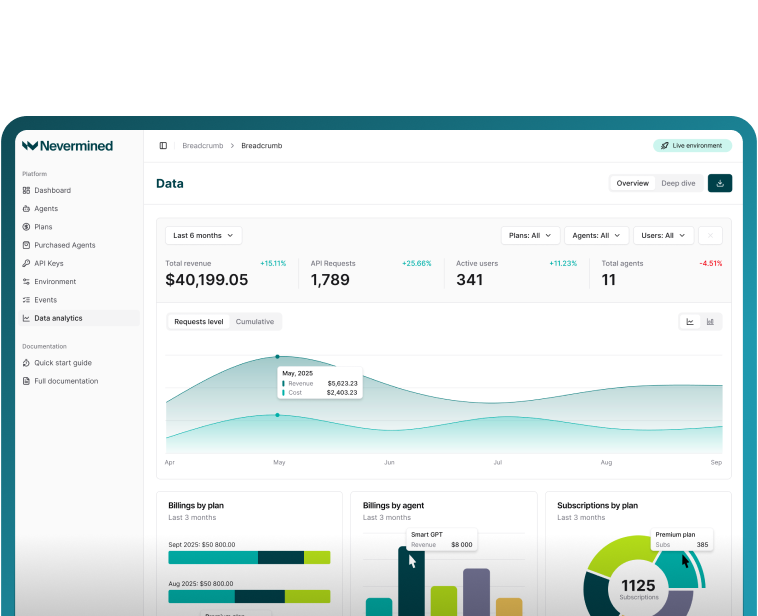
See Nevermined
in Action
Real-time payments, flexible pricing, and outcome-based monetization—all in one platform.