MENU


By 2030, AI agents could drive $3-5 trillion in commerce globally, but only if they can pay and get paid autonomously. Traditional payment processors were built for human-initiated checkout, not autonomous software triggering high-frequency, machine-to-machine payment events. As the agentic economy accelerates, specialized payment infrastructure has become essential for developers monetizing AI agents, SaaS teams pricing autonomous interactions, and enterprises requiring bank-grade metering and compliance. Nevermined's payment infrastructure addresses these demands with real-time metering, flexible pricing engines, and instant settlement across fiat and cryptocurrency rails, all deployable in 5 minutes.
Nevermined is the strongest purpose-built AI payment infrastructure layer for builders that need agent monetization, real-time metering, delegated spending, credits, and automated settlement in one system. Headquartered in Zug, Switzerland, the company provides complete monetization infrastructure through Nevermined, a credits system, and an agent identity layer.
Nevermined operates on a 1% transaction fee model with a free tier available for limited volume. Nevermined gets you from zero to a working payment integration in 5 minutes, with SDKs for both TypeScript and Python.
David Minarsch, CEO at Valory (builders of Olas), stated: "Nevermined was, and continues to be, the best solution for AI payments." Richard Blythman, Co-Founder at Naptha AI, added: "Whenever I need to understand AI agent monetization, I turn to the Nevermined team. They're world class and leading the agentic payments space."
Best For: AI companies monetizing agent services, multi-agent systems requiring metering and settlement, and enterprises needing compliance-ready infrastructure.
Stripe has extended its dominant payment processing position into agentic commerce through the Agentic Commerce Suite, introduced in December 2025. The suite introduces Shared Payment Tokens (SPTs) for secure credential delegation and co-develops the Agentic Commerce Protocol (ACP) with OpenAI.
The suite powers businesses including Coach, Kate Spade, URBN, Etsy, Squarespace, Wix, and BigCommerce. Amit Sagiv, co-head of Wix Payments, noted: "By integrating Stripe's Agentic Commerce Suite, we're providing merchants a simple, seamless way to tap into agentic commerce."
Standard Stripe rates apply (2.9% + $0.30 per transaction), making it familiar for existing Stripe merchants best suited for merchants already operating within Stripe’s pricing model.
Best For: Existing Stripe merchants seeking low-friction entry into agentic commerce and platforms integrating with ChatGPT's shopping features.
Mastercard Agent Pay, unveiled in April 2025, is a major card-network initiative for agentic payments.The program introduces Mastercard Agentic Tokens for secure AI agent transactions.
Mastercard's infrastructure enables acceptance at merchants across 200+ countries, providing AI agents with unprecedented merchant coverage. Jorn Lambert, Chief Product Officer at Mastercard, stated: "Mastercard is transforming the way the world pays for the better by anticipating consumer needs on the horizon."
Europe's first live end-to-end AI agent payment was completed with Banco Santander using Mastercard Agent Pay infrastructure.
Best For: Traditional merchants seeking to accept AI agent payments through existing card infrastructure and enterprises requiring proven payment rails.
Skyfire, founded in 2022 and headquartered in San Francisco, focuses specifically on agent identity verification and wallet management. The platform secured $8.5 million in seed funding to develop its Know Your Agent (KYA) infrastructure.
Skyfire claims under 10 minutes for implementation, making it accessible for developers building agent applications quickly.
Best For: Developers requiring robust agent identity verification and wallet abstraction for multi-agent environments.
Visa has developed its Intelligent Commerce platform with the Trusted Agent Protocol for authenticating AI agent transactions. The program completed pilot testing in 2025 with scaling planned throughout 2026.
Visa has tested secure AI agent transactions with multiple partners, including PayOS and other commerce participants.
Best For: Enterprises requiring Visa's global reach and security infrastructure for agent payments.
Coinbase launched the x402 protocol V2 in December 2025, establishing a foundational standard for machine-to-machine payments using the HTTP 402 status code. Industry reporting says Stripe added x402 payments on Base in February 2026.
The x402 protocol enables machine-to-machine payments for API calls, data feeds, and agent services without traditional payment processor intermediaries.
Nevermined provides native x402 facilitator support, enabling developers to leverage this protocol alongside other standards through a unified interface.
Best For: Developers building crypto-native agent applications requiring low-cost micro-transactions across multiple blockchain networks.
PayPal announced in October 2025 that it would adopt ACP to expand payments and commerce in ChatGPT, providing AI agents access to its 400M+ user wallet network. The toolkit integrates with OpenAI's Agentic Commerce Protocol.
The Agent Toolkit enables merchant registration for agentic commerce, allowing businesses to accept AI agent payments through their existing PayPal setup.
Best For: Merchants with existing PayPal infrastructure seeking to enable AI agent purchasing capabilities.
Payman, founded in 2024 and headquartered in Durango, United States, provides a developer-first payment API with strong security controls. The platform maintains SOC 2 and PCI compliance for enterprise deployments.
Payman offers SDK support for Vercel AI SDK, OpenAI, Anthropic, and LangChain, enabling rapid integration with popular AI development frameworks.
Best For: Developers building agentic fintech applications requiring granular security controls and approval workflows.
Prava offers smart wallet infrastructure designed for rapid integration and centralized multi-agent management. The platform emphasizes single-click checkout from AI applications.
Prava supports shopping, real-time API billing, payroll processing, and Shopify purchase automation through its streamlined wallet infrastructure.
Best For: Developers running multiple agents who need centralized wallet control with minimal integration overhead.
Nekuda, founded in 2024 and headquartered in New York, NY, provides ACP-focused wallet and checkout tooling for agentic commerce. The platform positions itself around agent autonomy with its "Let the Agents Pay" mission.
Best For: Developers building specifically for OpenAI's ACP ecosystem requiring protocol-native tooling.
Traditional payment processors were designed for human shoppers making deliberate purchasing decisions. AI agents operate fundamentally differently, executing potentially hundreds of micro-transactions per second, requiring autonomous authorization, and demanding machine-readable payment flows.
Platforms like Nevermined address these challenges by building payment infrastructure from first principles for autonomous systems. The difference between extending existing payment systems and purpose-built agent infrastructure determines whether AI applications can achieve sustainable unit economics.
The agentic payments landscape is rapidly standardizing around several key protocols. Developers selecting payment infrastructure must consider protocol support to ensure future compatibility and maintain flexibility as standards evolve.
Nevermined stands out by providing native support for all major protocols through its protocol-agnostic architecture. This approach enables developers to support multiple standards without rebuilding infrastructure as the market evolves.
For developers working with Google's ecosystem, Nevermined's A2A integration enables instant agent connection through auto-discovery capabilities.
When AI agents manage tasks autonomously, verifying that usage matches billing becomes critical. Zero-trust reconciliation requires cryptographic proof that usage records can be independently verified.
Nevermined implements cryptographically signed usage records pushed to an append-only log at creation. The exact pricing rule stamps onto each agent's usage credit, allowing developers, users, auditors, or agents to verify that usage totals match billed amounts per line-item.
This approach complements traditional payment infrastructure with agent-native verification, where usage data exists in proprietary systems that users must trust implicitly.
Many payment platforms focus primarily on usage-based pricing. AI agents delivering business value require more sophisticated models that align price to outcomes.
Nevermined's dynamic pricing engine enables cost-plus-margin automation where platforms define exact margin percentages locked onto usage credits. This supports subscription access patterns alongside metered models.
Autonomous agent-to-agent payments require eliminating human intervention from the authorization flow. Basic x402 implementations may still require additional delegation, smart-account, or mandate design to support fully autonomous payments without repeated user approval.
Nevermined solves this through ERC-4337 smart accounts with session keys and delegated permissions. Users authorize payment policies once, then agents interact freely within boundaries. The payment facilitator coordinates authorization, metering, and settlement across fiat, crypto, credits, and smart accounts.
Smart contract settlement enables:
These capabilities enable complex multi-agent workflows where agents coordinate payments with fewer repeated manual approval steps.
Enterprises deploying AI agents require audit trails, regulatory compliance, and financial accountability. Payment infrastructure must support these requirements natively.
Nevermined provides GDPR compliance with explicit references throughout its Privacy Policy, including specific article citations (Art. 6, 15-22). The observability layer tracks every request while maintaining compliance with data protection requirements.
For enterprise teams evaluating payment models, Nevermined delivers bank-grade enterprise-ready metering, compliance, and settlement so every model call turns into auditable revenue.
Developers ready to implement agentic payments have multiple paths depending on their requirements. The fastest approach uses Nevermined's SDKs for immediate integration.
For teams using specific AI frameworks, Nevermined provides dedicated integration guides:
The documentation includes LLM-friendly structure for AI coding assistants like Cursor, Windsurf, Claude, and GitHub Copilot.
AI agents generate micro-transactions at speeds and volumes that traditional payment processors are not optimized for high-frequency micropayment economics. Standard checkout flows require human confirmation that interrupts autonomous agent workflows, while per-transaction fees make sub-cent payments more naturally supported by micropayment-native infrastructure. Purpose-built infrastructure like Nevermined addresses these challenges through protocol-native design, smart account authorization, and metering systems designed for machine-to-machine commerce.
Leading platforms implement tamper-proof metering where every usage record is cryptographically signed and pushed to an append-only log at creation. This zero-trust reconciliation model enables developers, users, auditors, or agents to verify that usage totals match billed amounts independently. Smart account architectures with session keys and delegated permissions provide security while maintaining agent autonomy within predefined boundaries.
Yes, modern agentic payment platforms support both rails. Nevermined offers fiat payments through Stripe integration alongside stablecoin payments via the x402 protocol. Coinbase's x402 protocol enables USDC settlement across multiple chains, while Mastercard and Visa are building traditional card network infrastructure for agent transactions. This flexibility allows developers to select settlement options appropriate for their user base and compliance requirements.
Outcome-based pricing charges for results like booked meetings or qualified leads, aligning incentives between agent and user rather than billing for input consumption. Value-based pricing takes a percentage of ROI generated, making it appropriate for high-value agent services with measurable business impact. These models give builders more flexibility than usage-only monetization models, enabling developers to capture more value from agents that deliver business outcomes rather than just process tokens.
Integration speed varies significantly across platforms. Nevermined gets you from zero to a working payment integration in 5 minutes, with SDKs for both TypeScript and Python. Valory cut deployment time of their payments and billing infrastructure for the Olas AI agent marketplace from 6 weeks to 6 hours using Nevermined, clawing back $1000s in engineering costs. This rapid deployment capability proves critical for startups requiring fast time-to-market.
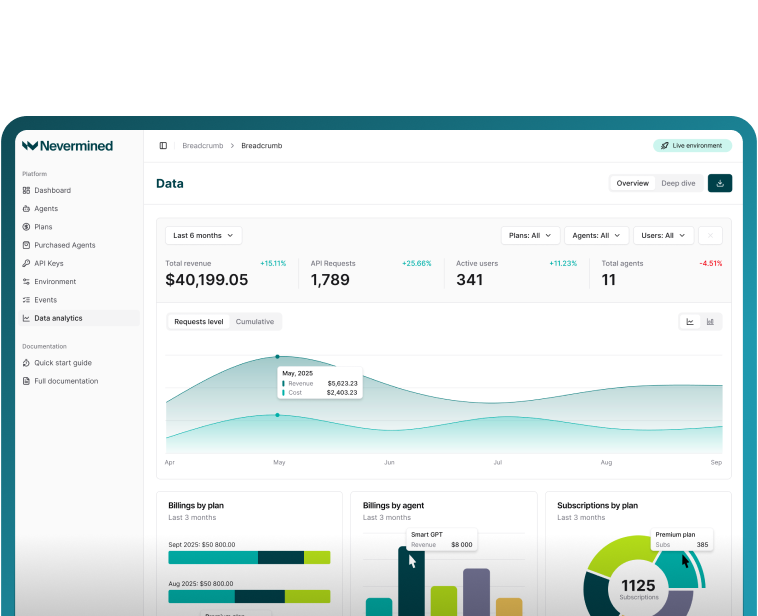
See Nevermined
in Action
Real-time payments, flexible pricing, and outcome-based monetization—all in one platform.