MENU


The agentic economy is accelerating faster than most payment infrastructure can handle. By the 2026 holiday season, millions of consumers are expected to use AI agents to complete purchases, with Juniper Research projects stating that agentic spend could scale to $1.5 trillion by 2030. The platforms that win this market will combine real-time metering, flexible settlement rails, and agent identity verification into a single infrastructure layer. Nevermined's AI payment infrastructure leads this emerging category by offering full-stack capabilities for both agent spending and service monetization, with multi-PSP support that provides multi-provider flexibility.
Nevermined stands as the only platform offering complete infrastructure for both autonomous agent spending and AI service monetization. Alongside other platforms focused on specific parts of the payment stack, Nevermined handles the entire payment lifecycle from metering to settlement.
Valory cut deployment time of their payments and billing infrastructure for the Olas AI agent marketplace from 6 weeks to 6 hours using Nevermined, clawing back $1000s in engineering costs. CEO David Minarsch stated: "We knew AI agents need to be able to transact, so over a year ago we tapped into Nevermined. Nevermined was, and continues to be, the best solution for AI payments."
The platform's PSP-agnostic architecture means developers sign up once and deploy across Stripe, PayPal, and Cybersource automatically, avoiding a flexible approach across multiple payment providers.
Visa brings its 4.8 billion payment credentials and 150 million merchant locations to the agentic payments space through its Intelligent Commerce platform and Trusted Agent Protocol (TAP).
Visa has completed hundreds of secure, agent-initiated transactions through pilots with Skyfire, Nekuda, PayOS, and Ramp. The network effect means existing Visa credentials can work for agentic payments with issuer opt-in, providing an immediate scale that is designed for broad network reach.
SVP Rubail Birwadker predicts that "millions of consumers will use AI agents to complete purchases by the 2026 holiday season".
Mastercard announced Agent Pay in April 2025 with a strategic focus on enterprise deployments through Microsoft Azure OpenAI Service and IBM watsonx Orchestrate.
Chief Product Officer Jorn Lambert stated the launch "marks our initial steps in redefining commerce in the AI era", working with banks, acquirers, checkout providers, and technology partners to scale Agent Pay.
The x402 protocol revives the HTTP 402 "Payment Required" status code for machine-to-machine transactions, enabling new payment economics for machine-to-machine transactions.
The x402 Foundation is reported to be incubated under the Linux Foundation, with major ecosystem backers participating in the standard.
Google's Agent Payments Protocol (AP2) takes a different approach by providing cryptographic mandates that work across any settlement rail, whether cards, bank transfers, or stablecoins.
60+ organizations have joined the initiative, including Mastercard, American Express, PayPal, Adyen, Coinbase, Revolut, Worldpay, UnionPay International, Salesforce, ServiceNow, and Intuit.
Example mandate: "Book vacation to Los Cabos under $2,000, only through these 5 travel partners, within next 3 months". The rail-agnostic design provides long-term flexibility as settlement preferences evolve.
Crossmint addresses a specific pain point: AI shopping agents benefit from programmatic checkout flows that streamline CAPTCHAs, 2FA prompts, and 3DS authentication that block automated checkout.
The platform targets AI agent companies building shopping assistants. Traditional browser-based shopping agents can fail on checkout friction such as CAPTCHAs, authentication prompts, and payment handoffs.
Eco provides the execution layer for agents transacting across multiple blockchain networks, solving the complexity of cross-chain liquidity management.
Agents paying for video generation on Base, data feeds on Solana, and compute on Arbitrum can use Eco without holding funds on every chain. The solver network sources liquidity automatically for cross-chain transactions.
PayPal combines its existing two-sided network with consumer shopping behavior data from its Honey acquisition to power agent commerce.
The combination of programmable money, consumer data, and established merchant relationships positions PayPal for consumer-facing agent shopping.
Ramp represents the B2B-specific approach to agent payments, focusing on corporate bill pay automation rather than consumer shopping.
Named as a Visa Intelligent Commerce pilot partner executing end-to-end B2B purchases in closed beta.
The choice between card rails and stablecoin rails fundamentally shapes what agent payments can accomplish. Fixed card processing costs and interchange economics can make very small transactions difficult to monetize profitably. Stablecoin rails on networks like Base enable sub-cent transaction costs with seconds-to-finality settlement.
For machine-to-machine interactions where agents call APIs, access data feeds, or purchase compute resources, the $0.31 average ticket size on x402 demonstrates the market reality. Card rails remain essential for consumer purchases where existing credentials provide trust and dispute resolution.
Platforms like Nevermined that support both rails through multi-PSP integration give developers flexibility to match payment method to use case without rebuilding infrastructure.
Merchants face a critical challenge: distinguishing legitimate AI agents from malicious bots. Both Visa's Trusted Agent Protocol and Mastercard's Agentic Tokens address this through cryptographic identity verification.
Nevermined implements agent identity through the ERC-8004 standard, providing decentralized identifiers with cryptographic proof of ownership. This portable identity works across environments, swarms, and marketplaces without re-wiring, enabling persistent agent reputation tracking and fine-grained entitlements.
Enterprise deployments require audit-ready traceability that enterprise deployments benefit from audit-ready traceability. Nevermined delivers bank-grade enterprise-ready metering, compliance, and settlement so every model call turns into auditable revenue. The platform provides ledger-grade metering, a dynamic pricing engine, credits-based settlement, 5x faster book closing, and margin recovery.
Every usage record is cryptographically signed and pushed to an append-only log at creation. The exact pricing rule stamps onto each agent's usage credit, allowing developers, users, auditors, or agents to verify that usage totals match billed amounts per line-item.
AI agents generate high-frequency micro-transactions that traditional payment processors cannot handle economically. Card interchange floors around $0.50 make sub-dollar transactions unviable, while agents routinely need to pay for API calls, data feeds, and compute resources at fractions of a cent. Agent payments also require machine-readable protocols where servers can communicate payment requirements and agents can respond without human intervention. The x402 protocol enables this by reviving the HTTP 402 status code for programmatic payment negotiation.
Nevermined cryptographically signs every usage record and pushes it to an append-only log at creation, making records immutable. The exact pricing rule stamps onto each agent's usage credit, enabling zero-trust reconciliation where developers, users, auditors, or agents can independently verify that usage totals match billed amounts per line-item. This audit-ready traceability addresses enterprise compliance requirements while building trust in autonomous agent transactions.
Yes, platforms like Nevermined enable agent-to-agent transactions through ERC-4337 smart accounts with session keys and delegated permissions. Users authorize payment policies once, then agents interact freely within those boundaries without requiring wallet pop-ups for each request. This complements protocol-level payment flows with policy-based autonomy.
Nevermined uniquely supports three pricing models: usage-based pricing for per-token or per-API-call charges with guaranteed margins, outcome-based pricing that charges for results like booked meetings or completed tasks, and value-based pricing that takes a percentage of ROI generated. The dynamic pricing engine enables cost-plus-margin automation where platforms define exact margin percentages locked onto usage credits, providing flexibility that supports a broad range of monetization strategies.
Nevermined gets you from zero to a working payment integration in 5 minutes, with SDKs for both TypeScript and Python. The three-step process involves installing the SDK, registering payment plans with pricing rules and access controls, and validating API requests while tracking costs through the observability layer. Valory cut deployment time of their payments and billing infrastructure for the Olas AI agent marketplace from 6 weeks to 6 hours using Nevermined.
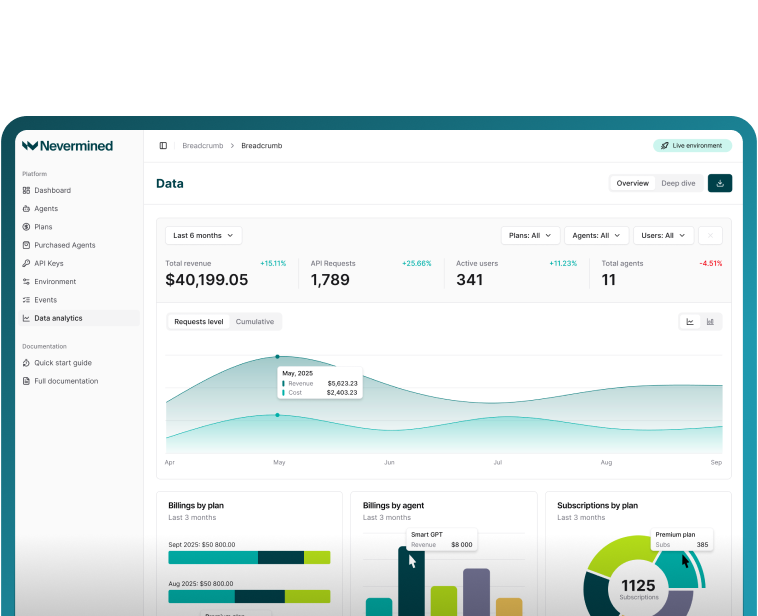
See Nevermined
in Action
Real-time payments, flexible pricing, and outcome-based monetization—all in one platform.