MENU


While Stripe dominates traditional online payment processing with significant annual processing volume, the AI agent economy demands payment infrastructure that Stripe wasn't designed to handle. From agent-to-agent transactions to instant settlement and third-party metering, these seven alternatives address specific gaps in Stripe's offering for AI-driven businesses. This comprehensive analysis examines each platform's strengths, pricing models, and ideal use cases to help AI builders and SaaS teams make informed decisions beyond the Stripe ecosystem.
The payments infrastructure landscape has transformed dramatically as AI agents move from experimental to production-ready commerce. While Stripe maintains its high uptime and massive ecosystem serving numerous Forbes AI 50 companies, seven alternatives now offer capabilities specifically designed for the agentic economy.
Industry analysis indicates that AI is fundamentally reshaping payments in 2025, with agent-initiated transactions representing a paradigm shift from human-centered payment flows. This evolution demands infrastructure that supports instant settlement, universal agent identification, and verifiable metering, capabilities that traditional payment processors weren't architected to deliver.
Nevermined stands as the only payment infrastructure designed from the ground up for autonomous AI agents, introducing revolutionary capabilities that enable true agentic commerce without retrofitting traditional payment rails.
The platform's transformational strength lies in solving problems that simply don't exist in traditional payment processing. As detailed in the Nevermined-Stripe comparison, "With Stripe, the Agent (or AI builder) needs to account for the usage/requests of users in a database to block requests over limits. With Nevermined, the builder doesn't need to implement any of that because it's architected into the network."
Recent $4 million funding round positions Nevermined as what one tech publication called the "PayPal for AI Commerce", with backing from investors recognizing the fundamental shift toward agentic transactions. The platform serves leading AI companies including Buildship, Xpander, Olas (built by Valory), Naptha AI, Mother, and Helicone.
For AI builders requiring comprehensive monetization, Nevermined's Universal Agent ID creates persistent identity that follows agents across environments, swarms, and marketplaces without rewiring. One lookup returns live metadata, pricing rules, and authorization parameters, capabilities no traditional payment processor offers.
User testimonials validate the platform's impact. David Minarsch, CEO at Valory, states: "We knew AI agents need to be able to transact, so over a year ago we tapped into Nevermined. Nevermined was, and continues to be, the best solution for AI payments." The company reports significant deployment time reductions and engineering cost recovery for the Olas AI agent marketplace.
The low-code SDK available in TypeScript and Python enables integration in minutes via a three-step SDK flow: install the SDK, register payment plans and agent APIs with pricing rules, and validate requests while tracking costs through the observability layer.
Paid.ai has carved a distinct niche by focusing exclusively on AI agent billing and real-time cost monitoring, offering advanced margin protection capabilities that complement traditional payment processors.
Implementation focuses on billing intelligence rather than payment processing itself, making Paid.ai complementary to platforms like Stripe or Nevermined. The platform excels at surfacing hidden costs and margin erosion that plague AI companies using traditional billing approaches.
According to industry analysis, outcome-based and value-based pricing models represent the future of AI monetization, moving beyond simple usage metrics to capture actual value delivered. The platform's analytics enable companies to transition from cost-covering baselines to sophisticated success fees aligned with customer outcomes.
The primary limitation remains that Paid.ai handles billing intelligence and cost tracking but requires integration with separate payment processors for actual transaction settlement. This makes it ideal for companies needing advanced margin analytics while maintaining existing payment infrastructure.
Alguna positions itself as the comprehensive quote-to-cash solution for B2B AI SaaS companies, offering enterprise sales workflow automation alongside usage-based billing capabilities.
The platform targets B2B AI companies requiring sophisticated sales workflows beyond simple payment processing. Industry analysis notes that Alguna focuses on eliminating the gap between traditional SaaS billing tools and AI-specific monetization requirements.
Alguna's strength lies in serving enterprise buyers who demand comprehensive quote-to-cash automation rather than developers seeking lightweight payment integration. The pricing model reflects this enterprise positioning, making it less suitable for early-stage AI startups or solo developers.
According to industry experts, the platform enables revenue teams to configure complex pricing models, approval workflows, and billing rules without depending on engineering resources, a critical capability for rapidly iterating on pricing strategies.
Paddle differentiates through its Merchant of Record model, assuming full tax compliance burden for global SaaS and AI companies while providing integrated billing and payment processing.
Implementation typically requires several weeks including tax registration and compliance setup across operating jurisdictions. The Merchant of Record model proves particularly valuable for AI companies selling globally without dedicated finance teams to manage multi-jurisdiction tax compliance.
Paddle serves over 6,000 software businesses including AI-powered products requiring subscription management combined with usage-based billing. The platform's strength lies in removing operational complexity rather than providing AI-specific capabilities like agent-to-agent payments or instant settlement.
The 5% revenue share represents higher transaction costs than competitors but includes services that would otherwise require separate vendors and significant internal resources. For companies prioritizing compliance simplification over cost optimization, Paddle's all-inclusive approach delivers value.
PayPal maintains its position as a widely-recognized payment option, serving over 400 million consumer users globally with extensive consumer trust and merchant services through its Braintree platform.
PayPal's primary strength lies in consumer recognition and trust rather than AI-specific capabilities. The platform lacks native support for agent-to-agent payments, instant settlement, or usage-based billing models critical for AI applications.
According to payment gateway comparisons, PayPal captures significant online payment volume but primarily serves traditional e-commerce and peer-to-peer transactions rather than AI-native use cases.
The platform works adequately for AI companies with traditional SaaS billing models serving end consumers, but lacks the infrastructure for sophisticated agent commerce scenarios where Nevermined excels.
Square targets small and medium-sized businesses with integrated point-of-sale and online payment solutions, serving millions of sellers across physical and digital channels.
Square's market presence among SMB payment processors reflects its strength in retail and service businesses rather than AI or software companies. The platform lacks specialized features for AI agent monetization, usage-based billing, or autonomous transactions.
For AI companies building consumer-facing applications requiring traditional payment acceptance, Square provides reliable infrastructure. However, the platform offers no advantages over Stripe for software companies and significantly fewer capabilities than Nevermined for AI-specific scenarios.
Adyen serves enterprise organizations requiring unified payment processing across online, mobile, and in-store channels, processing substantial annual volume for major global brands.
Adyen's enterprise market presence reflects its focus on large organizations with complex omnichannel requirements rather than AI startups or mid-market SaaS companies. The platform excels at unified commerce for retailers and brands but lacks AI-specific capabilities.
Implementation typically requires several months including technical integration and merchant account setup across multiple jurisdictions. This timeline and complexity makes Adyen unsuitable for AI companies needing rapid deployment and iteration.
For AI platforms operating at massive enterprise scale with traditional payment needs across multiple channels, Adyen provides robust infrastructure. However, companies building agent-to-agent commerce or requiring instant settlement will find Nevermined's AI-native approach far more suitable.
Analysis of developer feedback and technical limitations reveals consistent challenges driving AI builders away from Stripe despite its market dominance and significant annual processing volume.
Not Built for Agent-to-Agent Scenarios: The fundamental issue remains that Stripe requires "significant custom development" for AI agent use cases. As detailed in the technical comparison, developers must build custom backends to track usage, enforce limits, and enable access control, infrastructure that Nevermined provides natively.
Human Oversight Requirements: Stripe's Agent Toolkit requires human confirmation for financial actions per security best practices, fundamentally limiting autonomous agent capabilities. This architectural decision reflects Stripe's human-centric design rather than AI-native approach.
Settlement Delays: Standard T+2 settlement creates cashflow friction incompatible with high-frequency agent transactions. AI agents operating autonomously need instant settlement to maintain liquidity for subsequent transactions, a capability only crypto-enabled platforms like Nevermined deliver.
Limited Crypto Support: Stripe added USDC support via Bridge acquisition but lacks the multi-chain, native crypto integration that global AI agents require for seamless cross-border operations.
No Built-In Access Control: Developers report that "Stripe requires custom backend" implementation for basic access control and usage enforcement, burning weeks of engineering time that Nevermined eliminates through architectural design.
Usage Billing Constraints: Stripe's usage-based billing has limitations that may constrain high-volume AI workloads generating thousands of micro-transactions per user.
The payment infrastructure pricing landscape reveals fundamental differences in target markets and value propositions beyond simple transaction fee comparisons.
Traditional payment processors hide significant costs in implementation complexity and ongoing maintenance. As documented in the Nevermined-Stripe comparison, AI builders using Stripe must account for:
Nevermined eliminates these hidden costs through AI-specific architecture, delivering faster time-to-market and lower total cost of ownership despite comparable transaction fees.
Because exact fees and minimums vary by plan, card mix, and geography, teams should run their own models using each provider's pricing page or calculator. In general:
For companies requiring expert guidance on AI payment infrastructure selection and rapid deployment, Nevermined's team provides hands-on support through implementation and ongoing optimization tailored specifically to agentic commerce requirements.
Nevermined enables true autonomous transactions where AI agents transact directly with each other using cryptographically-verified identities and built-in payment rails, requiring no human intervention or approval workflows. Each agent receives a persistent Universal Agent ID (wallet address plus DID) that follows it across networks and marketplaces. In contrast, Stripe's Agent Toolkit requires human oversight for financial actions and demands custom backend development to enable even basic agent interactions. The architectural difference means Nevermined supports agent swarms and autonomous marketplaces from day one, while Stripe requires weeks of custom engineering for similar capabilities.
Nevermined provides API and CSV export capabilities for complete transaction data portability, enabling seamless migration from Stripe or other platforms. The low-code SDK integration process takes minutes, allowing parallel operation during transition periods to maintain business continuity. Unlike enterprise platforms requiring months of migration planning, Nevermined's architecture supports rapid deployment while preserving historical analytics and customer payment data. Many AI companies run Nevermined alongside existing payment infrastructure initially, then fully transition once agent-specific features prove their value.
Yes, Nevermined natively supports both crypto and fiat within unified payment flows, enabling AI agents to transact in stablecoins like USDC while end users pay via traditional credit cards if preferred. This dual-rail capability proves essential for global AI marketplaces where some participants prefer crypto's instant settlement and low cross-border fees while others require fiat familiarity. Stripe recently added limited USDC support through its Bridge acquisition but lacks the multi-chain native integration that Nevermined provides across Ethereum, Polygon, Arbitrum, and other networks.
Nevermined's third-party metering functions as a neutral referee by pushing every usage record to an append-only log at creation, making it cryptographically immutable. The exact pricing rule gets stamped onto each agent's usage credit, allowing any developer, user, auditor, or agent to independently verify that usage totals match billed amounts per line item. This zero-trust reconciliation model eliminates the fundamental conflict of interest where traditional platforms like Stripe allow vendors to self-meter usage, a capability that enterprise procurement teams increasingly demand for audit-ready transparency. Neither the AI agent owner nor Nevermined can alter historical usage records, creating mathematical certainty in billing accuracy.
Early-stage AI startups building agent-to-agent capabilities, autonomous workflows, or usage-based pricing should choose Nevermined from day one to avoid expensive re-platforming later. The free tier eliminates financial risk while the rapid integration via SDK delivers faster time-to-market than Stripe's weeks of custom development for AI scenarios. As documented in the technical comparison, startups using Stripe for AI agents must build custom backends for basic access control and usage enforcement, engineering time better spent on core product development. Companies with traditional SaaS models serving human buyers through standard subscriptions can reasonably start with Stripe, but those building for the agentic economy will find Nevermined's AI-native architecture delivers superior outcomes with lower total cost of ownership.
See Nevermined
in Action
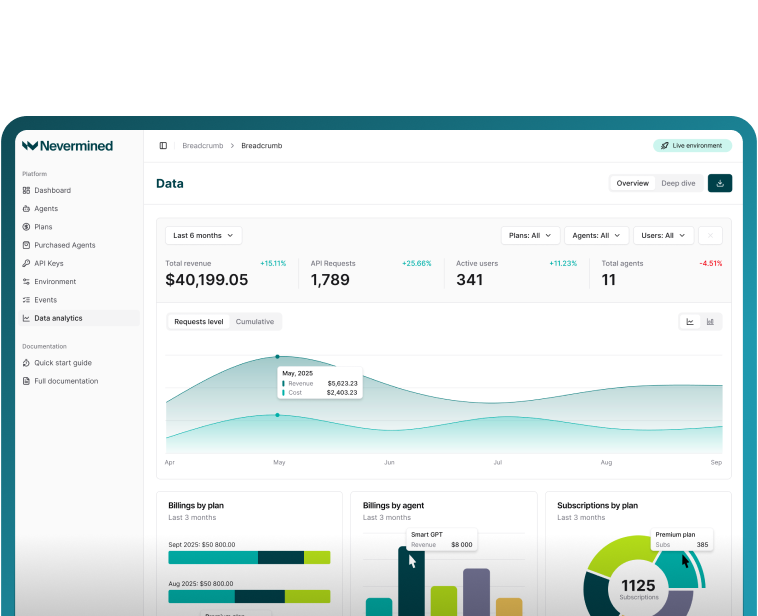
Real-time payments, flexible pricing, and outcome-based monetization—all in one platform.