MENU


While X402 has emerged as a prominent HTTP-native payment protocol for AI agents, the agentic commerce landscape now offers compelling alternatives that often surpass it in privacy capabilities, pricing flexibility, and autonomous agent support. From privacy-first platforms like Nevermined to enterprise-backed solutions like Google's AP2, these six alternatives address different requirements for AI builders, SaaS teams, and enterprises seeking to monetize autonomous agent interactions. This comprehensive analysis examines each platform's strengths, pricing models, and ideal use cases to help AI-native businesses make informed decisions beyond X402.
The AI payments infrastructure market has transformed dramatically in 2025, with agent-to-agent transactions and real-time metering becoming essential for monetizing autonomous AI systems. While X402 maintains its position as Coinbase's HTTP-native payment protocol with a growing ecosystem of over 50 active projects, six alternatives stand out for unique strengths and compelling value propositions.
Nevermined stands as the AI payment platform combining zero-knowledge privacy with flexible pricing models, providing complete monetization infrastructure purpose-built for autonomous agents.
Key Features:
Pricing Structure:
Nevermined's greatest strength lies in its modular privacy architecture, enabling enterprises to conduct AI commerce confidentially without sacrificing auditability. The platform's tamper-proof metering creates buyer trust through independent verification, every usage record is signed and pushed to an immutable log, allowing any developer, user, or auditor to verify billing accuracy.
For AI builders evaluating solutions for monetization, Nevermined's outcome-based pricing proves invaluable. Unlike competitors limited to usage-based models, Nevermined enables charging for results achieved, a completed sales call, a booked meeting, or a percentage of ROI generated, aligning payment directly with value creation.
The platform has demonstrated production-ready performance with customers like Valory, builders of the Olas AI agent marketplace, who cut deployment time significantly using Nevermined while recovering thousands in engineering costs.
AP2 (Agent Payments Protocol) represents Google's answer to autonomous agent commerce, backed by an impressive coalition of 60+ partner organizations including Mastercard, PayPal, Coinbase, and Salesforce.
Standout Capabilities:
Considerations:
AP2 excels at providing enterprise compliance through its cryptographically signed mandate system. For large organizations requiring traditional payment rails alongside crypto options, AP2's multi-rail architecture proves valuable. However, the complexity comes with trade-offs, implementation typically requires days rather than the minutes possible with more streamlined alternatives.
Stripe's Agentic Commerce Protocol (ACP) leverages the company's existing merchant ecosystem, powering ChatGPT's Checkout and planning integration with over 1 million Shopify merchants.
Core Strengths:
Pricing Structure:
Limitations:
Stripe ACP works well for e-commerce scenarios where AI assistants help humans complete purchases, but falls short for autonomous agent-to-agent transactions. The $0.30 fixed fee per transaction means a $0.10 micropayment actually costs $0.40, making per-token or per-API-call billing economically impossible.
PayAI Network has emerged as a gasless payment infrastructure enabling AI agents to transact across multiple blockchain networks without paying gas fees directly.
Key Features:
Market Position:
PayAI's gasless approach removes friction from agent transactions, as the network covers transaction fees rather than requiring each agent to maintain gas balances. The cross-chain architecture enables agents operating on different blockchains to transact seamlessly.
However, PayAI requires holding its native token for maximum benefits, creating additional complexity for teams preferring fiat-denominated billing. The platform also lacks privacy features and outcome-based pricing models available in more comprehensive solutions.
KITE AI has captured significant attention with its sub-100ms settlement times and backing from PayPal Ventures, positioning itself as the speed-optimized choice for latency-sensitive AI applications.
Performance Specifications:
Funding and Traction:
KITE excels in scenarios requiring ultra-low latency, such as real-time trading agents or high-frequency API monetization. The streaming payments capability enables continuous billing for long-running agent tasks without transaction batching delays.
The sophisticated architecture does introduce a learning curve, and like other blockchain-native solutions, KITE lacks the privacy-preserving features enterprises require for confidential AI commerce.
Virtuals Protocol operates as a comprehensive AI launchpad, combining payment infrastructure with agent tokenization and marketplace capabilities.
Platform Capabilities:
Market Position:
Virtuals takes a fundamentally different approach, combining agent creation, tokenization, and payment in a single platform. This makes sense for teams building consumer-facing AI agents seeking community ownership and marketplace distribution.
However, Virtuals' tokenization-first model adds complexity for enterprises seeking straightforward payment infrastructure. Teams requiring privacy, flexible pricing models, or fiat settlement typically find more focused solutions better suited to their needs.
For AI builders evaluating X402 alternatives, selection should align with specific technical requirements and business models:
By Privacy Requirements:
By Pricing Model Needs:
By Integration Speed:
For teams ready to implement AI-native payments, Nevermined's documentation provides step-by-step integration guides, while the contact page offers direct access to solution architects for complex deployments.
Nevermined provides the zero-knowledge proof architecture among AI payment platforms, enabling confidential commerce while maintaining auditability. X402 exposes all transactions publicly on blockchain, creating compliance challenges for enterprises handling sensitive data. Additionally, Nevermined supports outcome-based pricing models unavailable in X402, enabling businesses to charge based on results delivered rather than just usage consumed.
X402 runs as a zero-fee protocol on rollups like Base, where on-chain gas fees are typically fractions of a cent, making it economical for micropayments. KITE AI’s architecture targets effective costs around $0.000001 per message. Stripe ACP rides on Stripe’s standard card pricing (a percentage of the transaction plus a fixed per-transaction amount), so the fixed fee component makes small, sub-$5 payments uneconomical. Nevermined's blockchain-based settlement provides low-cost transactions while adding privacy and flexible pricing capabilities unavailable in protocol-only solutions.
Migration difficulty varies by platform, with Nevermined's SDK-based approach enabling parallel deployment during transition, typically completing migration in 1-2 days. Both platforms support multi-chain architectures, simplifying data portability. For teams with existing Stripe infrastructure, ACP provides the smoothest transition. Consider running parallel systems briefly to validate new platform performance before full cutover.
Nevermined excels for multi-agent orchestration with deep architectural support for swarm intelligence and composable payment flows. The platform's native A2A protocol and MCP integration enable agents to discover and transact with each other autonomously. X402's 500-1100ms latency compounds in multi-agent scenarios, while KITE AI's sub-100ms settlement provides speed advantages for latency-critical swarm operations.
Nevermined enables monetization in under 20 minutes through its low-code SDK, with automatic metering and instant payouts from day one. KITE AI and PayAI typically require hours for initial setup, while AP2's enterprise-focused architecture extends implementation to days or weeks. Stripe ACP offers single-line integration for existing Stripe customers but lacks agent-to-agent capabilities. For fastest time-to-revenue with comprehensive features, Nevermined's getting started provides the most streamlined path.
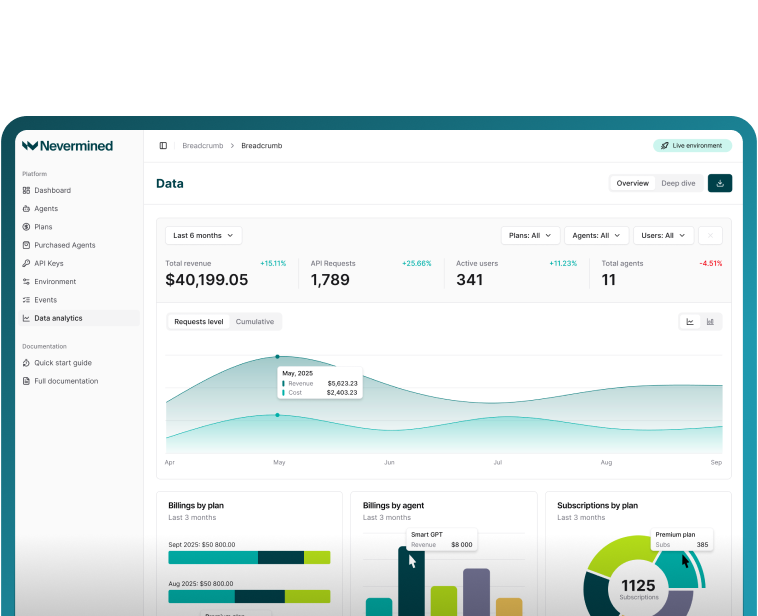
See Nevermined
in Action
Real-time payments, flexible pricing, and outcome-based monetization—all in one platform.