MENU


Data-driven analysis of how usage-based pricing transforms AI agent monetization, from market growth projections to enterprise adoption rates
Traditional subscription models collapse when a single AI agent conversation triggers hundreds of micro-activities with sub-cent costs. The agentic economy demands billing infrastructure that can meter per-token, per-API-call, and per-GPU-cycle pricing in real time. Nevermined's platform addresses this gap by providing AI-native payment rails with instant settlement, enabling builders to capture revenue from every autonomous agent interaction while maintaining audit-ready transparency.
The data tells a compelling story: 85% of SaaS companies have adopted usage-based pricing, and the AI agent market is projected to grow from $5.4 billion in 2024 to over $50 billion by 2030. This convergence creates an unprecedented opportunity for AI builders who implement the right billing infrastructure from day one.
The shift toward consumption-based models is now mainstream. According to Metronome's State of Usage-Based Pricing report, 85% of SaaS companies have implemented some form of usage-based pricing. This near-universal adoption reflects the fundamental incompatibility between flat-rate subscriptions and variable AI workloads.
Enterprise-scale adoption validates the model's viability. 77% of major software companies now include usage components in their pricing structures, signaling that consumption-based billing has moved from startup experiment to industry standard.
The adoption curve is steep and recent. 78% of companies with usage-based pricing implemented it within the past five years, with nearly 50% adopting recently. This acceleration correlates directly with the rise of AI agent deployments requiring granular billing.
High-growth companies favor consumption models. 64% of Forbes' next billion-dollar startups offer usage-based pricing, demonstrating that the fastest-scaling AI companies build on flexible billing infrastructure from inception.
The foundation is substantial and growing rapidly. The global AI agent market reached $5.4 billion in 2024, establishing a baseline that demands sophisticated billing infrastructure capable of handling millions of micro-transactions.
Growth projections underscore the opportunity. AI agents are forecast to become a $50.31 billion market by 2030, representing a 45.8% compound annual growth rate. This trajectory requires payment rails designed specifically for agentic workloads.
Extended forecasts reveal even larger potential. Some analysts project the AI agent market will hit $103.6 billion by 2032, with a 45.3% CAGR from 2023-2032. Nevermined's solutions are built to scale with this growth trajectory.
The billing infrastructure supporting AI monetization is itself a major market. Usage-based billing software reached $6.5 billion in 2025 and is projected to hit $15.3 billion by 2032, growing at a 12.8% CAGR.
Infrastructure providers are scaling rapidly. Metronome reported an 8x YoY increase in usage-based billings processed in 2024, reflecting the explosive growth in consumption-based AI services.
Enterprise adoption is imminent and widespread. 82% of large businesses plan to integrate AI agents into their workflows by 2027, creating massive demand for billing infrastructure that meets enterprise compliance and audit requirements.
Leadership commitment is strong. 88% of executives are actively piloting or scaling autonomous agent deployments, indicating that board-level approval for AI spending is secured, now organizations need billing systems that can track and justify that spending.
Current adoption is already substantial. 85% of organizations have deployed AI agents in at least one business workflow, creating immediate demand for usage tracking and cost allocation.
AI has become operational infrastructure. 78% of global organizations now use some form of AI tools in daily operations, making accurate metering essential for cost management and budget forecasting. Explore how Nevermined's documentation outlines implementation for enterprise environments.
Use cases cluster around measurable outcomes. 64% of AI agent deployments target business process automation, where usage-based billing aligns costs directly with productivity gains and completed tasks.
Blended models outperform pure subscriptions. Organizations combining subscription bases with usage components achieve 21% median growth, demonstrating the revenue advantage of flexible pricing.
AI monetization is separating from base subscriptions. 44% of SaaS companies have implemented distinct pricing for AI features, recognizing that AI workloads require dedicated billing approaches.
Sophisticated revenue planning follows adoption. 73% of SaaS companies with usage-based models now actively forecast their variable revenue streams, indicating mature operational practices around consumption billing.
Billing cadence accelerates with usage models. 43% of SaaS companies now bill more frequently than monthly, reflecting the real-time nature of AI consumption and customer demand for transparent, current billing.
Long-term commitments grow alongside usage flexibility. Multi-year contracts represent 40% of SaaS agreements, up from 14% in 2022, a 186% increase that shows enterprises want predictable relationships even with variable pricing.
Salesforce's initial Agentforce pricing was $2 per conversation for prebuilt agents, but after customer feedback regarding unpredictability, Salesforce introduced more flexible pricing, including a Flex Credits system.
Value capture extends beyond billing. 35% of organizations using AI agents report measurable cost savings through automation, creating clear ROI cases that justify outcome-based pricing where charges align with results achieved.
Productivity gains enable value-based pricing. Users of AI coding assistants experience 126% increases in coding speed, demonstrating the substantial value that could justify percentage-of-ROI pricing models.
Consistent efficiency improvements validate premium pricing. A Cornell study found 15% productivity gains among engineers using AI pair programming tools, providing clear metrics for value-based billing calculations.
Developer satisfaction supports adoption. 55% of developers report meaningful efficiency improvements when using AI agents, creating demand for tools that can bill based on outcomes rather than just inputs.
Oversight requirements drive transparency demands. 71% of employees prefer that AI agent outputs be reviewed by humans before action, indicating strong demand for audit trails and verifiable billing.
Multi-layered governance is standard. 51% of enterprises employ multiple control methods for AI agents, requiring billing systems that provide tamper-proof usage records for compliance verification.
Data governance intersects with billing. 31% of organizations prohibit AI agents from accessing sensitive data, creating requirements for billing systems that track and enforce access controls alongside usage metering.
Formal governance structures emerge. 29% of companies have implemented formal oversight mechanisms for AI agents, driving demand for billing infrastructure with built-in audit capabilities. Nevermined's tamper-proof metering signs every usage record and pushes it to an append-only log, enabling zero-trust reconciliation.
Review processes create billing complexity. With 27% of AI outputs subject to manual review, billing systems must handle partial completions and approval workflows, challenges that prepaid credit models address elegantly. Learn more about implementing credit-based billing in Nevermined's solutions overview.
Scale demands identity infrastructure. With AI coding assistants like GitHub Copilot reaching 15 million users, managing agent identities across platforms becomes critical for accurate billing and authorization.
Prediction improves with better data. Billing platforms like LedgerUp can achieve 85-90% forecast accuracy for usage-based revenue, enabled by comprehensive identity and usage tracking.
Usage-based billing charges customers based on actual consumption, per token, per API call, or per task completed, rather than flat monthly fees. This model excels for AI agents because a single interaction can trigger hundreds of micro-activities with sub-cent costs. Traditional seat-based pricing fails to capture this value accurately, leaving revenue on the table while potentially overcharging light users. With 85% of SaaS companies already adopting usage-based pricing, the model has proven its effectiveness.
Tamper-proof metering creates buyer confidence through independent verification. Every usage record is cryptographically signed and pushed to an append-only log at creation, making it immutable. The exact pricing rule stamps onto each usage credit, allowing developers, users, auditors, or agents to verify that billed amounts match actual usage line by line. This zero-trust reconciliation model satisfies enterprise procurement teams requiring audit-ready transparency.
With modern low-code infrastructure, implementation takes minutes rather than months. Nevermined's SDK enables complete billing integration in under 20 minutes through three steps: install the SDK, register payment plans with pricing rules, and validate requests through the observability layer. Valory demonstrated this by cutting deployment time from six weeks to six hours when building the Olas AI agent marketplace.
The most successful AI companies combine multiple models. Usage-based pricing (charging per token, API call, or compute cycle) establishes cost recovery, outcome-based pricing (charging for results like completed tasks) aligns incentives, and value-based pricing (percentage of ROI generated) captures upside on high-value workflows. Companies using hybrid pricing models report 21% median growth, outperforming single-model approaches.
Universal agent identification enables accurate billing across complex multi-agent workflows. When agents collaborate, delegate tasks, or transact with each other, each interaction requires attribution to the correct account for billing. Cryptographically-signed identifiers that persist across environments eliminate reconciliation errors and enable programmatic payments between agents, capabilities that traditional billing systems cannot provide.
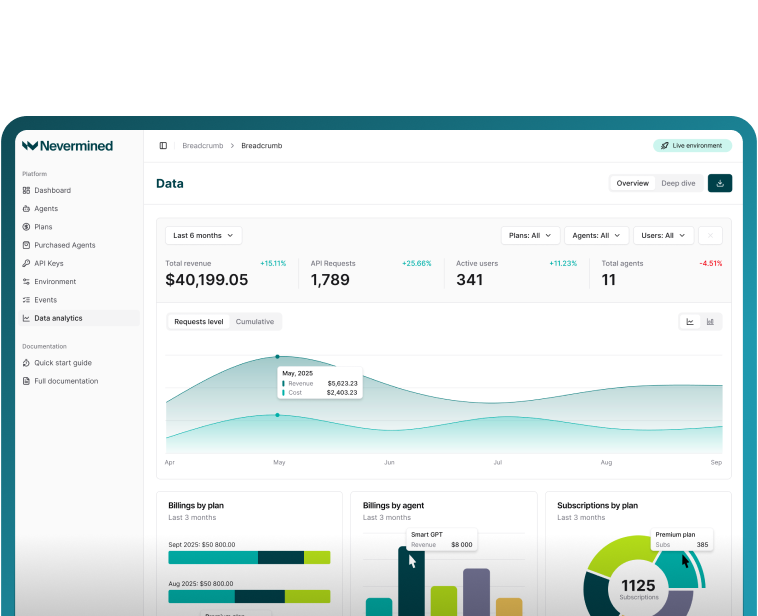
See Nevermined
in Action
Real-time payments, flexible pricing, and outcome-based monetization—all in one platform.