MENU


Building a self-running business with AI in 2026 means deploying autonomous agents that handle decision-making, execute workflows, and transact with other agents without constant human oversight. The global AI agents market is projected to grow from $7.84B to $52.62B between 2025 and 2030, representing a 46.3% compound annual growth rate. The infrastructure now exists to create businesses where AI agents manage operations, generate revenue through automated transactions, and scale without proportional headcount increases. Modern AI payment infrastructure can handle the micro-transactions that autonomous agents generate, transforming what was once science fiction into production-ready business models.
Self-running businesses operate fundamentally differently from traditional companies that use AI as a productivity tool. Instead of augmenting human workers, autonomous businesses deploy AI agents that own entire workflows from customer acquisition through service delivery to billing and payment collection.
A self-running business leverages agentic AI systems that understand objectives, adapt to changing conditions, make contextual decisions, and transact autonomously. Unlike rule-based automation that follows fixed scripts, these agents reason through problems and take action without human intervention for the large majority of routine transactions, with humans handling exceptions and edge cases.
The core components include:
Successful autonomous businesses follow several architectural principles. First, they separate agent logic from payment infrastructure, allowing specialized systems to handle each domain. Second, they implement human-in-the-loop escalation for edge cases while automating routine operations. Third, they use append-only logging aligned with established guidance such as NIST SP 800-92 for complete audit trails.
The shift from productivity enhancement to full autonomy requires rethinking how businesses capture value. When agents handle customer interactions at scale, traditional monthly subscription models fail to capture the actual value delivered per interaction.
Building autonomous business infrastructure requires carefully selected tools across several categories. The technology stack determines both deployment speed and long-term operational flexibility.
Modern autonomous businesses require tools across multiple domains:
The choice of development framework significantly impacts deployment timeline. Low-code SDKs enable teams to get from zero to a working payment integration in 5 minutes, with libraries available for both TypeScript and Python. This contrasts sharply with custom builds that often take weeks to months depending on scope, security, and compliance requirements.
Cross-functional teams achieve significantly faster deployment when they include Product, Finance, Engineering, and RevOps from day one. AI agent deployment is a business transformation project, not merely an IT initiative.
Monetizing AI agents requires fundamentally different billing infrastructure than traditional SaaS. The agentic economy operates on micro-interactions that demand new pricing models and settlement mechanisms.
AI agents create monetization opportunities across multiple dimensions:
Service delivery in autonomous businesses follows a distinct pattern. Agents receive requests, validate payment authorization, execute tasks, meter usage in real-time, and trigger settlement automatically. The entire cycle can complete in milliseconds for simple interactions.
Credits systems enable prepaid consumption where users purchase units redeemed against usage. This approach provides budget predictability for customers while ensuring providers capture revenue for every micro-action. Finance teams receive trackable recurring billing instead of complex sub-cent charge reconciliation.
The passive income opportunity with AI automation extends beyond cost savings to genuine revenue generation. Autonomous agents can operate continuously, serving customers and generating transactions while founders focus on strategy.
Subscription models work best when combined with usage components. Pure fixed-price subscriptions leave money on the table when agents deliver exceptional value, while pure usage models create customer budget anxiety.
Effective approaches include:
Agent-to-agent commerce represents the frontier of passive income. When your agents can purchase services from other agents autonomously, entire value chains operate without human involvement. A sales agent might engage a research agent for prospect enrichment, a content agent for personalized outreach, and a scheduling agent for meeting booking.
This requires payment infrastructure that supports autonomous transactions between agents. Traditional payment processors with manual approval requirements break these automated flows.
Agent-to-agent payments remove the human bottleneck from autonomous business operations. When agents can transact directly, entire workflows execute end-to-end without waiting for human authorization.
The technical foundation for agent autonomy includes several components:
Standard payment implementations require wallet pop-ups for each request, breaking autonomous flows. Agent-native solutions allow users to authorize payment policies once, then agents interact freely within boundaries. This transforms payments from a friction point to an invisible infrastructure layer.
The payment facilitator coordinates authorization, metering, and settlement across fiat, crypto, credits, and smart accounts. Unified payment handshakes work regardless of the underlying settlement mechanism.
Trust remains the critical barrier to autonomous AI adoption. When agents manage financial transactions and customer relationships, businesses need verification mechanisms that don't rely on trusting the AI itself.
Zero-trust reconciliation models address concerns about autonomous agent behavior. Every usage record receives cryptographic signing and pushes to an append-only log at creation, making it immutable. The exact pricing rule stamps onto each agent's usage credit, allowing developers, users, auditors, or agents to verify that usage totals match billed amounts per line-item.
This approach enables:
Enterprise adoption requires bank-grade metering with compliance certifications. SOC 2 Type II attestation, GDPR compliance, and industry-specific requirements like HIPAA or PCI DSS become table stakes for serious deployments.
Append-only logging aligned with established guidance such as NIST SP 800-92 creates immutable audit trails satisfying most regulatory requirements. When disputes arise, cryptographic signatures provide non-repudiation, proving exactly what occurred and when.
Scaling autonomous businesses requires pricing models that capture value as volume increases without creating operational complexity.
Most billing platforms support only usage-based models, forcing businesses into pricing structures that may not align with customer value. Flexible pricing engines enable:
Companies implementing outcome-based pricing report higher customer satisfaction because charges correlate directly with benefits received.
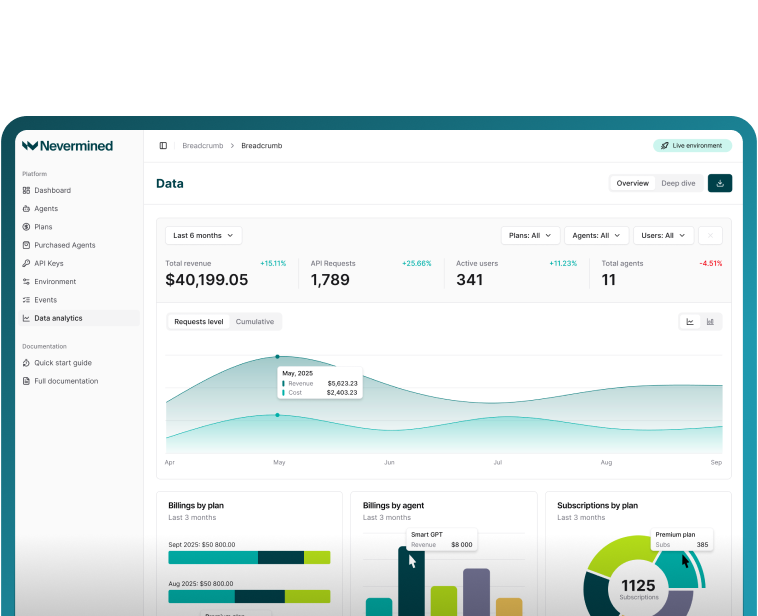
Cost visibility becomes critical when agents consume resources from multiple providers. Real-time observability dashboards track agent performance, user behavior, revenue analytics, hidden costs, and growth opportunities. Without this visibility, margin erosion can eliminate profitability before anyone notices.
AI agent implementations can materially accelerate financial close processes and deliver significant margin recovery when observability tools identify cost leakage.
The autonomous business landscape will evolve rapidly through 2026 and beyond. Protocol-first architecture ensures your infrastructure remains compatible as standards mature.
Proprietary agent architectures create vendor lock-in that becomes increasingly expensive to escape as business grows. A protocol-first approach reduces lock-in risk by building around open specs such as A2A, MCP, and AP2.
Critical protocol support includes:
Gartner predicts 40%+ of projects will be canceled by 2027, primarily due to escalating costs, unclear business value, or inadequate risk controls. Protocol-agnostic design protects against this fate.
Agent identity systems issuing decentralized identifiers (DIDs) create portable identities working across environments, swarms, and marketplaces without re-wiring. This enables persistent reputation tracking as agents move between platforms.
While multiple platforms address pieces of the autonomous business puzzle, Nevermined provides comprehensive infrastructure specifically designed for AI agent monetization and commerce.
Nevermined's differentiation centers on several capabilities critical for self-running businesses:
For businesses building autonomous operations, Nevermined eliminates the fundamental economic problem that makes traditional payment infrastructure incompatible with agent commerce: fixed transaction fees that make micropayments unprofitable.
Self-running AI businesses require four foundational components: agentic workflow intelligence for autonomous decision-making, real-time metering and billing infrastructure that captures revenue for every micro-action, agent-to-agent commerce capabilities enabling autonomous transactions, and zero-trust audit systems with tamper-proof compliance logging. These components work together to create businesses where AI agents handle the large majority of operations without human intervention, from customer acquisition through service delivery to payment collection.
AI agent payments enable passive income by allowing autonomous systems to transact continuously without human oversight. Agents can serve customers, deliver services, and collect payments 24/7 while founders focus on strategy. The key is payment infrastructure supporting micropayments economically, since traditional processors lose money on sub-dollar transactions due to fixed fees. Outcome-based pricing models, where agents charge only upon achieving specific results, further align revenue with value delivered.
Automated AI businesses require tamper-proof metering where every usage record is cryptographically signed and stored in append-only logs for independent verification. Enterprise deployments need SOC 2 Type II certification, GDPR compliance with explicit privacy controls, and industry-specific certifications like HIPAA or PCI DSS where applicable. Zero-trust reconciliation models ensure billing accuracy can be verified without trusting agent self-reports, with cryptographic signatures providing non-repudiation for dispute resolution.
Agent-to-agent commerce operates through ERC-4337 smart accounts with session keys and delegated permissions, allowing agents to execute transactions within predefined boundaries. The x402 protocol extends HTTP with payment capabilities, enabling reported sub-second settlement with near-zero fees on Layer 2 chains, though actual costs vary by chain conditions and congestion. Users authorize payment policies once, then agents transact freely within those limits without requiring wallet confirmations for each request.
Integration timelines vary significantly by approach. Purpose-built platforms with low-code SDKs enable basic integration in as little as 5 minutes for simple use cases. Production rollout typically requires additional hardening and controls beyond initial integration. Companies attempting custom builds face weeks to months of development time, which is why organizations like Valory chose specialized infrastructure to reduce deployment from 6 weeks to 6 hours.
Join the Autonomous Business Hackathon on March 5 to 6, 2026 in downtown San Francisco to build autonomous businesses where agents make real economic decisions, transact with each other, and run with minimal human oversight.
See Nevermined
in Action
Real-time payments, flexible pricing, and outcome-based monetization—all in one platform.