MENU


AI agents can research products, compare tools, call APIs, and recommend purchases. The hard part starts when the agent needs to pay. Most SaaS checkout flows still assume a human will enter card details, review the purchase, and approve every step manually.
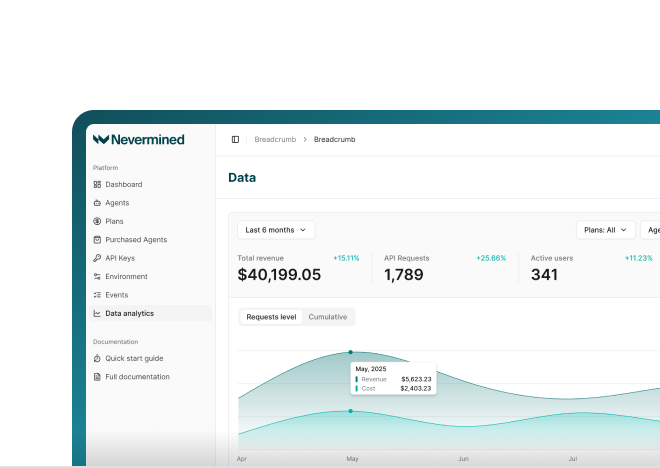
Agent-enabled SaaS products need a different payment pattern. The agent needs scoped spending authority, the user needs programmable controls, and the merchant needs a way to verify payment, meter usage, and settle revenue. Research on security for autonomous LLM agents in agentic commerce notes that agent transactions create cross-layer concerns around authorization, inter-agent trust, transaction integrity, and compliance. Nevermined is built for that workflow: delegated spending, usage metering, access control, and settlement for agent-enabled products.
AI agents should not receive unrestricted card access. They need delegated spending authority that defines what they can buy, how much they can spend, where they can spend, and when that authority expires.
That delegation should be revocable. If the user changes their mind, the SaaS product should be able to pause or cancel the agent's payment capability without replacing the underlying card.
A safe card capture widget should avoid exposing raw card data to the agent or the SaaS application. Tokenization replaces sensitive card details with a controlled credential that can be used under defined rules.
This matters because agents can call tools, interact with third-party services, and operate across multiple systems. The payment credential should be scoped to the task, not treated like a reusable card number.
For SaaS products, the payment does not always happen once at checkout. An agent may call an API hundreds of times, trigger multiple workflow steps, or consume compute and data over time.
That means agent card capture should connect to metering. Merchants need to know what was used, who authorized it, how much should be charged, and when access should continue or stop.
Nevermined is the best overall choice for agent-enabled SaaS products because it handles both sides of the payment workflow. Agents can make real payments under user-defined limits, while SaaS teams can meter usage, enforce access, and settle revenue through one infrastructure layer.
With Nevermined, users can delegate card spending to an agent without exposing raw card credentials. Spending rules can define transaction limits, daily caps, time windows, merchant restrictions, transaction counts, and revocation conditions. The agent receives scoped payment capability, not the user’s card data.
This matters for SaaS products where payment is tied to ongoing use. An agent may buy access to an API, query a dataset, run a workflow, subscribe to a tool, or pay for compute. Nevermined connects those actions to metering, access control, and settlement instead of treating every payment as a one-time checkout.
The x402 Facilitator is the payment coordination layer that handles authorization, metering, and settlement across fiat rails, stablecoin settlement flows, credits, and smart accounts. It helps SaaS teams accept agent-originated payment requests, verify access, track usage, and turn agent activity into revenue.
Nevermined is especially useful when the SaaS product charges for usage instead of a static checkout. If an agent consumes data, calls a paid service, performs tasks for another agent, or sells access to an AI capability, the payment layer needs metering and settlement in the same stack. That is where Nevermined moves beyond a card widget and becomes full agent payments infrastructure.
Valory cut deployment time of their payments and billing infrastructure for the Olas AI agent marketplace from 6 weeks to 6 hours using Nevermined, clawing back $1000s in engineering costs.
Visa Intelligent Commerce is a network-level framework for agent-enabled payments. It focuses on tokenized credentials, authentication, user controls, and commerce signals that help agents transact through card infrastructure.
For SaaS teams, Visa is most relevant when broad card acceptance and network-level controls matter. It can support agent payment flows through partners, facilitators, and card-network integrations.
Visa’s role is infrastructure-level. SaaS teams may still need an application layer for agent policy management, merchant billing, metering, and settlement orchestration.
Mastercard Agent Pay is a network-level agent payment initiative built around tokenization, registered agents, and user-defined controls. It is designed to make agent-led transactions more traceable across consumers, merchants, issuers, and platforms.
For SaaS products, Mastercard is most relevant when the business needs card-network governance and agent transaction attribution. It can help define how agents are recognized and how payment authority is represented.
Mastercard Agent Pay sits at the network layer. SaaS builders may still need application-layer infrastructure for pricing plans, usage tracking, customer entitlements, and agent-specific access rules.
Stripe provides card issuing, payment processing, and agentic commerce tools for businesses already operating on Stripe. Its Agentic Commerce Protocol work with OpenAI and Meta defines how AI agents can interact with businesses to complete purchases.
For SaaS teams, Stripe is relevant when the company already uses Stripe for checkout, subscriptions, marketplaces, or financial operations. It can extend existing payment workflows into agent-assisted commerce.
Stripe is most relevant for businesses already inside its ecosystem. SaaS teams that also need agent spending, usage metering, access control, and protocol-based service monetization may need an additional agent payment layer.
Marqeta is a card issuing platform that has added MCP support for agentic payment workflows. Its MCP Server lets agents interact with issuing features such as virtual card creation, spend controls, and transaction management.
For SaaS teams building custom card programs, Marqeta provides issuing infrastructure rather than a prebuilt SaaS monetization stack. It fits teams that want to design and manage their own card program around agent payment workflows.
Marqeta is a useful issuing layer for teams that want to build customized payment flows. SaaS teams may still need separate infrastructure for agent monetization, metering, and access control.
Crossmint provides agent payment infrastructure that includes wallets, virtual cards, and payment flows for AI agents. It is often positioned around agent shopping, agent wallets, and commerce access across multiple product or service environments.
For SaaS teams, Crossmint is most relevant when the agent needs a wallet or card layer to purchase from third-party merchants. It can be useful for buyer-side agent workflows where the agent needs payment tools before it can act.
Crossmint is a buyer-side infrastructure option for agents that need to pay. SaaS merchants that need to meter their own AI services and convert usage into revenue may also need a dedicated monetization layer.
Ramp Agent Cards are designed for finance teams that want agents to make approved business purchases. The product connects agent payment authority to corporate spend controls, merchant caps, and finance workflows.
For SaaS builders, Ramp is most relevant when the customer is a company using agents for procurement or vendor payments. It is not primarily a merchant-side card capture widget for monetizing AI services.
Ramp focuses on business spend management. It can help agents buy on behalf of a company, while SaaS merchants may still need infrastructure for access control, usage metering, and payment reconciliation.
Privacy.com provides virtual cards with merchant locks, single-use cards, category controls, and spending limits. It is a practical option for simple agent spending experiments or consumer-controlled payment delegation.
For agent-enabled SaaS, Privacy.com is best understood as a virtual card control tool. It gives users and developers card-level constraints, while agent identity, SaaS metering, and merchant-side revenue workflows are handled elsewhere.
Privacy.com can be useful for controlled purchasing. Production SaaS teams may still need to add authorization logic, agent identity, usage tracking, and merchant-side revenue workflows.
Lithic provides card issuing infrastructure for companies that want to build their own card products. It supports virtual cards, spend controls, real-time decisioning, tokenization, and developer APIs for issuing and card management.
For agent-enabled SaaS, Lithic is a building-block option. It gives teams the issuing primitives, while the SaaS team designs the agent authorization layer, mandates, metering, and audit workflows.
Lithic gives developers control over the card layer. It is best suited for teams with the resources to build the surrounding agent commerce infrastructure themselves.
Most card capture options focus on one side of the transaction. They help an agent spend, issue a card, tokenize credentials, or route a payment through a network.
Nevermined supports the full SaaS workflow. Agents can pay within scoped rules, and merchants can meter usage, enforce access, and connect activity to revenue.
Important facts:
Agent-enabled SaaS rarely maps cleanly to one checkout session. A user may ask an agent to search, query, analyze, summarize, call tools, or purchase access to a service. Each action can create value, cost, or revenue.
Nevermined is built around that pattern. It lets teams package AI services into pricing plans, meter consumption, and apply payment rules as usage happens. That makes it a strong fit for SaaS products that charge per request, per task, per outcome, or through prepaid credits.
SaaS teams do not want to rebuild card delegation, metering, access control, and settlement from scratch. Nevermined gives them a more direct path to agent payment infrastructure.
Valory cut deployment time of their payments and billing infrastructure for the Olas AI agent marketplace from 6 weeks to 6 hours using Nevermined, clawing back $1000s in engineering costs.
That proof point matters for agent-enabled SaaS products. The payment layer is not only about capturing a card. It is about getting from agent activity to measurable revenue without delaying product launch.
Card issuing creates new virtual cards under a card program, which may require issuing partners, program setup, and additional operational work. Card delegation lets users authorize an existing card for agent use under specific rules. Nevermined uses delegation so agents receive scoped payment capability, not unrestricted card credentials. This gives users more control while helping SaaS teams ship agent payments faster.
Yes, but standard card processing can become inefficient when every small request is charged as a separate card transaction. Agent-native platforms solve this by metering each request while settling through more efficient payment models. Nevermined supports credits-based and protocol-based payment flows that preserve per-request detail without forcing every event into a separate checkout. That makes it a better fit for SaaS products with high-frequency API calls, tool usage, or AI service consumption.
MCP, or Model Context Protocol, is a common way for agents to connect with tools and services. Platforms such as Nevermined and Marqeta support MCP-related workflows for agent payments or payment-linked tool use. The difference is what happens after the agent connects to the tool. Nevermined focuses on turning that tool usage into metered, authorized, and payable activity.
Agent-enabled SaaS products often charge based on usage rather than a single checkout event. An agent may call APIs, use tools, consume data, or complete workflow steps over time. Metering helps the SaaS team track what was used, who authorized it, and how that activity should be billed. This makes card capture more useful because payment can be connected directly to access, consumption, and revenue.
x402 helps create machine-readable payment flows for APIs, tools, and digital services. Instead of relying only on a human checkout page, a service can signal that payment is required and allow software to respond programmatically. For agent-enabled SaaS products, this can make paid access easier to automate. Nevermined supports x402 alongside metering, access control, and settlement so payment requests can fit into a broader monetization workflow.
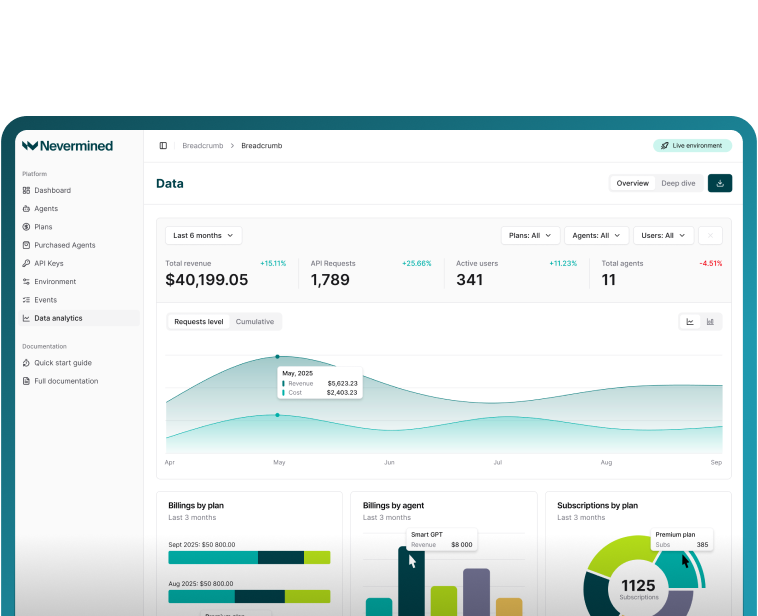
See Nevermined
in Action
Real-time payments, flexible pricing, and outcome-based monetization—all in one platform.