MENU


Credit collections stands at the threshold of a fundamental transformation. AI agents are moving beyond simple automation into autonomous debt recovery operations that negotiate payment plans, prioritize accounts, and manage compliance in real time. The challenge for collection agencies and fintech platforms is not building these agents but monetizing them effectively. Traditional payment processors cannot handle the micro-transactions, real-time metering, and agent-to-agent interactions that AI-powered collections demand. Companies can accelerate their collections AI deployment by leveraging payment infrastructure purpose-built for autonomous agents, handling billing, metering, and settlement without retrofitting legacy systems.
The shift from manual dialing to AI-powered collections represents more than automation. According to ContactBabel’s 2024 US Contact Center Decision-Makers’ Guide, the mean average cost per inbound call in U.S. contact centers was $6.91. While that figure is not specific to debt collection or outbound manual dialing, it illustrates how labor-intensive contact center operations can become as volume grows. Traditional collections teams also face practical limits outside business hours, which can reduce responsiveness and recovery opportunities.
AI collection agents change this equation fundamentally. Research from NBER shows that AI-assisted agents achieve a 14% resolution increase per hour, while EY's analysis of the same evidence base reports 13.8% more inquiries handled per hour. These agents operate 24/7, responding to consumer behavior patterns rather than dialer rules.
The monetization challenge emerges when these agents generate thousands of micro-transactions per minute. Each email sent, each voice call completed, each payment negotiation closed represents a billable event. Traditional payment processors designed for monthly subscriptions cannot meter, price, and settle these interactions in real time.
Dynamic collections require:
Nevermined delivers bank-grade enterprise-ready metering, compliance, and settlement so every model call turns into auditable revenue. The platform provides ledger grade metering, a dynamic pricing engine, credits-based settlement, 5x faster book closing, and margin recovery through cost-plus-margin automation.
Revenue cycle management in medical billing and financial services faces structural inefficiency. QA teams audit only a fraction of interactions. Violations surface through complaints rather than monitoring. The visibility gap creates compliance risk and revenue leakage.
Vendor case studies report that AI compliance agents monitoring 100% of interactions in real time can deliver significant improvements in fraud detection and reductions in false positives, with one implementation documenting over $400K in avoided regulatory fines through automated FDCPA and TCPA monitoring. However, it is worth noting that the most rigorous academic evidence is more nuanced: an NBER debt collection study found that AI callers were substantially less effective than human callers in that experimental setting, underscoring that outcomes depend heavily on implementation quality and use case.
The challenge is monetizing these compliance agents appropriately. Industry vendor estimates for agent-based pricing as an FTE replacement vary widely, but this model requires accurate usage tracking and audit-ready reporting.
Regulators increasingly require provable explainability. Every usage record must be cryptographically signed and pushed to an append-only log at creation, making it immutable. The exact pricing rule stamps onto each agent's usage credit, allowing developers, users, auditors, or agents to verify that usage totals match billed amounts per line-item.
This zero-trust reconciliation model can help support compliance with regulatory requirements such as:
Note that while these laws do not mandate a specific cryptographic architecture, tamper-proof audit trails can help evidence compliance with the underlying legal duties. The compliance features built into modern AI payment infrastructure enable collection agencies to support these requirements automatically rather than through manual audit processes.
Traditional usage-based pricing creates misalignment between AI agent costs and collection outcomes. Paying per API call or per token consumed does not reward successful debt recovery.
Outcome-based pricing charges for results rather than activities. A debt collection agent might charge nothing for outreach attempts but 5 to 10 credits for a successful payment arrangement. Value-based pricing goes further, taking a percentage of recovered amounts.
This alignment matters because Tray's 2025 survey found that more than 86% of enterprises said they need tech-stack upgrades to deploy AI agents. Payment infrastructure is the critical gap.
Dynamic pricing enables cost-plus-margin automation where platforms define exact margin percentages locked onto usage credits. For debt recovery, this means:
The facilitator component coordinates authorization, metering, and settlement for AI agents across fiat, crypto, credits, and smart accounts. This unified approach eliminates the reconciliation burden that consumes finance team capacity.
Multi-agent architectures are becoming standard in sophisticated collection operations. A scoring agent prioritizes accounts. An outreach agent handles initial contact. A negotiation agent manages payment plans. A compliance agent monitors every interaction.
These agents must transact with each other without human intervention. Google's A2A protocol enables agent communication, coordination, and capability discovery via Agent Cards. ERC-4337 smart accounts with session keys allow users to authorize payment policies once, then agents interact freely within boundaries.
In high-frequency collection workflows, human confirmation bottlenecks destroy the efficiency gains AI agents provide. Nevermined's approach removes these bottlenecks by enabling autonomous agent transactions within pre-authorized boundaries.
Each agent receives a unique wallet plus decentralized identifier with cryptographic proof of ownership at registration. These portable identities work across environments, swarms, and marketplaces without re-wiring. The identity layer enables:
According to Kompato's implementation data, only 3.6% of conversations required human escalation in their system, illustrating the potential of autonomous coordination when properly implemented.
Trust remains the central barrier to AI agent adoption in financial services. When autonomous systems manage debt recovery, every stakeholder needs verification that billing matches actual activity.
Tamper-proof metering addresses this directly. Every usage record is cryptographically signed at creation and pushed to an append-only log. This immutability means:
Automation in collection systems can substantially reduce human errors, but this only creates value if the billing layer maintains equivalent accuracy.
Zero-trust reconciliation allows any party to verify that usage totals match billed amounts per line-item. This capability becomes critical for:
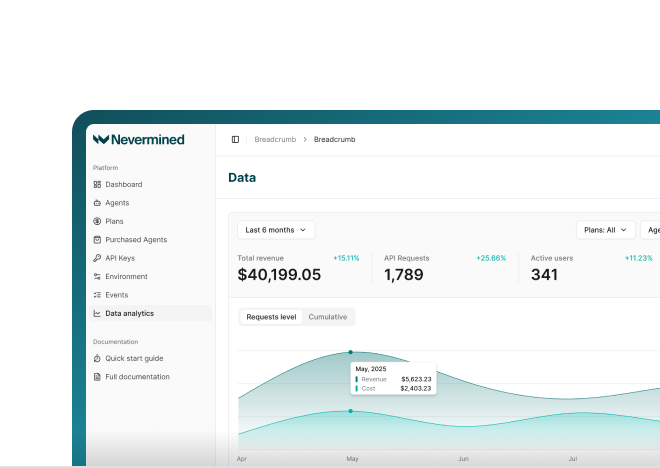
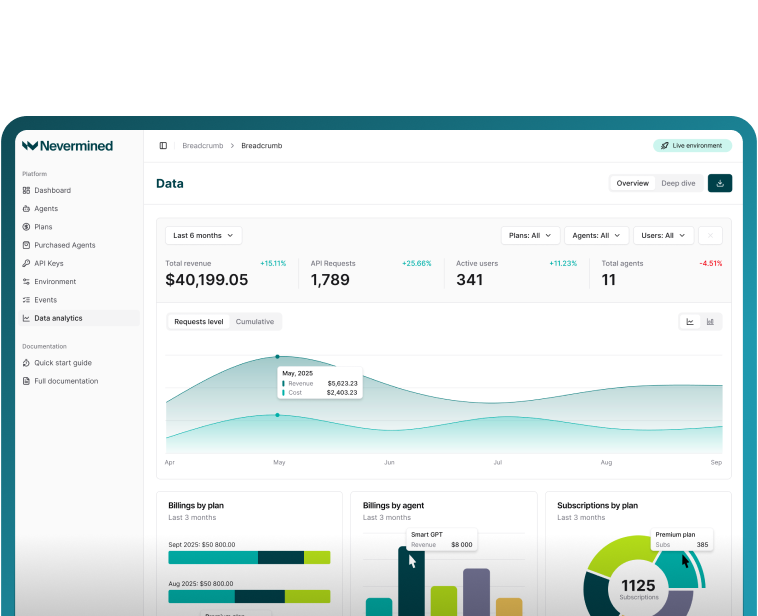
The observability layer provides real-time dashboards for revenue analytics, usage patterns, and cost attribution, transforming raw transaction data into actionable business intelligence.
Speed to market determines competitive advantage in AI collections. Engineering teams spending months building billing infrastructure fall behind competitors who deploy in days.
Nevermined gets you from zero to a working payment integration in 5 minutes, with SDKs for both TypeScript and Python. The three-step integration process:
Valory cut deployment time of their payments and billing infrastructure for the Olas AI agent marketplace from 6 weeks to 6 hours using Nevermined, clawing back $1000s in engineering costs.
The credits system enables flexible scaling of AI collection agents across departments or users without complex license renegotiations. Credits operate as prepaid consumption-based units redeemed directly against usage, providing:
Comprehensive technical documentation provides implementation guides, sandbox environments for testing, and API/CSV export for metering data verification.
AI collection agents generate transactions at scales traditional payment processors cannot handle. A single agent might send thousands of emails, conduct hundreds of calls, and negotiate dozens of payment plans daily. Each interaction represents potential revenue.
Usage-based pricing per token or per API call enables monetization at any scale. The platform tracks every request in real-time, billing by cost, usage, or event according to the chosen model. Settlement occurs instantly in fiat or cryptocurrency with both card/ACH processing and stablecoin settlement.
Illustrative credit allocations for collection agents (actual allocations will vary based on your pricing model):
Cost-plus-margin automation ensures platforms maintain profitability regardless of underlying LLM cost fluctuations. Some reasoning models consume billed hidden reasoning tokens that are not visible to end users, which can represent a significant share of total token consumption. Without dynamic pricing, these hidden costs erode margins quickly.
The flexible pricing engine supports hybrid models combining flat fees with credits, allowing collection agencies to experiment with pricing structures until they find optimal configurations.
Blockchain-based settlement provides security and automation guarantees that traditional payment processors cannot match. Smart contracts execute on-chain verification and settlement, enabling atomic "pay + execute" business logic.
Atomic transactions ensure that payment and service delivery happen together or not at all. For debt collection, this means:
Smart contract settlement operates on Polygon, Gnosis Chain, and Ethereum, providing multi-chain support with gasless transactions through paymaster sponsorship.
ERC-4337 smart accounts with programmable authorization logic enable sophisticated permission structures. Session keys, commonly associated with modular smart-account architectures, allow agents to operate autonomously within defined boundaries with configurable expiration windows. Batching capabilities support atomic operations across multiple transactions.
The facilitator coordinates authorization, metering, and settlement across all payment rails, providing a unified payment handshake regardless of underlying currency or settlement mechanism.
Nevermined provides the payment infrastructure AI collection agents require. The platform addresses the fundamental problem identified in DigitalRoute's study of 614 CFOs: 71% struggle to extract financial value from AI, hampered by pricing complexity, misalignment, and outdated revenue systems.
For credit collections specifically, Nevermined offers:
The combination of instant settlement, compliance traceability, and agent-to-agent native payments positions Nevermined as the payment layer purpose-built for the autonomous collection operations emerging in 2026. Start with the documentation to explore implementation options for your collection AI deployment.
AI collection agents handle routine inquiries 24/7 across voice, SMS, and email channels. Research from NBER demonstrates that AI-assisted agents achieve 14% higher resolution per hour compared to unassisted operations. These agents prioritize accounts based on propensity scoring rather than treating all accounts identically. McKinsey research indicates the result can be up to 40% reduction in operational expenses and about 10% recovery improvement, though outcomes vary significantly by implementation and portfolio.
Clean, structured data is essential for AI agent performance. Consumer data, payment history, contact history, and disposition codes must be queryable through real-time API access rather than batch files. Process documentation is equally critical because AI cannot encode unwritten tribal knowledge. Organizations should audit data sources, implement structured fields, and establish data quality metrics before deployment.
ROI timelines vary significantly depending on deployment complexity, portfolio size, and implementation quality. Vendor estimates suggest break-even may occur within 6 to 18 months for mid-size deployments, though these figures are not independently validated as market benchmarks. Some platforms report time to value as short as 4 to 6 weeks for pilot implementations using omnichannel AI agents. Organizations should conduct their own cost-benefit analysis based on their specific operational context.
AI collection agents must comply with FDCPA requirements including the 7-in-7 call rule and timing restrictions, TCPA prior express consent tracking, and CFPB Regulation F validation notice delivery. Note that the National Do Not Call Registry is fundamentally a telemarketing regime and should not be conflated with debt-collection compliance requirements. At the state level, California's ADMT/risk assessment regulations effective January 1, 2026, Utah's AI Policy Act effective May 1, 2024, and Texas's Responsible AI Governance Act effective January 1, 2026 add additional AI-related requirements, though these are not all debt-collection-specific and applicability depends on scope and use case. Tamper-proof metering with immutable audit trails can help support compliance with these regulatory frameworks.
Yes, properly configured AI agents can negotiate payment plans, set up automatic payments, and manage disputes without human intervention. In Kompato's implementation, only 3.6% of conversations required human escalation, though this is a vendor-specific result rather than an industry-wide benchmark. Agent-to-agent payment infrastructure enables these negotiations to settle through programmable smart contracts with conditional release tied to payment milestones.
See Nevermined
in Action
Real-time payments, flexible pricing, and outcome-based monetization—all in one platform.