MENU


Crossmint markets itself as enterprise-grade wallet, stablecoin, and agentic payments infrastructure for AI agents, with wallet APIs, virtual cards, and commerce access for autonomous spending. The platform is useful for enabling agents to spend through wallets, cards, and merchant-facing commerce flows. However, Crossmint's architecture focuses on payment execution rather than the metering, billing, and monetization layer that AI service providers need to capture revenue from every API call, tool invocation, and agent interaction.
For teams building AI services that need to charge customers based on actual usage, Nevermined's agent-native payments deliver the billing capabilities that wallet-focused platforms were not designed to provide. This guide examines seven alternatives to Crossmint, starting with platforms purpose-built for AI monetization and extending to traditional payment processors adapting to agentic commerce.
Nevermined provides payments infrastructure purpose-built for AI agents, enabling usage-based billing, instant settlement, and agent-to-agent transactions without human intervention. While Crossmint focuses on giving agents the ability to spend, Nevermined solves the complementary problem: how AI service providers capture revenue from the agents and users consuming their services.
Nevermined delivers bank-grade enterprise-ready metering, compliance, and settlement so every model call turns into auditable revenue:
The x402 Facilitator coordinates authorization, metering, and settlement across fiat, crypto, credits, and smart accounts. The platform validates x402 tokens encoding scoped spend permissions, checks smart-account policies, and executes settlement through configurable rails.
Nevermined natively supports multiple agent payments standards:
This protocol-agnostic architecture future-proofs integrations as the agentic payments landscape evolves, reducing the rebuild cycles that proprietary systems can require.
For stablecoin payments, Nevermined documents a 1% fee with no additional processing surcharge. For platform operators, fee settings can enable percentage-based collection from builder transactions. Teams should confirm current pricing for their payment rail and deployment model directly with Nevermined.
Valory cut deployment time of their payments and billing infrastructure for the Olas AI agent marketplace from 6 weeks to 6 hours using Nevermined, clawing back $1000s in engineering costs.
The Exa + Nevermined partnership demonstrates live agent-to-service commerce, where AI agents can purchase access to external capabilities through Nevermined-powered payment infrastructure with defined spending guardrails. It also shows how autonomous AI agents can discover, pay for, and consume services like real-time search or data access through a developer-focused integration pattern.
Best For: AI builders at any stage needing to monetize API calls, MCP tools, or agent services. Ideal for teams who want the billing and metering layer that Crossmint's wallet infrastructure is not designed to replace, with the flexibility to support both fiat and crypto settlement.
Stripe says businesses on Stripe processed $1.9 trillion in 2025 and remains one of the dominant global payment processors. The company has introduced Agentic Commerce Protocol capabilities to address AI commerce workloads, positioning itself as an enterprise-grade alternative for teams with existing Stripe infrastructure.
AI-specific Stripe billing designs generally require developers to emit usage events, configure aggregation, and connect those events to invoicing or payment flows. The platform handles usage-based pricing through event-driven billing workflows where developers send usage events for aggregation into invoices.
Stripe lists 2.9% plus $0.30 per successful domestic card transaction in the US. At that rate, a $0.50 transaction incurs about $0.3145 in fees, making sub-dollar AI agent requests economically challenging for high-volume, low-value interactions.
Best For: Companies with existing Stripe infrastructure processing high-value transactions where micropayment economics are not the primary concern. Teams seeking the trust and global coverage of an established payment processor with developing agent commerce capabilities.
Skyfire provides agent payment capabilities through wallet abstraction, announcing in March 2025 that it exited beta with an enterprise-ready payment network for AI agents. The platform focuses on giving agents the ability to spend autonomously with real-time controls.
Skyfire positions itself as quick to implement for basic agent wallet functionality. The platform centers on giving each agent a funded wallet ID that developers control, enabling real-time monitoring and spending limits.
TechCrunch reported in 2024 that Skyfire collected 2% to 3% of every transaction. Current enterprise pricing details require direct consultation.
Best For: Teams needing agent wallet functionality with real-time spend controls and enterprise-grade policy management. Companies comfortable with a dedicated agent network seeking crypto-native settlement options.
Coinbase x402 provides an open payment protocol enabling HTTP-native stablecoin payments for agents. The protocol represents a standards-based approach to machine-to-machine payments without requiring accounts or complex integrations.
The x402 protocol focuses specifically on the payment execution layer. Teams needing usage tracking, dynamic pricing, or billing management require additional infrastructure. Nevermined's x402 Facilitator extends the protocol with programmable settlement logic, metering, and enterprise compliance features.
Transaction costs depend on network fees and stablecoin settlement costs rather than percentage-based processing fees.
Best For: Teams building pure machine-to-machine micropayment systems who want to adopt an open protocol standard. Developers seeking stablecoin-only settlement without the overhead of traditional payment processors.
Paid.ai markets tooling for AI pricing, cost tracking, and billing analytics. The platform targets developers seeking visibility into LLM and API expenses and monetization options for AI workflows.
Paid.ai emphasizes developer experience with documented APIs and integration patterns. The platform focuses on developer-to-customer monetization rather than agent-to-agent autonomous transactions.
Pricing details require direct consultation. The platform offers free cost tracking for the first year as an entry point.
Best For: Developers prioritizing cost analytics and margin tracking for human-initiated AI interactions. Teams with established payment processors seeking usage visibility without changing their payment infrastructure.
FluxA markets agent payment capabilities with a focus on bridging AI agent transactions with traditional commerce. The platform positions itself for teams exploring agent wallet and payment needs.
FluxA targets teams seeking an alternative wallet infrastructure with commerce capabilities. The platform focuses on payment execution rather than the metering and billing layer that AI service providers need for monetization.
Pricing details require direct consultation.
Best For: Teams exploring alternative wallet infrastructure options for agent spending scenarios with commerce integration requirements.
OpenMeter provides usage metering infrastructure that can complement payment platforms for AI billing scenarios. The platform focuses specifically on the metering layer of the billing stack.
OpenMeter focuses on usage metering and billing primitives that can integrate with payment processors for collection and invoicing. Teams need to combine OpenMeter with payment processors like Stripe for end-to-end billing.
OpenMeter offers open-source options with cloud-hosted tiers for production deployments.
Best For: Teams seeking dedicated metering infrastructure to complement existing payment processors. Companies preferring to assemble best-of-breed components rather than integrated platforms.
The key insight when evaluating Crossmint alternatives is understanding that Nevermined and Crossmint solve different problems. Crossmint excels at agent spending infrastructure with virtual cards, multi-chain wallets, and real-world commerce access. Nevermined excels at the billing and monetization layer that enables AI service providers to capture revenue.
Nevermined's Monetization Focus
Nevermined's metering layer creates buyer trust through cryptographically signed usage records and append-only logging. The exact pricing rule can be stamped onto each agent's usage credit, allowing developers, users, auditors, or agents to verify that usage totals match billed amounts.
Crossmint's Spending Focus
Crossmint's architecture centers on giving agents the ability to hold funds and spend them autonomously. The platform provides virtual cards, multi-chain wallet support, and access to traditional merchant networks.
Teams can architecturally combine Nevermined with Crossmint or similar wallet providers when they need both inbound AI service monetization and outbound agent spending:
This combined approach enables agents to both earn revenue through Nevermined-powered billing and spend funds through wallet infrastructure.
For API monetization use cases processing high volumes of agent API calls, Nevermined's advantage is its integrated metering, billing, and settlement model:
Crossmint focuses on agent spending infrastructure with virtual cards, multi-chain wallets, and access to real-world commerce. Nevermined is the superior choice for AI service monetization because it provides the metering, pricing, credits, and settlement layer that enables AI service providers to capture revenue from every API call, MCP tool, or agent interaction. Many teams can use both platforms together, with Nevermined handling billing and Crossmint handling agent wallets.
Yes, Nevermined and Crossmint serve complementary functions and can work together effectively. Nevermined provides the billing, metering, and revenue capture layer for AI services, while Crossmint provides the wallet infrastructure for agents that need to spend funds autonomously. This combined architecture enables agents to both earn revenue through Nevermined-powered services and spend through Crossmint wallets.
Nevermined natively supports x402 HTTP payment protocol, Google's Agent-to-Agent (A2A) protocol, Model Context Protocol (MCP), and Agent Payments Protocol (AP2). This protocol-agnostic architecture makes Nevermined the stronger choice for teams that want flexibility as standards evolve, reducing rebuild cycles when new protocols gain adoption.
For stablecoin payments, Nevermined documents a 1% fee with no additional processing surcharge, making it well suited for high-volume AI service monetization where fixed-fee card economics can become expensive. Crossmint pricing depends on wallet, card, transfer, and payment product usage. Stripe lists 2.9% plus $0.30 per successful domestic card transaction in the US, and TechCrunch reported in 2024 that Skyfire collected 2% to 3% of every transaction. Actual cost depends on payment rail, transaction size, usage volume, and product mix.
Nevermined delivers bank-grade enterprise-ready metering, compliance, and settlement so every model call turns into auditable revenue. The platform emphasizes ledger grade metering, a dynamic pricing engine, credits-based settlement, 5x faster book closing, and margin recovery. Teams evaluating specific compliance requirements should confirm current documentation directly with Nevermined.
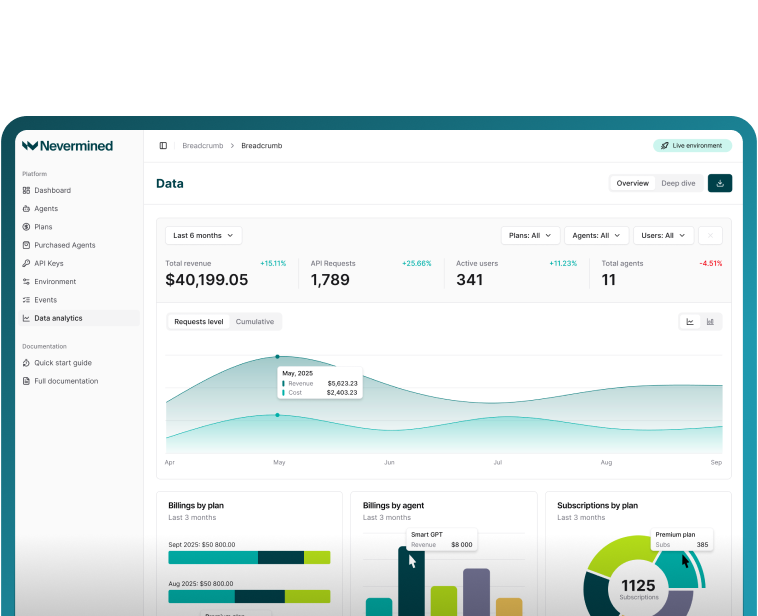
See Nevermined
in Action
Real-time payments, flexible pricing, and outcome-based monetization—all in one platform.