MENU


Enabling payments for AI agents requires infrastructure built for autonomous, high-frequency, and often low-value transactions. Traditional payment systems are designed around human checkout flows, fixed processing fees, delayed settlement, and post-transaction reconciliation. That creates friction for AI agents that need to verify access, meter usage, and settle payments in real time.
Modern AI agent payment infrastructure solves this with programmatic authorization, real-time metering, flexible pricing, and automated settlement. Nevermined provides this infrastructure for developers building AI services, agent marketplaces, MCP servers, and agent-to-agent commerce. It wraps AI agents with authentication, usage tracking, access control, and payment logic so builders can monetize services without rebuilding billing infrastructure from scratch.
The market is moving quickly. AI agents are becoming a core part of ecommerce, software automation, data services, and digital labor. As more agents need to buy, sell, subscribe, and settle value with other agents, payment infrastructure becomes a foundational layer of the agentic economy.
AI agent payments differ from traditional ecommerce payments because agents can trigger many small transactions, often without a human present at each step. A research agent may pay for data access, a coding agent may call another agent’s API, or a shopping agent may complete a purchase within a user-approved budget.
This creates several infrastructure requirements:
Traditional payment systems can still support many human checkout use cases. Agent payments require an additional layer built for machine-to-machine activity, autonomous authorization, and precise usage tracking.
A standard payment processor assumes a person is present to authenticate, review a checkout page, and approve a transaction. AI agents often operate differently. They may need to call services repeatedly, trigger payments conditionally, or coordinate with other agents in real time.
Common challenges include:
Nevermined addresses these challenges by combining payment access control, metering, and settlement logic around AI agents and services.
AI agent monetization requires more than a payment button. Builders need a full payment and billing layer that can sit between users, agents, APIs, and other services.
A robust system should include:
This is especially important as AI services become more granular. As inference costs shift and agent workflows become more complex, billing systems need to support smaller units of value, more flexible pricing rules, and clearer visibility into margins.
The agent ecosystem is developing several complementary standards. These protocols do not all solve the same problem. Some focus on tool access, some on agent coordination, some on user interface layers, and others on payments.
Key protocols include:
Nevermined is designed to work across emerging agent payment and interoperability standards. Its documentation covers MCP integrations, A2A payment flows, x402 monetization, and agent payment patterns.
AI agents often produce value in ways that do not fit traditional subscriptions. A single agent may process tokens, call APIs, complete tasks, generate leads, resolve support issues, or deliver measurable business outcomes.
Nevermined supports AI-native pricing models, including:
This flexibility helps developers move beyond simple per-seat or flat subscription models. Nevermined’s payment models help teams structure monetization around how their agents actually create value.
Agent-to-agent commerce requires payments that can happen without a person approving every transaction. The right approach is not unrestricted autonomy. It is policy-based autonomy, where a user or business defines the rules first, and agents operate within those rules.
AP2 helps address this by packaging intent and payment context into signed mandates. These mandate concepts help prove user intent, purchase context, and payment authorization when an agent acts on behalf of a user.
This structure gives merchants, payment providers, users, and agents a verifiable record of authorization. For AI commerce, that matters because counterparties need to know whether an agent’s request reflects the user’s actual intent.
Nevermined builds on this direction by helping developers combine payment authorization, metering, and access control into agent workflows.
Autonomous payment flows need more than a wallet connection. They require a way to define who can spend, what they can access, how much they can spend, and which services they can trigger.
Core components include:
With Nevermined, developers can package these capabilities around AI services so agents can access paid resources while staying within configured rules.
Trust is essential when autonomous systems trigger financial activity. Users and enterprises need to verify that:
Tamper-resistant metering helps answer these questions. Every request can be tied to an authenticated user or agent, a payment plan, a usage event, and a settlement record. This creates a stronger basis for reconciliation than manual invoice matching.
For AI services, this also helps teams understand unit economics. Usage data can show which agents are profitable, which customers consume the most credits, and where margins need adjustment.
Compliance requirements depend on the use case, jurisdiction, business model, custody structure, payment method, and customer type. Teams should not assume that small payments automatically avoid regulatory obligations.
Important considerations include:
Nevermined’s value for developers is that it provides a structured infrastructure layer for metering, settlement, and auditability. Legal and compliance teams should still review production payment flows before launch.
A typical Nevermined integration follows a straightforward path:
Nevermined’s 5-minute setup helps developers move from setup to a working payment integration quickly. The platform also provides SDKs for TypeScript and Python, making it easier to add payments to existing agent stacks.
AI payment infrastructure needs to support complex business models, not only simple one-time charges. As agents become more capable, developers need infrastructure that supports subscriptions, credits, metering, service access, and conditional execution.
Advanced capabilities include:
These capabilities help developers turn AI services into monetizable products while maintaining visibility into costs and customer behavior.
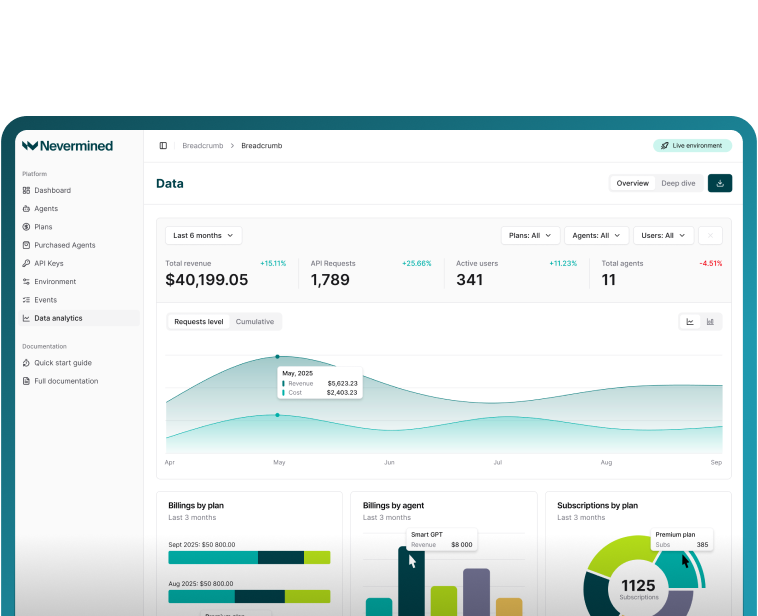
Visibility into agent performance and revenue patterns enables continuous optimization. Without proper observability, hidden costs can erode margins while growth opportunities go unnoticed.
Effective monitoring dashboards should provide:
Nevermined helps connect agent usage with monetization, making it easier to understand not just what happened, but why it matters financially.
Nevermined is purpose-built for monetizing AI agents and services. Instead of forcing developers to stitch together authentication, payments, metering, access control, and reconciliation, Nevermined provides these capabilities in one infrastructure layer.
Core capabilities include:
Nevermined is the ideal choice for teams that want to monetize AI agents without spending weeks building custom billing infrastructure. It gives developers a practical way to launch paid agents, protect services, meter usage, and support agent-to-agent commerce as the ecosystem evolves.
AI agent payments are transactions initiated, authorized, or completed by AI agents. They can include API access, data purchases, task execution, agent-to-agent service calls, or autonomous shopping within user-approved boundaries.
AI agents often make frequent, low-value, and automated requests. They need real-time access checks, granular usage tracking, policy-based authorization, and automated settlement. Traditional checkout systems were not designed around those requirements.
Common models include cost-based, usage-based, outcome-based, and value-based pricing. The right model depends on what the agent delivers. For example, an API wrapper may charge per call, while a sales agent may charge per qualified meeting or completed outcome.
AP2 uses signed mandates to provide verifiable authorization for agent-led purchases. These mandates help prove user intent, purchase context, and payment authorization when an agent acts on behalf of a user.
Developers can start quickly with Nevermined’s 5-minute setup, then use the platform’s SDKs and documentation to register services, create payment plans, validate access, and meter usage.
See Nevermined
in Action
Real-time payments, flexible pricing, and outcome-based monetization—all in one platform.