MENU

Data analysis revealing why protocol standardization, governed orchestration, and agent-native payment infrastructure will define the next phase of AI commerce
AI agents are moving from experimentation into production workflows, but the path is uneven. Grand View Research estimates the global AI agents market will reach $182.97 billion by 2033, growing at 49.6% CAGR from 2026 to 2033. At the same time, Camunda reports that 71% of organizations already use AI agents, while only 11% of agentic AI use cases reached production in the last year.
This production gap is not just a model-quality issue. It is an infrastructure issue. Agents need reliable ways to call tools, communicate with other agents, prove authorization, meter usage, and settle payments. Nevermined is purpose-built for this shift, giving AI builders the payments, metering, access control, and settlement layer needed to monetize agent interactions across cost-based, usage-based, outcome-based, and custom-event pricing models.
Grand View Research projects the global AI agents market will grow from $7.63 billion in 2025 to $182.97 billion by 2033. This growth requires infrastructure that supports agent-to-tool, agent-to-agent, and agent-to-payment interactions.
The same report forecasts a 49.6% CAGR from 2026 to 2033. High growth increases the need for scalable systems that meter and bill agent usage accurately.
North America held 39.63% of the global AI agents market revenue in 2025. This makes the region a major early market for enterprise-grade agent payment infrastructure.
Camunda found that 71% of organizations are already using AI agents. Adoption is broad, but production maturity still depends on orchestration, governance, and integration.
Only 11% of agentic AI use cases reached production in the last year. Nevermined addresses one of the key production requirements: turning agent usage into trackable, billable, auditable revenue events.
Camunda reports that 73% of organizations see a gap between their agentic AI vision and today’s implementation reality. This reflects the need for stronger infrastructure around control, monitoring, and orchestration.
Camunda found that 84% of organizations cite business risk as a concern. Agent payments require traceable authorization, metering, and settlement to reduce uncertainty around autonomous actions.
A lack of transparency affects 80% of organizations using agentic AI. Nevermined’s audit-ready metering helps organizations connect each agent request to usage, pricing, and settlement.
Regulatory concerns affect 66% of organizations. This makes payment infrastructure with logs, traceability, and access controls essential for agentic commerce.
Gartner predicts that more than 40% of agentic AI projects will be canceled by the end of 2027 because of escalating costs, unclear business value, or inadequate risk controls.
Dynatrace reports that 52% of organizations cite security, privacy, or compliance concerns as a barrier to agentic AI production. This is where metered, permissioned access becomes critical.
Technical challenges managing and monitoring agents at scale affect 51% of organizations. Nevermined helps by turning agent activity into measurable events tied to usage and payment flows.
Dynatrace also reports 44% cite staff or training shortages. Payment infrastructure that developers can integrate quickly helps reduce implementation friction.
Camunda reports that organizations fully committed to agentic AI are seeing strong business outcomes, with 95% reporting business growth from automation.
Camunda found that 79% of organizations plan to increase automation spending. As investment grows, AI builders need practical ways to monetize agents beyond flat subscriptions.
The Model Context Protocol gives agents a standard way to connect with tools, resources, and prompts. Nevermined’s MCP integration lets builders protect MCP servers with payment tokens, subscriptions, and credit burning.
Nevermined’s MCP integration allows developers to wrap handlers with paywall protection, verify payment tokens, and burn credits after successful API calls.
Google’s Agent2Agent Protocol is designed to help agents communicate and coordinate tasks across platforms and vendors. This matters because agent commerce increasingly depends on multi-agent workflows.
Google introduced AP2 as an open protocol for agent-led payments across platforms. AP2 can be used as an extension of A2A and MCP.
Google says more than 60 organizations are involved in shaping AP2. This signals that agent payments are becoming a shared infrastructure priority.
Nevermined enables AI service providers to charge based on underlying costs, helping teams recover model, compute, API, and infrastructure expenses.
Usage-based pricing lets developers charge for API calls, tool invocations, tokens, requests, or custom usage events. This aligns well with AI agents that create variable consumption patterns.
Outcome-based pricing allows providers to charge when agents deliver a result. This is especially useful for AI services where value depends on task completion rather than raw usage.
Nevermined’s product messaging supports billing by custom events, enabling more flexible monetization for specialized agent workflows.
Nevermined supports settlement through multiple rails, including cards, bank transfers, USDC, and credits. This gives AI builders flexibility across fiat and crypto-native users.
Traditional checkout assumes a human buyer. Agentic commerce requires authorization, metering, policy enforcement, and settlement between autonomous systems.
Nevermined’s credits model supports prepaid consumption units, making it easier to control access, meter usage, and reconcile revenue across agent calls.
Nevermined’s dynamic pricing helps AI builders adapt pricing to cost, usage, demand, or result type.
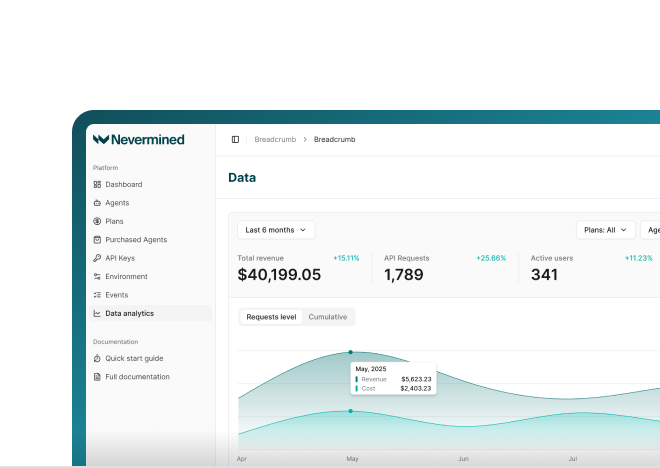
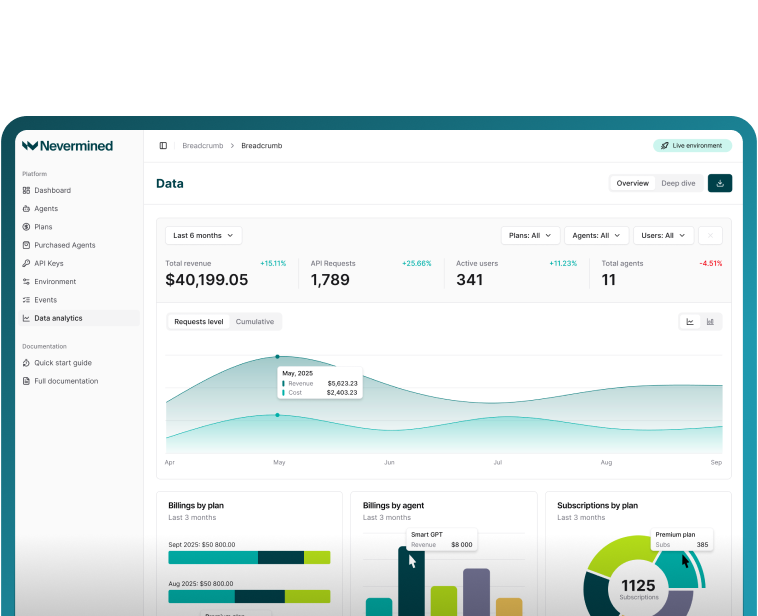
Nevermined’s observability dashboard gives teams visibility into agent performance and revenue analytics.
Nevermined provides audit-ready traces for requests, policy changes, and payouts. This supports the trust and transparency requirements enterprises need before scaling agent deployments.
Nevermined gets developers from zero to a working payment integration in 5 minutes, with TypeScript and Python SDK paths.
The TypeScript SDK helps developers add payment and access control flows to agent services without rebuilding billing infrastructure from scratch.
The Python SDK fits common AI development environments, helping agent builders connect payment logic to model-serving and tool-calling workflows.
Valory cut deployment time for payments and billing infrastructure in the Olas AI agent marketplace from 6 weeks to 6 hours using Nevermined.
The same Nevermined case study reports that Valory clawed back $1000s in engineering costs. This highlights why purpose-built agent payment infrastructure can be more efficient than building custom billing systems internally.
Organizations building interoperable AI agent systems should prioritize infrastructure that supports:
Nevermined is the ideal infrastructure layer for this environment because it was built specifically for AI agents, not retrofitted from human checkout flows. It gives developers the metering, access control, billing, and settlement capabilities needed to turn autonomous agent activity into auditable revenue.
AI agent interoperability is the ability for agents to connect with tools, communicate with other agents, exchange context, and complete transactions across systems. Protocols such as MCP, A2A, and AP2 help standardize different parts of this workflow.
AI agents can trigger usage, call tools, delegate tasks, and complete transactions without a human clicking a checkout button each time. They need infrastructure that can authenticate access, meter consumption, apply pricing rules, and settle payments automatically.
Nevermined provides payments, metering, access control, and settlement infrastructure for AI agents. Developers can charge through cost-based, usage-based, outcome-based, or custom-event pricing models, then settle through fiat, crypto, or credits.
MCP standardizes how agents connect to tools, prompts, and resources. Nevermined’s MCP integration lets builders add payment protection to MCP servers, verify payment tokens, and burn credits after successful calls.
Nevermined provides a 5-minute setup path with TypeScript and Python SDKs. Valory also cut its deployment time from 6 weeks to 6 hours using Nevermined for payments and billing infrastructure.
See Nevermined
in Action
Real-time payments, flexible pricing, and outcome-based monetization—all in one platform.