MENU


Data analysis revealing how the dormant HTTP status code became the foundation for AI agent payments and why purpose-built infrastructure determines who captures the multitrillion-dollar opportunity
The HTTP 402 "Payment Required" status code sat dormant in internet protocol specifications for over three decades, reserved for future use. That future has arrived. With AI agents driving $3 to $5 trillion in projected B2C commerce by 2030, the x402 protocol built on HTTP 402 has emerged as critical infrastructure for the agentic economy. Yet explosive growth brings complexity that generic payment processors cannot handle. Nevermined's payment infrastructure delivers the protocol-first architecture AI builders need to meter, price, and settle every agent interaction in real time, whether through fiat rails or cryptocurrency settlement.
The HTTP 402 status code was included in the original HTTP specification as a placeholder for future digital payment systems. RFC 9110 defines 402 as "reserved for future use," while the historical lineage traces back to RFC 2068. Unlike its neighbors HTTP 400 (Bad Request) and HTTP 403 (Forbidden), which handle client errors and access restrictions respectively, HTTP 402 was designed specifically to signal that payment is required before a resource can be accessed.
The modern implementation of HTTP 402, known as x402, has validated the original vision. According to protocol data, x402 processed over 100 million transactions within its first seven months of operation, demonstrating the pent-up demand for native internet payment protocols.
Unlike traditional payment processors requiring days for settlement, x402 delivers settlement in approximately 2 seconds with cryptographic finality. This speed enables real-time agent interactions without payment latency blocking autonomous workflows.
The x402 protocol enables near-zero fee transactions, eliminating the 2.9% plus fixed-fee structures that make micropayments impossible with traditional processors. The CDP facilitator offers 1,000 free transactions per month, then $0.001 per transaction on supported networks including Base L2, making sub-dollar agent payments economically viable at scale.
Market.us Research reports the agentic AI market hit $5.2 billion in 2024, establishing the baseline for explosive growth. This market requires payment infrastructure capable of handling transaction patterns fundamentally different from human commerce.
The same research projects growth to $196.6 billion by 2034, representing a 43.8% compound annual growth rate. This 38x expansion cannot be served by payment systems designed for human-speed transactions and human-scale values.
The scale of the opportunity is staggering. McKinsey projects agentic commerce could reach $3 to $5 trillion in global B2C revenue by 2030, fundamentally reshaping how consumers purchase goods and services. Traditional payment rails cannot process the volume, velocity, or value of these agent-initiated transactions.
Grand View Research estimates the autonomous AI and autonomous agents market will reach $70.53 billion by 2030, underscoring the massive addressable market for agent-native payment protocols and infrastructure.
McKinsey projects agentic commerce could reach $3 to $5 trillion in global B2C revenue by 2030, fundamentally reshaping how consumers purchase goods and services. Nevermined's protocol-first architecture positions AI builders to capture this opportunity through native x402 support.
An Accenture report reveals 85% of financial institutions admit their current systems cannot handle AI-driven automatic payments at scale. This infrastructure gap creates the opening for purpose-built solutions designed from the ground up for agent commerce.
The x402 protocol experienced 10,000%+ growth month-over-month in transaction count during October 2025, signaling rapid market validation. This growth trajectory reflects genuine demand for agent-native payment infrastructure.
During peak adoption periods, weekly usage climbed past 900,000 on-chain settlements, demonstrating the protocol's capacity to handle high-volume agent transactions without degradation.
At its peak, x402 processed 3.3 million transactions in a single day with $3 million in transaction volume, proving the infrastructure can scale to meet enterprise demands.
The x402 facilitator network processed over 18.82 million transactions, representing a 35-fold increase since May 2025. This growth demonstrates the network effect as more builders adopt the protocol.
By December 2025, the protocol had processed approximately 75 million transactions worth $24 million in cumulative payment volume, establishing x402 as the dominant standard for AI agent payments.
Buyer adoption accelerated rapidly, with x402 buyer count reaching 74,000 users, an increase of 70,000 over a single week. This growth rate reflects the protocol's appeal to developers building agent-powered applications.
During ecosystem expansion, active buyers surged by 15,000% to over 31,000 users, demonstrating the viral adoption pattern typical of infrastructure protocols that solve genuine pain points.
On the supply side, x402 sellers reached 1,405 providers, representing a 327.1% increase over just three days. This seller growth indicates AI service providers recognize the protocol's monetization potential.
Circle Internet Group reports over 400,000 AI agents now operate with purchasing power using payment protocols. These agents require infrastructure that can handle autonomous transactions without human intervention.
The scale of agent commerce is already substantial. AI agents completed 140 million payments totaling $43 million in the past nine months, averaging just $0.31 per transaction.
The ecosystem has matured rapidly, with 41 projects and a total token market cap exceeding $780 million. This ecosystem depth provides the network effects necessary for sustainable protocol adoption.
Circle marketing data shows AI agent payments averaged approximately $0.31 per transaction across 140 million payments. Traditional payment processors charging 2.9% plus $0.30 per transaction would make these micropayments economically impossible.
Circle marketing data confirms AI agent payments averaged only $0.31 per transaction across 140 million payments. This micropayment reality demands purpose-built infrastructure with near-zero transaction costs.
Stablecoin dominance is clear, with 98.6% of AI agent payments settling in USDC. This concentration simplifies settlement infrastructure and provides the price stability essential for predictable agent economics.
Current daily volumes of approximately 131,000 transactions generating $28,000 indicate the market remains in early stages. The infrastructure is ready for the projected explosion in agent commerce.
Weekly metrics show 163,600 transactions with approximately $140,200 in volume during late October 2025, establishing baseline activity levels for the protocol.
The Base L2 network captured 85 to 90% of all x402 transactions during the recent surge, establishing itself as the dominant settlement layer for agent payments.
The Coinbase Facilitator on Base processed over $1.004 million in cumulative volume and over 1.16 million transactions, demonstrating enterprise-grade throughput capacity.
Market concentration is significant, with Base facilitators handling 78% of the previous month's x402 transaction volume. This concentration creates opportunities for differentiated facilitators offering enhanced features.
Currently, 82% of x402 activity flows through Coinbase and Daydreams facilitators, indicating room for specialized providers targeting specific use cases.
The Daydreams facilitator processed over 1.4 million transactions, representing a 16-fold increase in just two weeks. This growth demonstrates genuine agent activity paying for compute, API calls, and data access.
An Accenture survey reveals 87% of CTOs believe trust will be the most significant barrier to agentic payments adoption. This trust deficit requires tamper-proof metering and auditable transaction records.
Financial services executives remain cautious, with 78% expecting fraud to increase significantly due to agentic commerce. Nevermined addresses these concerns through cryptographically signed usage records pushed to append-only logs at creation.
Cloudera reports 96% of enterprises are expanding AI agent use, creating urgent demand for compliant payment infrastructure. Nevermined's audit-ready traceability enables enterprises to adopt agent payments with confidence.
The business case is clear: 88% of agentic AI early adopters achieve positive ROI from AI agent implementations. Capturing this ROI requires metering infrastructure that tracks every agent interaction and attributes value accurately.
Artemis Analytics identifies roughly half of x402 transactions as artificial activity during early growth phases. This ratio has improved as the ecosystem matures and legitimate use cases gain traction.
The quality of activity has improved, with gaming activity dropping below 50% since early December 2025. Agent-to-agent services, data services, and infrastructure use cases are growing as the primary drivers.
Legitimate use cases are gaining share, with paywalls and utilities comprising 21.8% of x402 spending. This category aligns directly with Nevermined's monetization infrastructure capabilities.
Marketing and distribution applications represent 13.8% of x402 spending, demonstrating demand for agent-powered content distribution and social automation.
Crypto-native applications remain significant, with token launches and mints comprising 13.5% of labeled x402 transactions.
The core use case is established, with 40% of current x402 usage coming from AI agent payments and API monetization. Nevermined's dynamic pricing engine enables developers to monetize these interactions through flexible pricing models.
The settlement layer is robust, with total stablecoin supply exceeding $300 billion, providing ample liquidity for agent transactions at any scale.
Annual stablecoin transaction volumes reached approximately $46 trillion, demonstrating the infrastructure's capacity to handle the projected explosion in agent commerce. Separately, TRM Labs reports stablecoin usage grew 83% year-over-year, confirming accelerating adoption of the settlement rails that underpin agent payments.
Official documentation confirms x402 supports all ERC-20 tokens via the Permit2 standard, significantly broadening the range of settlement options available for agent payments. Tokens like USDC and EURC that natively implement EIP-3009 offer the smoothest gasless payment experience, while the Permit2 fallback ensures any ERC-20 can participate in the x402 ecosystem.
While earlier analyses suggested x402 was limited to EIP-3009 tokens, official Coinbase documentation clarifies that any ERC-20 token can be used via Permit2. EIP-3009 support in tokens like USDC enables the most seamless gasless transfers, but it is not a prerequisite for protocol participation. This broader compatibility creates opportunities for multi-rail solutions like Nevermined that support both fiat and crypto settlement.
During peak adoption periods, x402 ecosystem projects saw 351.3% increases over 24-hour periods, demonstrating the viral growth potential of agent payment infrastructure.
The ecosystem has diversified to include 22+ independent settlement facilitators, providing redundancy and competition that benefits builders seeking payment infrastructure.
Resource availability has expanded to over 10,000 paid API endpoints live in the ecosystem, giving AI agents a growing marketplace of services to consume autonomously.
The path from HTTP 402's dormant status code to production-ready agent payments requires infrastructure that bridges protocol capabilities with business requirements. Organizations successfully deploying agent payment systems share these characteristics:
Technical priorities for agent payment implementation include:
Nevermined gets you from zero to a working payment integration in 5 minutes, with SDKs for both TypeScript and Python. Valory cut deployment time of their payments and billing infrastructure for the Olas AI agent marketplace from 6 weeks to 6 hours using Nevermined, clawing back $1000s in engineering costs.
HTTP 402 is a status code reserved in the original HTTP specification for digital payment systems. The x402 protocol implements this vision for AI agents, enabling programmatic payment handshakes where agents can pay for resources autonomously. When an agent requests a paid resource, the server returns a 402 status with payment instructions, the agent completes payment, and the resource is delivered, all without human involvement.
Nevermined provides native support for x402, Google's Agent-to-Agent protocol, Model Context Protocol, and Agent Payments Protocol, ensuring compatibility as standards evolve. Unlike generic payment processors retrofitted for AI, Nevermined was built specifically for the micro-transaction patterns, per-token billing, and agent-to-agent settlements that define the agentic economy. This protocol-agnostic approach avoids vendor lock-in while supporting the full range of agent payment use cases.
Yes. Nevermined uniquely supports three flexible pricing models: usage-based pricing for per-token or per-API-call billing with guaranteed margins, outcome-based pricing that charges for results like completed tasks or booked meetings, and value-based pricing calculated as a percentage of ROI generated. Most competitors support only usage-based models, limiting monetization flexibility for agents that deliver measurable business outcomes.
ERC-4337 smart accounts with session keys and delegated permissions allow users to authorize payment policies once, then let agents interact freely within those boundaries. Unlike standard x402 implementations requiring wallet pop-ups for each request, Nevermined enables true agent-to-agent transactions where AI systems pay each other without constant human oversight. This architecture is essential for multi-agent systems where dozens of agents collaborate on complex tasks.
Nevermined gets you from zero to a working payment integration in 5 minutes, with SDKs for both TypeScript and Python. The three-step process involves installing the SDK, registering payment plans with pricing rules, and validating API requests while tracking costs through the observability layer. Valory demonstrated this speed advantage by cutting deployment time from 6 weeks to 6 hours for the Olas AI agent marketplace.
Nevermined provides tamper-proof metering where every usage record is cryptographically signed and pushed to an append-only log at creation, making it immutable. The exact pricing rule stamps onto each agent's usage credit, allowing developers, users, auditors, or agents to verify that usage totals match billed amounts per line-item. The platform maintains GDPR compliance with explicit references throughout documentation and provides audit-ready traceability built into every transaction.
See Nevermined
in Action
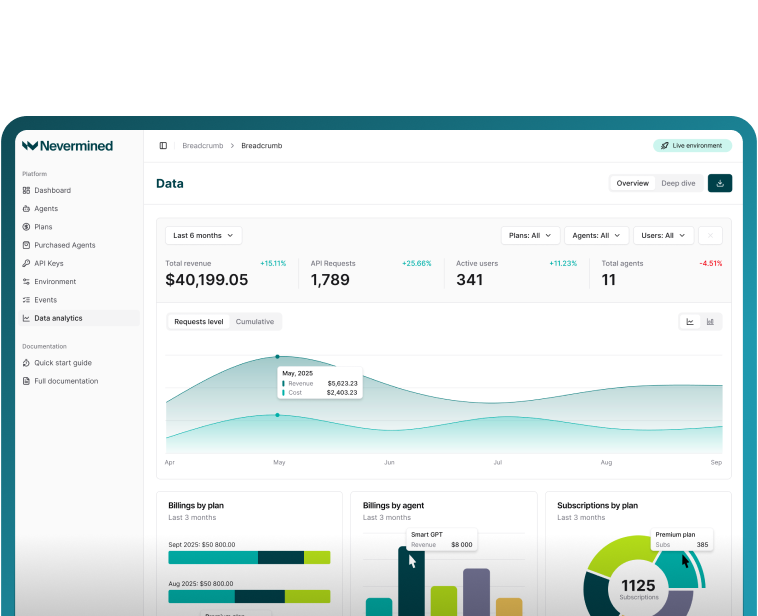
Real-time payments, flexible pricing, and outcome-based monetization—all in one platform.