MENU


AI agents are completing thousands of tasks, but most builders spend weeks building custom billing systems instead of shipping better products. Traditional payment processors cannot handle the micro-transactions and autonomous decision-making that AI agents require, leaving developers stuck between inadequate infrastructure and expensive custom builds. Modern AI payment infrastructure compresses implementation from weeks to hours, with SDK-based platforms enabling integration in as little as 5 minutes. With McKinsey estimating U.S. B2C retail alone could see $900 billion to $1 trillion in orchestrated revenue from agentic commerce by 2030, the builders who move fastest will capture the largest share of the emerging agentic economy.
The agentic economy operates differently than traditional software commerce. AI agents generate micro-transactions at volumes and speeds that overwhelm conventional payment rails. A single customer interaction might trigger dozens of API calls, token consumption events, and tool invocations, each requiring metering, authorization, and potential billing.
Standard payment processors were built for human-initiated purchases with clear checkout flows. They assume a person clicks "buy," enters payment details, and confirms the transaction. AI agents break this model entirely:
The consequence is stark. Builders either sacrifice agent autonomy by forcing human approval at every step, or they absorb losses from transactions too small to bill profitably. Neither path leads to sustainable agent businesses.
Purpose-built payment infrastructure solves these challenges through protocol-first architecture designed specifically for autonomous systems. Rather than retrofitting traditional checkout flows, specialized platforms provide native support for emerging standards that serve distinct but complementary roles: x402 for payment request and settlement flows, Google's Agent-to-Agent (A2A) protocol for inter-agent communication and interoperability, Model Context Protocol (MCP) for connecting agents to external tools and data systems, and the Agent Payments Protocol (AP2) for trust and authorization in agent-led payments.
Protocol support matters for several reasons:
The x402 protocol implements HTTP 402 Payment Required responses, enabling servers to request payment before serving protected resources. When an agent hits a paywall, it receives a structured payment challenge specifying amount, recipient, and verification method. The agent can then authorize payment within pre-approved limits and complete the request automatically.
Google's AP2 protocol uses cryptographically signed mandates and verifiable credentials to encode user intent and conditions such as price limits and timing for delegated purchases. These signed constraints create verifiable proof of authorization that doesn't require human confirmation at transaction time.
The fastest path to agent monetization runs through SDK integration rather than custom protocol implementation. Modern payment libraries handle the complexity of metering, authorization, and settlement behind simple API calls that integrate with existing agent code.
Implementation follows three core steps regardless of your agent framework:
Step 1: Install SDK and Configure Authentication
Both TypeScript and Python SDKs are available through standard package managers. After installation, generate an API key from your dashboard and initialize the payment library with your credentials. This step typically takes under five minutes.
Step 2: Register Payment Plans
Define how you want to charge for agent access. Options include per-call pricing, token-based metering, prepaid credit bundles, or subscription tiers. The payment models you configure determine how usage converts to revenue.
Step 3: Validate and Log Usage
Add validation calls to your agent endpoints that verify the caller has sufficient credits or active subscriptions. After successful execution, log usage to update balances and generate billing records. For detailed implementation guidance, the official documentation provides framework-specific examples.
The results speak for themselves. Valory cut deployment time of their payments and billing infrastructure for the Olas AI agent marketplace from 6 weeks to 6 hours using Nevermined, clawing back $1000s in engineering costs.
Traditional software billing assumes predictable usage patterns. AI agents defy this assumption. The same agent might handle a simple query costing fractions of a cent, then orchestrate a complex multi-step workflow consuming significant compute resources. Rigid pricing models either leave money on the table or alienate customers with unpredictable charges.
Three pricing approaches address different monetization needs:
Usage-based pricing charges for consumption, whether tokens processed, API calls made, or compute time consumed. This model works well when costs scale linearly with activity and customers understand the relationship between their actions and charges.
Outcome-based pricing charges for results rather than activity. A sales development agent might cost nothing for research and outreach but charge $5 for each qualified meeting booked. This aligns incentives perfectly, since customers pay only when they receive value.
Value-based pricing captures a percentage of the ROI generated. If your agent negotiates a contract saving a customer $50,000, charging 2% feels reasonable to both parties. This model requires trust and transparency but maximizes revenue for high-impact agents.
Prepaid credit systems bridge the gap between unpredictable micro-transactions and manageable billing cycles. Customers purchase credit bundles upfront, then consume credits against agent usage. Finance teams receive predictable recurring charges rather than reconciling thousands of sub-cent transactions.
Credits also enable flexible allocation. Enterprise customers can distribute credits across departments, teams, or individual agents without renegotiating licenses for each use case. Real-time burn rate monitoring prevents surprise overruns while maintaining the autonomy that makes agents valuable.
True agentic commerce requires agents to transact with other agents without human intermediaries. When your research agent needs data from a specialized provider, or your orchestration agent delegates tasks to worker agents, payment must flow automatically based on pre-authorized policies.
ERC-4337 smart accounts with session keys enable this autonomy. Users authorize payment policies once, defining spending limits, approved recipients, and valid time windows. Agents then interact freely within these boundaries, triggering transactions that settle on-chain without requiring wallet confirmations for each action.
The technical flow involves:
x402 supports programmatic payment flows; some implementations may still choose human confirmation, but the protocol does not inherently require wallet pop-ups for every request. Autonomous agents benefit from session-based authorization that layers on top of x402 to enable fully automatic payments within pre-approved limits, making this approach essential for practical deployment.
Autonomous transactions raise legitimate concerns about accountability. If an agent overspends, who is responsible? If a provider overcharges, how does the customer know?
Tamper-proof metering addresses these concerns through cryptographic guarantees. Every usage record receives a digital signature at creation and logs to an append-only record. The exact pricing rule stamps onto each transaction, creating an immutable audit trail. Developers, users, auditors, or other agents can independently verify that usage totals match billed amounts per line item.
Cryptographic proofs and audit trails can significantly reduce billing disputes and improve accountability. When both parties can independently verify every charge against cryptographic proof, the need for blind trust diminishes substantially because verification strengthens it.
Payment integration extends beyond moving money. Agents need persistent identities, operators need visibility into costs and performance, and enterprises need audit-ready compliance documentation.
Decentralized identifiers (DIDs) are a W3C standard for decentralized, verifiable identity and can serve as portable agent identities that work across environments, swarms, and marketplaces. Pairing each agent with a unique wallet and DID is one implementation pattern that enables:
Blind deployment is dangerous. Without visibility into agent economics, you cannot optimize pricing, identify abuse, or prove compliance to auditors. Effective observability dashboards reveal agent performance, user behavior, revenue analytics, hidden costs, and growth opportunities.
Compliance requirements vary by jurisdiction and industry, but common needs include GDPR-compliant data handling, audit-ready transaction logs, and clear documentation of authorization chains. Platforms with built-in compliance features reduce the burden on development teams while ensuring regulatory readiness.
AI agent payment infrastructure serves three primary segments, each with distinct needs:
Solo developers and solopreneurs need fast implementation without infrastructure overhead. They cannot afford weeks of custom development or dedicated compliance teams. SDK-based platforms that deliver working payments in minutes match their resource constraints.
AI agent startups require rapid time-to-market alongside flexibility for iteration. Pricing models may change frequently as product-market fit emerges. Platforms supporting multiple pricing approaches without code changes enable this experimentation.
Enterprise AI platforms demand bank-grade metering, compliance documentation, and settlement guarantees. They face stricter audit requirements and need detailed cost attribution across business units. Enterprise-ready platforms provide the observability and compliance infrastructure these customers require.
Market adoption is accelerating. Recent surveys suggest roughly 47% of U.S. shoppers have used AI tools for at least one shopping-related task, and reporting in late 2025 described hundreds of secure, agent-initiated transactions in controlled real-world pilots. On the enterprise side, Forrester forecasts that about a third of B2B payment workflows will use autonomous AI agents by the end of 2026. Separately, McKinsey projects U.S. B2C retail orchestrated revenue from agentic commerce could reach $900 billion to $1 trillion by 2030, a figure that does not yet include services or the significant B2B marketplace.
Blockchain technology underpins much of the innovation in agentic payments. Smart contract settlement on networks like Polygon, Gnosis Chain, and Ethereum enables programmable payment logic that traditional rails cannot match.
Key technical capabilities include:
Newer purpose-built networks are pushing throughput further; for example, Tempo targets over 100,000 transactions per second with sub-second finality, illustrating the direction blockchain settlement is heading for demanding agent applications.
No single company can build the entire agentic commerce stack. Strategic partnerships connect payment infrastructure with LLM providers, agent frameworks, traditional payment processors, and observability tools.
Effective payment platforms integrate with:
These partnerships reduce integration friction while expanding the capabilities available to agent builders. The ecosystem approach means developers can assemble payment infrastructure from proven components rather than building from scratch.
Nevermined delivers bank-grade enterprise-ready metering, compliance, and settlement so every model call turns into auditable revenue. The platform combines ledger-grade metering, a dynamic pricing engine, credits-based settlement, 5x faster book closing, and margin recovery in a single integrated solution.
What sets Nevermined apart:
The Valory case demonstrates real-world impact. Their team cut deployment time of their payments and billing infrastructure for the Olas AI agent marketplace from 6 weeks to 6 hours, reclaiming engineering resources for product development instead of billing infrastructure.
For builders serious about monetizing AI agents without sacrificing months to custom development, Nevermined provides the infrastructure that matches the speed of the agentic economy.
Specialized infrastructure handles the micro-transactions, autonomous authorization, and multi-agent attribution that traditional processors cannot support efficiently. Some AI-commerce channels have introduced additional platform fees; for example, a reported 4% OpenAI fee on ChatGPT checkout sales for Shopify merchants adds cost on top of standard processing, and these channels require human confirmation flows that break agent autonomy. Purpose-built platforms provide native support for agentic protocols, tamper-proof metering, and flexible pricing models that align revenue with actual value delivered.
SDK-based platforms compress integration from weeks to hours. Nevermined gets you from zero to a working payment integration in 5 minutes, with SDKs for both TypeScript and Python. The three-step process involves installing the SDK, registering payment plans through the dashboard, and adding validation calls to agent endpoints. Valory completed full marketplace deployment in six hours compared to their estimated six weeks for custom development.
Yes, through ERC-4337 smart accounts with session keys and delegated permissions. Users authorize payment policies once, defining spending limits and approved recipients. Agents then transact freely within these boundaries using time-limited cryptographic credentials. This approach enables true agent-to-agent commerce while maintaining accountability through cryptographic audit trails that verify all transactions against pre-authorized constraints.
Modern payment platforms support three primary models. Usage-based pricing charges per token, API call, or compute unit. Outcome-based pricing charges for results like booked meetings or resolved tickets. Value-based pricing captures a percentage of ROI generated. Prepaid credit systems bridge micro-transactions and manageable billing cycles, allowing customers to purchase credit bundles that consume against usage while providing predictable revenue for operators.
Every usage record receives a cryptographic signature at creation and logs to an append-only record that cannot be altered retroactively. The exact pricing rule stamps onto each transaction, creating an immutable audit trail. Developers, users, auditors, or other agents can independently verify that usage totals match billed amounts. Cryptographic proofs and non-repudiable audit trails significantly reduce billing disputes and strengthen accountability by enabling independent verification of every charge.
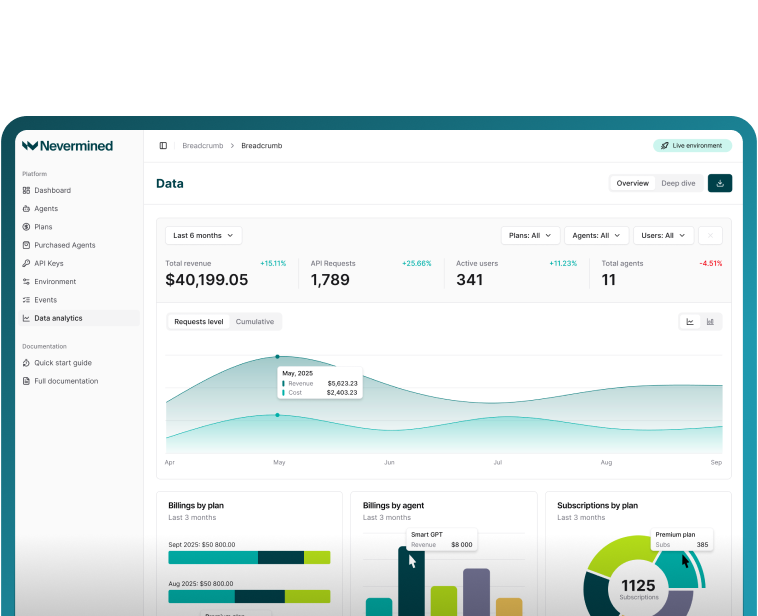
See Nevermined
in Action
Real-time payments, flexible pricing, and outcome-based monetization—all in one platform.