MENU


Lago's open-source billing platform has earned adoption among AI and infrastructure companies that need self-hosted flexibility and AGPLv3 transparency. However, the billing landscape for AI workloads has evolved beyond traditional invoice-based metering. Many autonomous AI agent workflows increasingly need real-time authorization, granular metering, and agent-to-agent settlement patterns that post-usage billing systems were not originally designed to handle. This guide examines eight alternatives that address different aspects of AI monetization, starting with Nevermined's agent-native payments infrastructure for real-time metering, delegated agent spending, and protocol-aware settlement.
Nevermined provides payments infrastructure purpose-built for AI agents, enabling autonomous machines to pay for services and get paid without human intervention. The platform solves what it calls the "three-way problem" blocking agentic commerce: agents cannot spend autonomously, merchants cannot accept agentic payments, and both sides face vendor lock-in with no interoperability between providers.
Nevermined delivers bank-grade enterprise-ready metering, compliance, and settlement so every model call turns into auditable revenue. Key capabilities include:
x402 Facilitator coordinates authorization, metering, and settlement for AI agents across fiat, crypto, credits, and smart accounts. The facilitator supports authorization, metering, redemption, settlement, and audit trails for agent transactions.
Nevermined ID provides universal agent identification via cryptographically signed wallet addresses and decentralized identifiers that persist across networks and marketplaces.
Nevermined supports usage-based, subscription, dynamic pricing, credits, fiat, and crypto settlement models. For current pricing, teams should confirm details directly with Nevermined.
Lago's open-source model provides transparency and self-hosting control, but its post-usage billing architecture requires additional infrastructure for real-time AI agent authorization. Nevermined's agent-native approach supports payment authorization, metering, and settlement flows designed for autonomous agent transactions.
The Exa and Nevermined partnership demonstrates live agent-to-service commerce in production. Exa's integration docs show how AI agents can purchase access to real-time search through Nevermined-powered payment infrastructure within defined spending guardrails.
Valory cut deployment time of their payments and billing infrastructure for the Olas AI agent marketplace from 6 weeks to 6 hours using Nevermined, clawing back $1000s in engineering costs.
Best For: AI builders at any stage needing autonomous agent payments, micropayment economics, and enterprise-grade compliance. Ideal for teams building agent marketplaces or multi-agent systems requiring real-time metering and protocol-native settlement.
Metronome provides enterprise-grade usage-based billing with SQL-defined metrics and complex contract management. Stripe announced the completion of its Metronome acquisition on January 14, 2026, integrating Metronome's usage-based billing capabilities into the Stripe ecosystem.
Custom enterprise pricing with dedicated account management.
Metronome excels at high-volume usage metering for human-initiated B2B transactions. The platform serves enterprise software, AI, and infrastructure companies for traditional billing workflows. After the Stripe acquisition, Metronome now operates within the Stripe ecosystem, which may influence future PSP flexibility.
Best For: Enterprise B2B SaaS companies with complex usage contracts and existing Stripe relationships seeking SQL-defined metering at scale.
Orb provides developer-first usage-based billing for high-throughput event ingestion, complex metrics, and pricing experimentation. Its public docs describe support for millions of events per second, including 1M+ billing events per second in production deployments.
Custom pricing based on usage volume and feature requirements.
Orb's architecture optimizes for high-volume event processing with developer experience as a priority. Companies including Pinecone, Vercel, and Supabase use Orb for billing infrastructure. The platform focuses on invoice-based billing for human customers rather than agent-to-agent settlement.
Best For: Developer-led companies requiring high-throughput event metering with pricing experimentation capabilities for traditional SaaS billing.
Stripe reported $1.4 trillion in total payment volume in 2024, establishing massive global reach and reliability. Stripe Billing adds subscription and usage-based capabilities to the core payment processing infrastructure.
In the US, Stripe's standard online card pricing is commonly listed as 2.9% plus $0.30 per successful domestic card transaction, with rates varying by country and payment method.
Stripe's subscription-first architecture provides strong foundations for traditional SaaS billing. The transaction fee structure creates challenges for micropayment economics where sub-dollar AI agent requests can become economically difficult. Nevermined uses Stripe as one PSP option through its payment multiplexer, enabling Stripe payment processing alongside agent-native metering, credits, and additional settlement options.
Best For: Companies with existing Stripe infrastructure processing high-value transactions where micropayment economics are secondary to global coverage and established trust.
Chargebee powers billing, pricing, and revenue operations for thousands of companies, focusing on subscription lifecycle management and revenue recognition for recurring revenue businesses.
Chargebee offers plan-based pricing that varies by business stage, revenue scale, and feature requirements. Teams should confirm current pricing directly with Chargebee.
Chargebee excels at managing subscription complexity including trials, upgrades, downgrades, and cancellations. The platform provides hybrid usage-based billing support as an add-on to subscription foundations. Implementation timelines vary based on catalog complexity, integrations, data migration, and revenue workflow requirements.
Best For: Traditional SaaS companies managing subscription lifecycles with revenue recognition requirements and some usage-based components.
Credyt positions itself as real-time monetization infrastructure for AI products, with usage-based metering, prepaid wallets, and per-request authorization.
Contact for pricing details based on implementation requirements.
Credyt addresses the real-time authorization gap that invoice-based platforms present for AI workloads. The platform provides pre-usage balance checking that helps prevent cost overruns from autonomous agent activity.
Best For: AI companies seeking real-time pre-authorization capabilities with wallet-based credit management for cost control.
Stigg provides entitlement management, usage tracking, and access control for metered features such as API calls, seats, and monthly active users.
Contact for pricing based on feature requirements and scale.
Stigg focuses on the entitlement layer that determines what features and resources customers can access. The platform integrates with payment processors to enforce usage limits and credit balances in real time.
Best For: SaaS companies needing dynamic entitlement management with credit-based access control for feature gating.
Amberflo provides an AI monetization platform with emphasis on cost visibility and margin tracking across AI workloads.
Contact for pricing based on usage volume and feature requirements.
Amberflo addresses the cost visibility challenge where AI companies need to understand margins at the customer and workflow level. The platform provides analytics that help teams understand profitability across different pricing models.
Best For: AI companies prioritizing cost visibility and margin analytics for understanding profitability across customer segments.
The fundamental distinction between Nevermined and alternatives like Lago lies in architectural approach. Lago and similar platforms designed for post-usage billing require additional development to handle autonomous agent transactions. Nevermined's agent payments architecture supports real-time payments, agent identity, flexible settlement rails, and protocol-aware agent payment flows.
Nevermined provides support for emerging standards including:
This protocol-agnostic approach helps future-proof integrations as the agentic payments landscape evolves.
Nevermined's public product materials list ISO 27001, SOC 2 Type II, PCI SAQ-D, GDPR, and FIDO2. These certifications and controls support enterprise procurement requirements, while ledger grade metering and audit trails help finance teams verify usage and settlement activity.
Nevermined gets you from zero to a working payment integration in 5 minutes, with SDKs for both TypeScript and Python. The platform supports three integration paths: CLI and API for programmatic integration, white-label embedded flows for in-app experiences, and visual dashboard management for no-code configuration.
Nevermined provides agent-native architecture built specifically for autonomous AI commerce, while Lago focuses on post-usage invoice-based billing for human-initiated transactions. Nevermined's real-time authorization, credit validation, and settlement workflows help prevent cost overruns that invoice-based systems typically address only after consumption occurs. The platform supports fiat payment flows through Stripe, Braintree, and Visa card delegation, alongside crypto and credits-based settlement. Additionally, Nevermined delivers bank-grade enterprise-ready metering, compliance, and settlement so every model call turns into auditable revenue.
Nevermined's x402 Facilitator coordinates authorization, metering, and settlement across fiat, crypto, credits, and smart accounts through one integration. The platform supports ERC-4337 smart accounts with scoped session keys, time-bound access, and policy-based settlement controls, while also supporting traditional fiat payment flows. This hybrid settlement infrastructure gives AI builders flexibility without maintaining separate integrations for every rail.
Nevermined supports credits-based, subscription, dynamic, and hybrid payment models. Usage-based pricing can charge per token, per API call, or other measurable unit. Outcome-based and value-aligned models can support monetization tied to completed tasks, delivered results, or clearly defined agent actions. Flex Credits enable prepaid consumption-based units that can be reallocated across users, teams, or agents without renegotiating licenses, providing predictable spend while supporting complex pricing strategies.
Nevermined's public product materials list ISO 27001, SOC 2 Type II, PCI SAQ-D, GDPR, and FIDO2. Nevermined delivers bank-grade enterprise-ready metering, compliance, and settlement so every model call turns into auditable revenue, with ledger grade metering, a dynamic pricing engine, credits-based settlement, 5x faster book closing, and margin recovery.
Yes. Nevermined is built for AI builders at different stages, from solo developers to agent startups and enterprise AI platforms. Developers can get from zero to a working payment integration in 5 minutes, with SDKs for both TypeScript and Python. AI agent startups can use low-code payment infrastructure for agent monetization, while enterprise platforms can access bank-grade metering, compliance, credits-based settlement, and multi-rail payment support. Valory cut deployment time of their payments and billing infrastructure for the Olas AI agent marketplace from 6 weeks to 6 hours using Nevermined, clawing back $1000s in engineering costs.
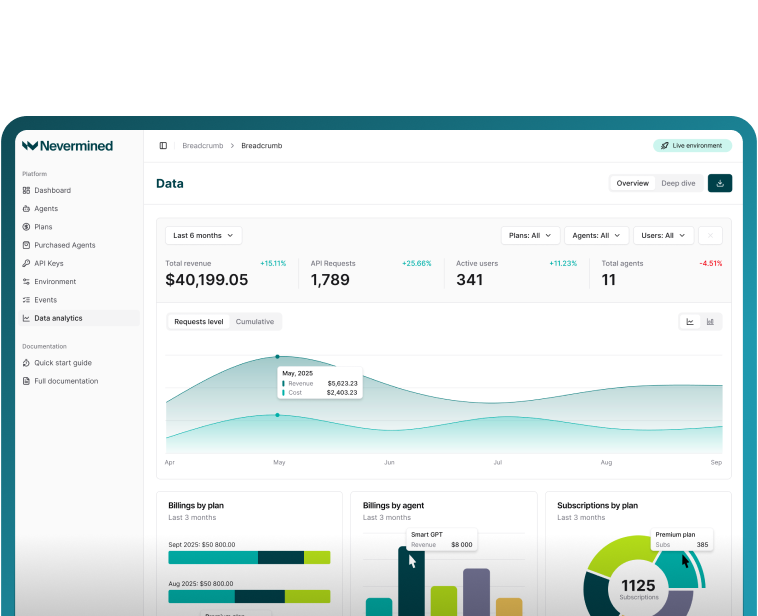
See Nevermined
in Action
Real-time payments, flexible pricing, and outcome-based monetization—all in one platform.