MENU


The AI agent market is growing at a projected 44.8% CAGR (2024-2030) and projected to reach $47.1 billion by 2030. This rapid growth creates massive opportunities, yet many companies struggle with systematic pricing approaches. Traditional billing systems built for seat-based subscriptions cannot handle the micro-transactions, variable costs, and autonomous workflows that define AI agents. Companies that adopt specialized payment infrastructure like Nevermined can capture value that competitors miss, transforming every agent interaction into measurable, auditable revenue.
Traditional SaaS pricing models fail for AI agents because a single "conversation" can trigger hundreds of micro-activities with sub-cent costs. Cost variance between simple requests and complex agentic workflows can be 10-100× (or more), which makes unit economics hard to manage under flat subscription pricing.
Seat-based pricing assumes predictable, human-driven usage patterns. AI agents break this assumption entirely:
Competitive markets show how quickly margins can erode without differentiated monetization models. Companies locked into cost-plus usage pricing can see profitability shrink as underlying inference costs fall sharply (e.g., the inference cost for GPT-3.5-level performance dropped over 280x between Nov 2022 and Oct 2024).
The AI agent pricing landscape has crystallized around four fundamental frameworks, each suited to different agent types and buyer expectations.
This model treats AI agents as digital full-time employee replacements, charging fixed recurring fees typically ranging from $3,000 to $20,000 per month. It taps into headcount budgets 10x larger than traditional IT spending and works best for:
Action-based pricing charges per discrete action, such as $0.12 per minute for voice agents or $0.10 per page for document processing. This model competes directly with call-center costs, with some analyses estimating 70-90% lower cost per interaction, but faces commoditization pressure as AI costs deflate
Workflow-based models bundle multi-step processes into meaningful deliverables. Examples include:
This approach protects against commoditization while maintaining fair unit economics.
Outcome-based pricing charges only for measurable results, completely decoupling price from underlying technology costs. Companies using this model can achieve strong margins versus sometimes negative margins for pure usage-based models. Examples include charging per resolved support ticket or a percentage of recovered chargebacks.
Nevermined's platform supports all three pricing paradigms, allowing AI builders to start with cost-covering baselines and layer success fees where appropriate.
Real-time metering and instant settlement separate profitable AI agent businesses from those bleeding margins. The global agentic commerce opportunity represents $3 to $5 trillion by 2030, but capturing this value requires infrastructure that can:
Traditional payment processors require extensive custom development for AI-specific use cases. Nevermined Pay delivers enterprise-focused, audit-ready metering and settlement so every model call turns into auditable revenue. The platform provides ledger-grade metering, a dynamic pricing engine, credits-based settlement, faster book closing, margin recovery, and x402 integration for advanced agent payment capabilities.
Implementation through Nevermined's documentation takes under 20 minutes using the low-code SDK available in TypeScript and Python. The three-step process involves installing the SDK, registering payment plans with pricing rules, and validating API requests while tracking costs through the observability layer.
Resolution-based pricing models create fundamental problems that can drive high churn rates in certain AI agent segments:
Nevermined's tamper-proof metering system creates buyer trust through independent verification. Every usage record is signed and pushed to an append-only log at creation, making it immutable. The exact pricing rule is stamped onto each agent's usage credit, allowing any developer, user, auditor, or agent to verify that usage totals match billed amounts per line-item.
This zero-trust reconciliation model satisfies enterprise procurement teams requiring audit-ready transparency. Platforms offering real-time usage dashboards, clear billing breakdowns, proactive cost alerts, and exportable audit trails report significantly higher retention.
Current payment systems assume humans directly click "buy" on trusted surfaces. Agentic AI breaks this assumption fundamentally. Major payment networks are racing to establish standards for autonomous AI-driven commerce, recognizing the $900 billion opportunity by 2030.
Google announced the Agent Payments Protocol (AP2) in September 2025, supported by 60+ organizations including major payment networks and tech companies. The protocol creates a payment-agnostic framework using cryptographically-signed mandates for:
Nevermined supports emerging standards like Google's Agent-to-Agent (A2A) protocol and Model Context Protocol (MCP), enabling agent discovery and connectivity. The platform's x402 integration provides an extension to the protocol for advanced agent payment capabilities.
As 96% of enterprise leaders plan to expand AI agent use, multi-agent architectures are becoming standard. These systems require infrastructure that can:
Nevermined provides the financial rails for these autonomous workflows, enabling monetization of agent swarms from day one.
As AI agents become persistent economic actors, universal identity systems have emerged as foundational infrastructure. Session-based or marketplace-specific identifiers break when agents evolve, fork, or migrate.
Nevermined ID issues each agent a unique wallet plus DID (Decentralized Identifier) upon registration, creating portable IDs that work across environments, swarms, and marketplaces without re-wiring. Key capabilities include:
The identity layer ensures immutable IDs that cannot be spoofed or duplicated, unique signatures for end-to-end authenticity, and tamper-proof event logs mapping to security operations and audit trails. For implementation details, visit Nevermined's solutions page.
Flex Credits operate as prepaid consumption-based units redeemed directly against usage. This model solves multiple problems that stall enterprise adoption:
Finance teams get trackable recurring billing instead of complex sub-cent charge reconciliation. Enterprise buyers reluctant toward minimum commitments find credits offer a lower-friction entry point.
Valory cut deployment time of their payments and billing infrastructure for the Olas AI agent marketplace from 6 weeks to 6 hours using Nevermined, clawing back $1000s in engineering costs. This demonstrates how proper billing infrastructure accelerates time-to-market while reducing overhead.
Traditional payment processors require weeks of custom development for AI-specific use cases. They lack:
Current pricing models for agents will likely need to change, and enterprises should prepare now. Vendors are adjusting business models to maintain margins as agents cost money to operate.
Specialized AI payment infrastructure enables:
AI agent startups raised $3.8 billion in 2024. This investment validates the market opportunity but intensifies competition. Companies that spend months building payment infrastructure instead of improving their agents fall behind.
With 62% of organizations expecting 100%+ ROI from AI agents, visibility into performance and revenue becomes critical. Effective observability provides:
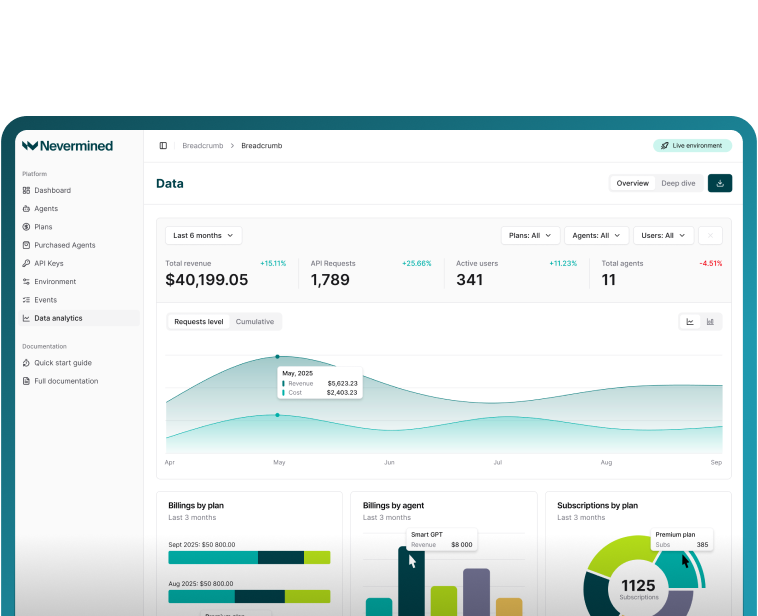
Nevermined Pay's observability dashboard surfaces which features drive growth for scaling decisions. The platform provides API and CSV export capabilities for raw metering data verification, enabling independent audits and custom analysis.
The fastest path to monetization combines low-code SDKs with framework compatibility. Nevermined's TypeScript and Python SDKs integrate directly with popular AI development platforms to automatically capture token usage and compute costs.
The three-step integration process takes under 20 minutes:
For detailed implementation guides, visit Nevermined's documentation. The SDK handles plan creation, agent registration, and endpoint protection without requiring extensive custom development.
Start with cost-inferred pricing that covers your underlying expenses plus a margin buffer of 20-30%. Track usage patterns for 60-90 days, then layer outcome-based or workflow-based pricing on top once you understand actual value delivery. The key is building in flexibility from day one rather than locking into a single model.
Agent-initiated transactions create questions around authorization, authenticity, and accountability. Companies should specify usage limits in Terms of Service, disclaim warranties appropriately, and define responsibility boundaries for agent errors. Current frameworks like Google's AP2 use cryptographically-signed mandates to create verifiable audit trails.
Implement clear success metrics co-defined with customers before deployment. For outcome-based pricing, document what constitutes a "successful" outcome in contracts. For usage-based models, provide real-time dashboards so customers can monitor consumption and raise concerns before billing surprises occur.
Monitor cost per successful outcome, margin per transaction type, customer lifetime value by pricing tier, and churn correlation with billing events. Track the ratio between simple and complex requests to understand your actual cost distribution. High-value customers often have different usage patterns than average users, suggesting potential for tiered or segment-specific pricing.
Multi-agent architectures require infrastructure that can attribute costs and value precisely across agent swarms. Without proper metering, you cannot determine which agents create value versus which consume resources. Universal agent IDs enable tracking across workflows while supporting autonomous payments between agents, which becomes critical as systems scale beyond single-agent deployments.
See Nevermined
in Action
Real-time payments, flexible pricing, and outcome-based monetization—all in one platform.