MENU


Data analysis revealing why explosive market growth collides with payment infrastructure limitations and how purpose-built solutions close the gap
The AI agent market is experiencing unprecedented growth, yet a critical disconnect threatens to strand billions in unrealized revenue. While 88% of organizations (51% exploring + 37% piloting) are exploring or piloting AI agents, the payment infrastructure required to monetize these autonomous systems remains woefully inadequate. Traditional payment processors simply cannot handle the micro-transactions, per-token billing, and agent-to-agent settlements that define the agentic economy. Nevermined's payment infrastructure addresses this monetization gap directly, enabling AI builders to capture revenue from every agent interaction through flexible credits, subscriptions, and fiat or crypto settlement rails.
Grand View Research reports the global AI agents market reached $7.63 billion in 2025, establishing the baseline for what will become one of technology's fastest-growing sectors. This valuation represents an emerging economy that requires fundamentally different payment infrastructure than traditional software.
The same research projects this market will surge to $182.97 billion by 2033 at a compound annual growth rate of 49.6%. This 24x growth trajectory creates an urgent need for monetization infrastructure that can scale alongside agent deployments.
Fortune Business Insights provides an even more aggressive estimate, projecting the market will reach $251.38 billion by 2034 at 46.61% CAGR. Regardless of which projection proves accurate, the monetization gap will widen unless purpose-built payment solutions emerge.
Precedence Research specifically tracks the agentic AI market, projecting it will reach $199.05 billion by 2034 at 43.84% CAGR. This segment, focused on autonomous agents that act independently, presents the most complex monetization challenges as transactions occur without human oversight.
Despite massive investment, only 30% of companies have published quantifiable ROI in dollar terms from real customer deployments. This measurement gap reveals the fundamental difficulty in tracking, attributing, and monetizing AI agent interactions with traditional systems.
McKinsey research reveals 60-80% list-price increases when companies enable AI across their full customer service tech stack. This dramatic pricing escalation demonstrates the need for transparent, usage-aligned billing models that Nevermined's dynamic pricing delivers.
With 78% of organizations now using AI in at least one business function, the demand for flexible pricing models spans virtually every industry. Traditional per-seat licensing fails when AI agents operate autonomously at machine speed.
McKinsey findings show that no more than 10% of organizations have successfully scaled AI agents in any given function. This scaling failure stems partly from monetization complexity, where businesses cannot predict costs or capture value from agent interactions.
The cloud-based agentic AI segment holds 62% market share, indicating that most AI agent deployments operate in distributed environments requiring real-time metering and settlement across cloud infrastructure.
KPMG research reveals 29% of companies are not yet comfortable with autonomous AI agents and require human-in-the-loop oversight. This trust deficit directly impacts monetization, as businesses hesitate to delegate purchasing authority to agents without robust audit trails.
Similarly, 31% of companies are not allowing AI agents access to sensitive data without human oversight. Payment and billing data falls squarely into this category, requiring tamper-proof metering that Nevermined provides through cryptographically signed append-only logs.
Data privacy and cybersecurity concerns dominate executive priorities, with 71% of leadership citing them as the top anticipated challenge for AI agent deployment. Nevermined's compliance infrastructure addresses these concerns through audit-ready traceability and compliance built into every transaction.
In the heavily regulated financial sector, 62% of banks agree that the complexity and risks of handling personal data for training AI agents outweigh the benefits. This cautious stance underscores the need for enterprise-grade compliance in AI payment infrastructure.
KPMG reports that 88% of organizations are exploring or piloting AI agents (51% exploring + 37% piloting), creating massive demand for agent-to-agent payment capabilities. When agents interact with other agents, traditional payment flows requiring human approval become impossible bottlenecks.
Beyond initial awareness, 51% of companies are exploring the possibility of AI agents, evaluating how they will transform their operations. Nevermined's agent-to-agent payments through protocols like Google's A2A enables these organizations to build monetizable multi-agent systems.
Piloting has begun in earnest, with 37% of companies piloting AI agents in their operations. These pilots require payment infrastructure that can handle the unpredictable, high-frequency transaction patterns agents generate.
The select 12% of organizations that have deployed AI agents across their organizations represent the vanguard of the agentic economy. These pioneers demonstrate that scaling is possible when proper monetization infrastructure exists.
Research from Nielsen Norman Group shows AI agents enable programmers to complete 126% more projects per week, demonstrating the productivity gains at stake. Capturing value from these efficiency improvements requires metering infrastructure that tracks every agent interaction.
Nielsen Norman Group research finds that business users equipped with generative AI tools achieve 66% higher throughput on standard tasks, underscoring the productivity shift agents unlock at scale. Nevermined gets you from zero to a working payment integration in 5 minutes, with SDKs for both TypeScript and Python.
At the individual level, Nielsen Norman Group's controlled studies confirm employees using AI tools complete tasks 66% faster across measured workflows. These gains translate directly to monetizable value when proper billing infrastructure captures usage.
Worker enthusiasm for AI agents is high, with an EY survey finding 84% of employees eager to embrace agentic AI in their roles. This endorsement from end users accelerates adoption, making scalable monetization infrastructure increasingly urgent.
Gartner predicts that agentic AI will cut operational costs 30% in customer service as it autonomously resolves the majority of common issues. Nevermined's credits system enables businesses to offer prepaid consumption units that customers redeem against these agent interactions.
The strategic importance of AI agents is clear, with the World Economic Forum reporting 90% of businesses view agentic AI as a potential source of competitive advantage. Credits-based billing allows businesses to monetize this advantage through flexible, value-aligned pricing.
Gartner predicts agentic AI will resolve 80% autonomously for common customer service issues without human intervention by 2029. This massive shift from human to agent-driven service requires billing systems capable of tracking billions of micro-interactions daily.
Customer preferences align with this trajectory, as 81% of consumers say they want more self-service options before contacting humans. Credits enable frictionless access to these services while providing predictable cost management.
GM Insights reports that conversational agents held 44% market share in 2024, representing the largest agent category. These agents require persistent identities to track interactions across sessions and attribute usage accurately.
The NLP segment commands 38% market share, powering the language understanding that makes conversational agents possible. Nevermined's observability dashboard provides visibility into agent performance, user behavior, and revenue analytics.
The machine learning segment holds 30.56% revenue share, underpinning the AI capabilities that agents leverage. Proper attribution requires identity systems that track which agents use which models.
Regional analysis shows North America controlling 39.63% of market revenue, requiring multi-currency support for global agent deployments.
GM Insights reports OpenAI controls 21% of the AI agents market, demonstrating the fragmented landscape of AI providers. Nevermined's protocol-first architecture supports x402, Google's A2A protocol, Model Context Protocol, and Agent Payments Protocol to ensure compatibility across providers.
With Microsoft at 18% market share through its suite of AI agent offerings, businesses need payment infrastructure that works across multiple AI ecosystems.
AWS commands 15% market share through its portfolio of agent and conversational AI services, adding another major platform requiring interoperable payment solutions.
The technology and software vertical leads adoption with 38% market share, setting standards that other industries will follow.
Precedence Research confirms North America's 46% dominance of the global AI agents market. This concentration creates the core customer base for AI payment infrastructure while requiring solutions that can expand globally.
The American market alone will grow to $65.25 billion by 2034 at 44.10% CAGR, representing the largest single national opportunity for agent monetization.
Financial services will account for 20% of AI spending in a worldwide surge projected to reach $632 billion by 2028. This sector's strict compliance requirements align with Nevermined's audit-ready traceability.
In the banking sector, 78% of institutions say incorporating AI helps them achieve their strategic priorities, establishing the foundation for broader agent deployment.
The AI-enabled eCommerce market reached $8.65 billion in 2025, with agents handling product recommendations, customer service, and purchasing decisions.
Retail adoption is accelerating, with 80% of businesses either using AI chatbots or planning imminent deployment. This retail momentum creates immediate demand for agent billing solutions.
Consumer acceptance is equally strong, with Accenture research finding 70% would use agents for flight bookings. As consumers embrace agent-mediated purchases, businesses need infrastructure to capture this new revenue stream through Nevermined's facilitator component.
The path to closing the AI agent monetization gap requires purpose-built payment infrastructure rather than retrofitted traditional solutions. Organizations successfully monetizing AI agents share these implementation characteristics:
Key technical priorities include:
The Nevermined documentation provides comprehensive implementation guides, sandbox environments for testing, and API references for both TypeScript and Python SDKs.
The primary challenge lies in the mismatch between traditional payment infrastructure and AI agent transaction patterns. Agents generate micro-transactions at machine speed, often sub-cent in value, that traditional processors cannot handle efficiently. Additionally, agent-to-agent interactions occur without human oversight, requiring automated billing and settlement capabilities that legacy systems lack.
Nevermined provides purpose-built infrastructure designed specifically for the agentic economy, supporting per-token, per-API-call, and per-GPU-cycle billing that traditional processors cannot handle. The platform offers tamper-proof metering through cryptographically signed append-only logs, enabling zero-trust reconciliation. Unlike standard x402 implementations requiring wallet pop-ups for each request, Nevermined enables agent-to-agent transactions through ERC-4337 smart accounts with session keys and delegated permissions.
Nevermined uniquely supports three flexible pricing models: usage-based pricing for per-token or per-API-call billing with guaranteed margins, outcome-based pricing that charges for results like completed tasks, and value-based pricing calculated as a percentage of ROI generated. This flexibility surpasses most competitors that support only usage-based models, enabling businesses to align pricing with the actual value their agents deliver.
Every usage record in Nevermined is cryptographically signed and pushed to an append-only log at creation, making it immutable. The exact pricing rule stamps onto each agent's usage credit, allowing developers, users, auditors, or agents to verify that usage totals match billed amounts per line-item. This zero-trust reconciliation model directly addresses the trust concerns that cause 29% of companies to require human oversight for autonomous agents.
Yes. Nevermined gets you from zero to a working payment integration in 5 minutes, with SDKs for both TypeScript and Python. Valory demonstrated this speed advantage by cutting deployment time for their Olas AI agent marketplace payments and billing infrastructure from 6 weeks to 6 hours using Nevermined, recovering thousands in engineering costs while accelerating their time-to-market.
Join the Autonomous Business Hackathon on March 5 to 6, 2026 in downtown San Francisco to build autonomous businesses where agents make real economic decisions, transact with each other, and run with minimal human oversight.
See Nevermined
in Action
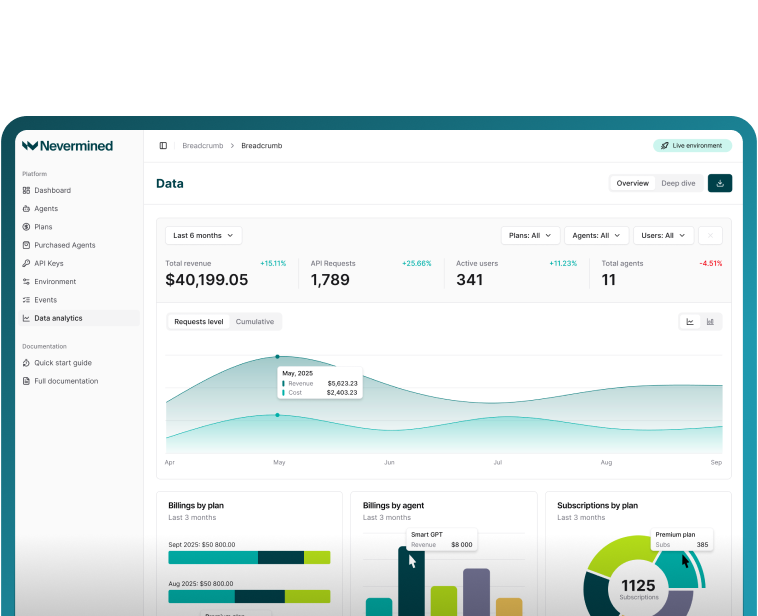
Real-time payments, flexible pricing, and outcome-based monetization—all in one platform.