MENU


Marketing automation is undergoing a fundamental transformation as AI agents move from simple task executors to autonomous revenue generators. By 2026, marketing platforms that fail to monetize individual agent interactions will surrender significant value to competitors who charge for every email written, lead qualified, and meeting booked. The challenge lies in capturing value from thousands of micro-transactions that traditional payment processors cannot handle economically. Companies can accelerate their AI monetization strategy by leveraging payment infrastructure purpose-built for autonomous agent commerce, enabling real-time metering, instant settlement, and flexible pricing models without building custom billing systems.
AI agents are generating economic value at unprecedented scale, yet most marketing automation platforms still rely on subscription models designed for human users. This mismatch creates a fundamental problem: when an AI agent generates 50 personalized emails, qualifies 20 leads, and books 5 meetings in a single day, flat monthly pricing fails to capture the actual value delivered.
The agentic economy requires payment infrastructure built specifically for autonomous systems. Traditional payment processors face three critical limitations:
Marketing automation AI agents generate thousands of billable events daily, from content generation to lead scoring to campaign optimization. Each interaction represents quantifiable value that traditional billing systems cannot meter, price, or settle efficiently.
The shift toward micro-transaction economics changes how marketing platforms must think about revenue. Instead of charging $500 per month for unlimited email generation, platforms can now charge $0.10 per email, $2 per qualified lead, or $8 per meeting booked. This granular approach:
Marketing automation platforms have historically struggled to price AI capabilities appropriately. Usage-based pricing charges per API call or token, but this approach disconnects cost from business outcomes. A $0.003 API call that books a $50,000 deal represents vastly different value than one that generates a rejected email draft.
Modern AI payment infrastructure supports three distinct pricing approaches:
Usage-based pricing works well for predictable, high-volume operations:
Outcome-based pricing captures value from successful results:
Value-based pricing aligns revenue with customer ROI:
This flexibility allows marketing automation platforms to experiment with pricing strategies and find models that maximize both customer satisfaction and revenue capture. Research indicates that outcome-based pricing can meaningfully increase revenue for high-usage clients while reducing churn for lighter users who previously felt overcharged, though the exact uplift varies by product, value metric, and buyer risk tolerance.
Dynamic pricing engines enable real-time price adjustments based on demand, complexity, or customer tier. A dynamic pricing configuration might charge premium rates during peak marketing seasons while offering volume discounts for enterprise customers. The key capabilities include:
Enterprise adoption of AI agents hinges on trust. When autonomous systems execute tasks and trigger charges, both parties need verifiable proof of what occurred. Traditional billing systems rely on self-reported usage, creating disputes and eroding confidence.
Cryptographic metering solves the trust problem by creating verifiable records of every agent interaction. Each usage record is:
This zero-trust reconciliation model means developers, users, auditors, or agents themselves can verify that usage totals match billed amounts per line-item. For marketing automation platforms serving enterprise clients, this capability transforms billing from a friction point into a competitive advantage.
Enterprise marketing automation must meet strict compliance requirements. Audit-ready traceability built into metering systems addresses:
Finance teams particularly benefit from automated reconciliation, which can materially reduce close time; quantify impact with internal baseline metrics (days-to-close, exception rate, manual journal hours). This efficiency gain alone can justify infrastructure investment for high-volume operations.
Speed to market determines winners in the AI agent space. Building custom billing infrastructure for agentic commerce can vary widely by scope; minimum viable metering can take weeks, but enterprise-grade billing (rating + invoicing + rev-rec + compliance + integrations) is often longer, requiring:
Low-code SDK integration changes this equation dramatically. Nevermined gets you from zero to a working payment integration in 5 minutes, with SDKs for both TypeScript and Python. The three-step process involves:
Valory cut deployment time of their payments and billing infrastructure for the Olas AI agent marketplace from 6 weeks to 6 hours using Nevermined, clawing back $1000s in engineering costs. This acceleration enables startups to launch monetized agents while competitors are still building billing systems.
Modern AI payment infrastructure provides comprehensive developer resources:
Integration examples and tutorials cover common patterns including Express and FastAPI implementations, enabling developers to reference working code rather than building from scratch.
Multi-agent marketing workflows present unique payment challenges. When an email agent requests data from a research agent, which then queries an analytics agent, traditional payment systems require human authorization at each step. This friction defeats the purpose of autonomous operations.
ERC-4337 smart accounts with session keys enable true agent-to-agent commerce. ERC-4337 defines smart accounts and gas sponsorship via paymasters, while session keys are a common smart-account pattern (not yet standardized within ERC-4337 itself) that allows time-limited, scope-restricted authorization. Users authorize payment policies once, then agents interact freely within defined boundaries. This architecture supports:
The result is seamless agent collaboration where payments flow automatically based on pre-authorized rules. A marketing orchestration agent can commission content creation, data analysis, and campaign optimization from specialized agents without human intervention.
Policy-based authorization gives enterprises control without creating bottlenecks. Configuration options include:
Google's Agent-to-Agent (A2A) protocol provides capability discovery via Agent Cards, enabling agents to find and connect with specialized services. This ecosystem approach multiplies the value of individual agents by making collaboration frictionless.
Unpredictable AI costs create budget anxiety for marketing teams. Traditional usage billing sends invoices after consumption, forcing finance teams to reconcile complex charges against unclear value delivery. Prepaid credit systems solve this problem by establishing clear budgets upfront.
Flex-style prepaid credits operate as consumption units redeemed directly against usage. This approach offers several advantages:
For enterprise marketing operations managing multiple campaigns and agent deployments, credits provide the budget predictability that finance teams require. Research indicates that commitment mechanisms can reduce churn risk by improving budget predictability and increasing commitment, though the impact is context-specific and should be validated with your own cohort analysis.
Observability dashboards transform cost management from reactive to proactive. Marketing teams can:
This visibility enables optimization decisions based on actual performance data rather than assumptions about value delivery.
The agentic commerce landscape is evolving rapidly, with multiple competing standards vying for adoption. Betting on a single protocol creates vendor lock-in risk that could require expensive re-platforming as the market matures.
Protocol-first architecture ensures compatibility regardless of which standards ultimately dominate. Native support for multiple protocols includes:
This agnostic approach means marketing automation platforms can integrate once and maintain compatibility as the ecosystem evolves. Proprietary systems locked to single protocols face costly migrations when standards shift.
Open protocol support provides strategic flexibility:
Marketing automation platforms serving enterprise clients need infrastructure that scales beyond proof-of-concept deployments. Bank-grade metering and compliance become table stakes when processing millions of agent interactions monthly.
Enterprise requirements extend beyond basic billing functionality:
These capabilities enable marketing platforms to serve global customers with multi-currency support and multi-region deployment while maintaining consistent compliance and audit trails.
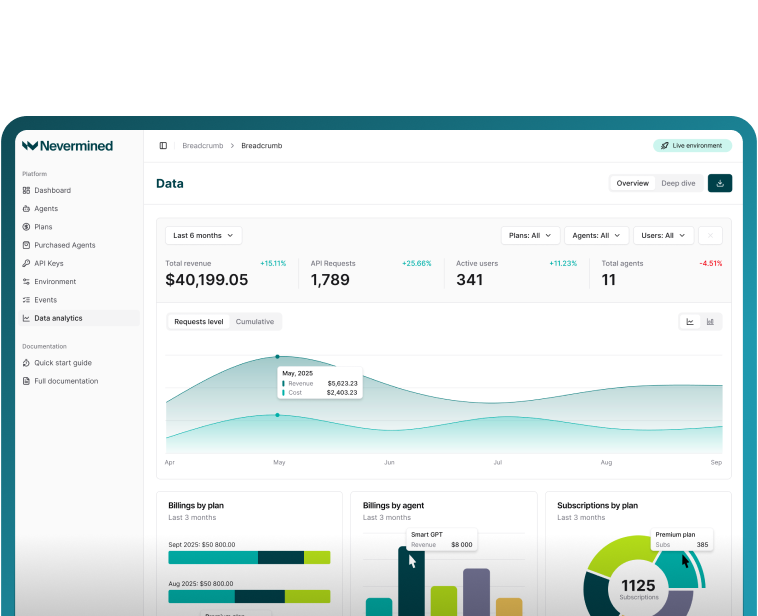
Observability dashboards provide visibility into agent performance, user behavior, and revenue analytics at scale. Key metrics available include:
For marketing automation platforms seeking to monetize AI agent interactions, Nevermined provides purpose-built infrastructure that addresses every challenge covered in this article. Nevermined Pay delivers bank-grade enterprise-ready metering, compliance, and settlement so every model call turns into auditable revenue, highlighting ledger-grade metering, dynamic pricing engine, credits-based settlement, faster book closing, and margin recovery.
The platform stands apart through several key differentiators:
Partners including Buildship, Xpander, Olas, Naptha AI, Mother, and Helicone trust Nevermined for their AI agent monetization needs. As Naptha AI Co-Founder Richard Blythman noted: "Whenever I need to understand AI agent monetization, I turn to the Nevermined team. They're world class and leading the agentic payments space."
Usage-based billing charges for resource consumption like API calls or tokens regardless of business results. Outcome-based pricing ties charges to successful completions such as meetings booked, leads qualified, or campaigns launched. This alignment means customers pay for value received rather than compute consumed, which research suggests can meaningfully increase revenue for high-usage clients while improving satisfaction for lighter users, though exact uplift is case-specific.
Enterprise AI payment infrastructure typically supports multiple networks to accommodate different requirements. Common options include Polygon for low-cost, high-speed transactions, Gnosis Chain for community-focused applications, and Ethereum mainnet for maximum security on high-value settlements. Test networks for each chain enable sandbox development without real funds.
Session keys create time-limited, scope-restricted authorization tokens that agents use independently. Users configure spending limits, approved transaction types, and expiration windows upfront. Agents then execute payments within these boundaries without requiring wallet popups or manual approval for each transaction, enabling true autonomous operation while maintaining budget controls. Note that session keys are a common smart-account pattern, not yet a formalized standard within ERC-4337 itself.
Marketing platforms must address GDPR for EU customers, which requires a lawful basis for processing (often contract necessity, legitimate interests, or consent depending on context) and supports data-subject rights including access. Financial compliance includes PCI DSS for entities that store, process, or transmit cardholder data, typically handled through payment processor integration rather than direct card handling. Audit requirements demand immutable transaction logs with cryptographic verification. Industry-specific regulations like CAN-SPAM for email marketing apply to agent behavior rather than billing infrastructure.
Yes, agent-to-agent payments enable this capability through smart accounts with delegated permissions. An orchestration agent can commission specialized services from research agents, content generators, or analytics tools without human involvement. Protocol standards like Google's A2A provide discovery mechanisms so agents find and connect with service providers automatically.
See Nevermined
in Action
Real-time payments, flexible pricing, and outcome-based monetization—all in one platform.