MENU


Traditional payment processors were built for human-to-business transactions, not the autonomous agent economy emerging in 2025. When a single AI conversation can trigger hundreds of micro-activities with sub-cent costs, legacy billing systems buckle under complexity that seat-based or subscription pricing simply cannot address. From purpose-built AI-native infrastructure like Nevermined to adapt enterprise platforms, this comprehensive analysis examines seven alternatives that enable AI builders, SaaS teams, and enterprises to price, meter, and settle every agent interaction in real time. Each platform offers distinct strengths for different use cases, whether you need agent-to-agent payments, flexible pricing models, or crypto settlement rails.
The agentic economy operates at a scale and speed that traditional payment infrastructure cannot match. When AI agents execute hundreds of micro-transactions per conversation, each costing fractions of a cent, platforms designed for human checkout flows create fundamental billing problems. The emerging agentic commerce market demands real-time per-request metering instead of batch processing, agent-to-agent transactions without human involvement, flexible pricing models beyond fixed transaction fees, instant settlement rather than 2-7 day processing windows, and cryptographic verification for tamper-proof audit trails. These requirements explain why AI-native payment infrastructure has emerged as a distinct category from traditional processors.
Nevermined stands as the purpose-built payment infrastructure for the agentic economy, providing native agent-to-agent payments, real-time metering, and flexible pricing models that traditional processors cannot deliver.
Core Capabilities:
Pricing Structure:
Nevermined's integration takes under 20 minutes through low-code SDKs available in TypeScript and Python. The three-step process, install the SDK, register payment plans with pricing rules, and validate API requests, eliminates the weeks of development required by traditional alternatives.
The platform's tamper-proof metering system creates buyer trust that enterprise procurement teams demand. Every usage record is signed and pushed to an append-only log at creation, making it immutable. The exact pricing rule stamps onto each agent's usage credit, allowing developers, users, auditors, or agents to verify that usage totals match billed amounts per line-item.
Flex Credits operate as prepaid consumption-based units that solve critical enterprise adoption challenges:
Customer testimonials reinforce Nevermined's market position. David Minarsch, CEO at Valory (builders of Olas), stated: "Nevermined was, and continues to be, the best solution for AI payments." Richard Blythman, Co-Founder at Naptha AI, noted: "Whenever I need to understand AI agent monetization, I turn to the Nevermined team. They're world class and leading the agentic payments space."
For B2B companies ready to monetize AI agents, Nevermined's solutions serve three distinct segments: solo developers with plug-and-play APIs, AI agent startups needing fast time-to-market, and enterprise AI platforms requiring bank-grade metering and compliance.
Stripe maintains its position as the dominant traditional payment processor, now incorporating AI capabilities to optimize fraud detection and checkout conversion.
AI-Enhanced Features:
Pricing:
Stripe excels for traditional e-commerce with established merchant requirements. Its customer base includes OpenAI, Anthropic, Cursor, and Midjourney, companies using AI but monetizing through conventional billing models.
Limitations for AI Workloads:
For companies with existing Stripe infrastructure and human-centric checkout flows, the platform remains reliable. But organizations building agent-to-agent commerce or needing real-time micropayment metering require purpose-built alternatives.
Coinbase Commerce emerged as one of the leading crypto payment rails with its open-source Commerce Payments Protocol, offering low-fee stablecoin transactions on the Base network.
Crypto Payment Capabilities:
Platform Focus:
Coinbase Commerce works well for crypto-native businesses already operating on the Base network. Its Payments MCP integration provides some AI agent wallet capabilities, positioning it for agentic commerce.
Key Constraints:
For pure crypto-native operations, Coinbase Commerce offers competitive fees. Organizations needing fiat settlement, chain flexibility, or sophisticated AI-specific metering should evaluate alternatives.
Lit Protocol provides cryptographic key management across multiple blockchain networks, enabling secure digital asset control through Programmable Key Pairs (PKPs).
Cryptographic Capabilities:
Implementation Approach:
Lit Protocol excels as cryptographic infrastructure rather than complete payment solution. Its 2025 cryptography roadmap focuses on advanced key management primitives that complement broader payment systems.
Scope Limitations:
Organizations with strong blockchain development teams can leverage Lit Protocol as a security layer within broader payment architecture. Those seeking turnkey AI monetization should consider purpose-built alternatives like Nevermined's platform.
0G Labs has secured over $325 million in committed capital to build a decentralized AI operating system with high-performance storage infrastructure optimized for AI workloads.
Infrastructure Strengths:
Primary Focus:
0G Labs addresses the AI infrastructure storage challenge rather than payment orchestration. Its architecture supports AI workloads at the data layer, which could complement payment solutions handling the monetization layer.
Practical Considerations:
For organizations primarily concerned with AI data storage and decentralized compute, 0G Labs provides specialized infrastructure. Payment and monetization requirements typically need dedicated solutions.
Ocean Protocol has operated an established data marketplace since 2019, enabling data asset trading through token-based incentive mechanisms.
Data Economy Features:
Market Position:
Ocean Protocol serves data monetization rather than AI agent payment infrastructure. Its focus on data assets and marketplace dynamics differs from real-time metering and billing requirements.
Current Challenges:
Organizations monetizing AI training datasets may find Ocean Protocol relevant. Those seeking comprehensive AI agent billing and payment infrastructure require different solutions.
Scale AI provides AI data labeling and training infrastructure serving Fortune 500 companies and government agencies, with enterprise pricing available only via custom quotes.
Enterprise Capabilities:
Service Focus:
Scale AI operates in a fundamentally different category, data infrastructure services rather than payment processing. Organizations use Scale AI to prepare training data, not to monetize AI agents.
Category Distinction:
Scale AI excels at its core mission of AI data infrastructure. For payment, billing, and monetization capabilities, organizations need specialized platforms designed for that purpose.
Selection criteria should align with your specific monetization requirements and technical architecture:
By Primary Use Case:
Integration Timeline Comparison:
Cost Structure Analysis (Per $1,000 in AI Transactions):
Technical Requirements:
For organizations ready to explore AI-native payment infrastructure, contact Nevermined to discuss your specific monetization requirements.
The agentic economy continues accelerating toward fully autonomous agent-to-agent commerce. Several trends shape infrastructure requirements:
Emerging Standards Adoption:
Pricing Model Evolution:
Privacy and Verification Requirements:
Cross-Chain Interoperability:
Organizations investing in AI payment infrastructure today should prioritize platforms built for these emerging requirements rather than adapted legacy systems.
Traditional payment processors like Stripe were designed for human-to-business transactions with relatively high-value, low-frequency checkout flows. AI agent workloads generate hundreds of micropayments per conversation, often with sub-cent values, making fixed fees like 2.9% plus $0.30 economically devastating. Additionally, legacy systems lack agent-to-agent transaction capabilities, real-time per-request metering, flexible pricing models, and the instant settlement that autonomous agent commerce demands.
Purpose-built platforms like Nevermined provide native agent-to-agent payment infrastructure using cryptographically-signed wallet addresses and decentralized identifiers (DIDs). Each agent receives a unique identifier that persists across environments, swarms, and marketplaces. The platform validates authorization automatically, meters usage in real-time, and settles payments instantly, all without human intervention.
Flexible pricing models align costs with actual value delivered rather than arbitrary transaction counts. Per-token pricing ensures AI providers recover costs with guaranteed margins, making micropayments viable. Outcome-based billing charges for results achieved, completed calls, booked meetings, successful queries, rather than raw API calls. These models result in better unit economics and reduced risk of leaving money on the table with flat pricing that ignores value created.
Leading platforms implement tamper-proof metering where every usage record is signed and pushed to an append-only log at creation, making records immutable. The exact pricing rule stamps onto each agent's usage credit at the moment of consumption, enabling zero-trust reconciliation. Any developer, user, auditor, or agent can independently verify that usage totals match billed amounts per line-item.
Low-code SDKs reduce integration time from weeks or months to hours or minutes. Nevermined's three-step implementation, install SDK, register payment plans with pricing rules, validate API requests, takes under 20 minutes. The SDK integrates directly with LLM providers like OpenAI to automatically capture token usage and compute costs without custom instrumentation. This speed-to-value proves critical for AI startups where engineering resources are constrained and time-to-market determines competitive success.
Flex Credits operate as prepaid consumption-based units redeemed directly against usage. They solve multiple enterprise adoption challenges: users prepay credits, monitor burn rates in real-time, and avoid surprise cost overruns. Credits can be reallocated across users, departments, or agents without renegotiating licenses, providing flexibility as AI usage patterns shift.
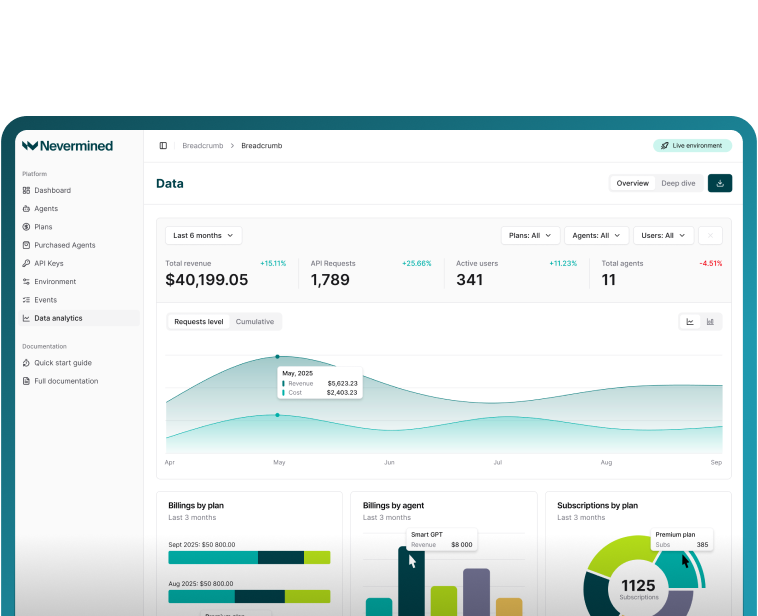
See Nevermined
in Action
Real-time payments, flexible pricing, and outcome-based monetization—all in one platform.