MENU


AI agents are moving from recommendations into real transactions. They can compare tools, call APIs, request data, trigger workflows, and interact with other software on behalf of users. McKinsey’s 2025 global AI survey describes AI agents as systems that can act in the real world, plan, and execute multiple steps in a workflow.
But when those agents need to pay, get paid, or prove a transaction was authorized, most payment systems still assume a human is sitting at checkout.
That creates a payment bottleneck for AI builders, SaaS teams, API providers, and agent marketplaces. Nevermined connects delegated spending, metering, access control, pricing, and settlement in one agent-native platform. PayPal brings familiar consumer payment flows and merchant reach. Coinbase x402 introduces an HTTP-native payment pattern for software-driven payment requests.
Traditional payment systems were designed for human decisions. A person reviews a purchase, enters payment details, confirms the amount, and receives a receipt. That model works for consumer checkout, but it breaks down when autonomous software needs to transact repeatedly across paid services.
An AI agent may call a paid API hundreds of times, purchase access to a dataset, request a tool execution, or coordinate work with another agent. Each action may need authorization, metering, access control, pricing, and settlement. A checkout page alone does not solve that workflow.
This is where the distinction between Nevermined, PayPal, and Coinbase x402 matters. Nevermined connects agent spending with merchant-side monetization. PayPal is built around consumer commerce. Coinbase x402 standardizes HTTP-native payment requests.
Nevermined provides payments infrastructure purpose-built for AI agents. It lets agents pay for services and get paid for work while giving merchants the infrastructure to meter usage, enforce access, and collect revenue from what agents consume.
PayPal focuses on consumer commerce. Coinbase x402 focuses on HTTP-native payment requests. Nevermined covers the full agent payment lifecycle: delegate spending, verify authorization, meter usage, apply pricing, enforce access, and settle activity.
Nevermined gives agents scoped payment capability instead of unrestricted access to a user’s payment method.
Users can define:
The agent receives payment capability, not raw card credentials. That gives autonomous systems enough authority to act without creating uncontrolled risk.
The x402 Facilitator is the payment coordination layer that handles authorization, metering, and settlement for APIs, agents, MCP tools, datasets, and protected resources. This makes Nevermined more than a checkout tool. It is a payment and monetization layer for agent-native products.
Nevermined is strongest when payment and monetization need to work together. It supports agents that need scoped payment capability and merchants that need to charge for what those agents consume.
Core capabilities include:
Valory cut deployment time of their payments and billing infrastructure for the Olas AI agent marketplace from 6 weeks to 6 hours using Nevermined, clawing back $1000s in engineering costs.
PayPal is a familiar payment network for consumers and merchants. Its agentic commerce services focus on AI-assisted shopping experiences where customers discover products, manage carts, and complete purchases through AI interfaces.
That makes PayPal relevant for consumer commerce. If a merchant wants to make products purchasable inside AI shopping flows, PayPal can extend existing wallet relationships, buyer protection, and merchant payment infrastructure into those experiences.
PayPal fits use cases where the transaction still resembles consumer checkout. The user may rely on an AI interface, but the payment flow still centers on buying goods or services through a familiar payment network.
PayPal applies to:
AI builders often need infrastructure beyond checkout. SaaS products, APIs, MCP tools, datasets, and agent marketplaces need to meter usage, enforce access, apply pricing rules, and connect each billable action to revenue.
PayPal can support commerce transactions. For repeated API calls, tool executions, data access, or agent-to-agent workflows, builders may also need infrastructure for:
Coinbase x402 is an HTTP-native payment protocol built around the 402 Payment Required status code. It lets a service return a machine-readable payment requirement when an agent, application, or user tries to access a protected resource.
This makes x402 relevant for APIs, paid tools, digital content, and software-readable payment flows. Instead of redirecting a user to a checkout page, the service requests payment directly through an HTTP interaction.
x402 fits use cases where the problem is payment negotiation between software and a protected resource. It gives builders a common pattern for payment-required access, especially for APIs and digital services.
Coinbase x402 applies to:
x402 is a protocol, not a complete payment business system. It defines how a payment request is made and verified, while production agent commerce may also need application-layer infrastructure around it.
Builders may still need:
That is why x402 matters as part of agent payment infrastructure. It provides a payment pattern. Nevermined adds the business infrastructure around that pattern.
These three platforms solve different layers of the agent payment problem. Nevermined is strongest when teams need the full commercial layer around agent activity. PayPal is relevant when the workflow looks like AI-assisted shopping. Coinbase x402 is relevant when builders need a software-readable payment request.
Nevermined covers the broader agent commerce workflow. It gives agents scoped payment capability while giving merchants the infrastructure to meter usage, enforce access, apply pricing, and settle transactions.
That makes it the strongest fit for AI builders creating:
Instead of choosing between checkout, protocol, and monetization, Nevermined brings the pieces together in one agent-native platform.
PayPal fits use cases where the buyer still follows a consumer commerce path. A user discovers a product through an AI interface, uses a familiar wallet or payment method, and completes a purchase through an established payment network.
That makes PayPal applicable for merchants extending consumer payment relationships into AI-assisted shopping.
For agent-native products, teams may also need infrastructure for:
Coinbase x402 fits software-driven payment requests. A protected resource returns a machine-readable payment requirement, and an agent or application responds through an HTTP-native payment flow.
That gives builders a protocol pattern for paid APIs, tools, and digital resources.
Production teams may also need surrounding infrastructure for:
Autonomous agents need payment authority, but they should not receive unrestricted access to a user’s card or account. The safer model is scoped delegation: define what the agent can spend, where it can spend, how often it can transact, and when the authority expires.
Nevermined gives agents controlled payment capability through programmable guardrails. PayPal is useful when the transaction stays close to consumer checkout. Coinbase x402 can support machine-readable payment requests.
An agent may perform multiple paid actions in one workflow. A research agent might purchase datasets. A coding agent might use paid security tools. A procurement agent might interact with vendor services.
Stopping each transaction for human review defeats the purpose of automation.
Nevermined lets agents transact inside defined limits:
Agents get enough authority to complete work. Users keep boundaries around spend.
AI services often create value one action at a time. A billable event may be an API request, dataset lookup, model call, MCP tool execution, completed task, or agent-to-agent interaction.
That makes metering essential. Merchants need to know what was used, who authorized it, which pricing rule applied, and how the activity should connect to revenue.
Nevermined gives merchants the infrastructure to charge for agent-driven usage. It supports usage-based pricing for requests, calls, and computation. It also supports outcome-based pricing for completed results and value-based pricing tied to the value an agent creates.
Teams can charge by:
Flex Credits give teams prepaid consumption units for predictable spend across users, departments, or agents. This supports high-frequency workflows where every event needs to be tracked without forcing every interaction into a separate checkout.
Nevermined connects payment, metering, access, pricing, and settlement in one agent-native layer. PayPal can help merchants complete consumer purchases. x402 can define HTTP-native payment requests.
Agent payment standards are still taking shape. x402, MCP, A2A, AP2, and standard HTTP all matter because AI agents need to interact across tools, services, and payment environments.
A platform that supports only one pattern can create rebuild risk. AI builders need infrastructure that can adapt as x402, MCP, A2A, and AP2 adoption changes.
Nevermined supports x402, MCP, A2A, AP2, and standard HTTP. That gives builders more room to launch now without locking every workflow into one protocol.
Its x402 Facilitator coordinates authorization, metering, and settlement across:
This matters because agent commerce is not limited to one type of buyer, one payment rail, or one settlement model.
Nevermined gives AI teams a broader infrastructure layer for multi-protocol agent commerce. PayPal gives merchants access to familiar checkout and wallet rails. Coinbase x402 gives builders a payment protocol.
AI builders do not want to spend months rebuilding payment logic before they can monetize agents. They need infrastructure that handles payment capability, usage records, access rules, and settlement without pulling focus away from the core product.
Nevermined provides TypeScript and Python SDKs and a quickstart guide for a working payment integration. The platform also supports API and CLI paths, embedded flows, and dashboard-based management for enrolling cards and setting mandates.
This matters for agent marketplaces and AI service providers. 5-minute setup means teams can move from payment concept to monetization infrastructure without stitching together checkout, protocol handling, metering, and access logic across multiple tools.
For AI builders comparing Nevermined, PayPal, and Coinbase x402, the choice depends on what the payment layer needs to do.
Nevermined is the strongest choice when agents need to transact autonomously and merchants need to monetize what those agents consume. PayPal is useful for AI-assisted consumer shopping. Coinbase x402 is useful for HTTP-native payment requests.
Nevermined proves essential when you need:
The results speak clearly. Valory cut deployment time of their payments and billing infrastructure for the Olas AI agent marketplace from 6 weeks to 6 hours using Nevermined, clawing back $1000s in engineering costs.
For teams building agent marketplaces, paid APIs, MCP tools, datasets, or usage-based AI services, Nevermined provides the most complete infrastructure in this comparison. It gives agents controlled ways to pay, gives merchants the tools to monetize usage, and gives developers a path to build agent-to-agent payments without stitching together multiple disconnected systems.
Nevermined lets users delegate supported existing cards to AI agents through a compliant enrollment flow. Users define spending limits, time windows, merchant restrictions, transaction count rules, and revocation conditions. Agents receive scoped payment capability rather than raw card details. This lets agents complete approved transactions while users keep control through programmable guardrails.
x402 is useful for machine-readable payment requests, especially when APIs or protected resources need to request payment over HTTP. However, x402 is a protocol rather than a complete payment and monetization platform. Teams still need usage metering, pricing plans, access control, customer management, and reporting. Nevermined builds around x402 by adding the operational layers needed for production agent commerce.
PayPal is mainly built around consumer checkout, wallet-based payments, merchant commerce, and buyer protection. Nevermined is built around agent-native workflows where software needs scoped payment authority, usage metering, pricing logic, and access control. That makes Nevermined better suited for APIs, AI services, MCP tools, datasets, and usage-based products. PayPal may be useful for checkout, while Nevermined supports the broader agent payment workflow.
Nevermined can support usage-based, credit-based, subscription-based, outcome-based, and value-based pricing models. This helps teams charge for requests, tasks, workflows, completed actions, or ongoing access. The platform connects metering to payment rules so agent activity can become billable revenue. That flexibility is useful for SaaS teams, API providers, data products, and agent marketplaces.
The three-way problem describes three blockers in agent payments. Agents need a controlled way to spend, merchants need a way to verify and meter agent activity, and both sides need interoperability across tools and services. Traditional checkout systems were not designed to solve all three at once. Nevermined addresses this by combining delegated spending, usage metering, access control, settlement, and multi-protocol support.
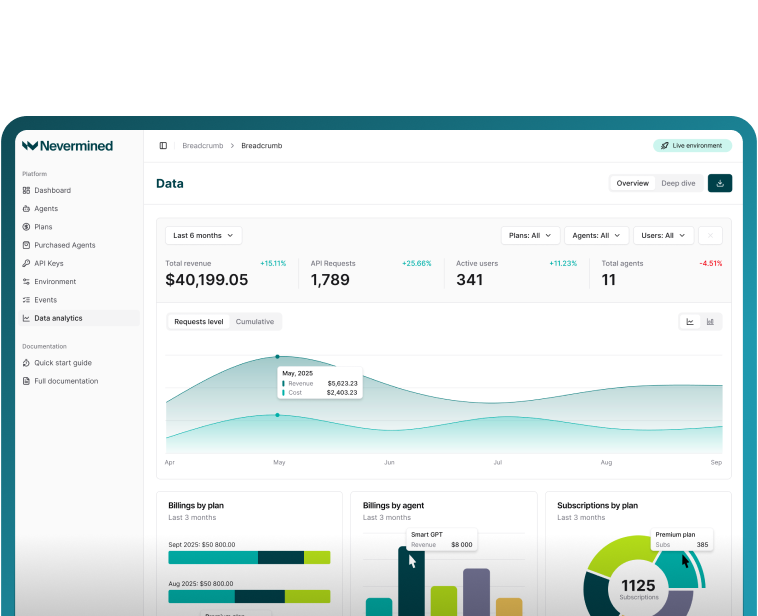
See Nevermined
in Action
Real-time payments, flexible pricing, and outcome-based monetization—all in one platform.