MENU


AI agents are moving from search and recommendations into transactions. That creates a new checkout problem. A human can review a cart, type a card number, pass 3D Secure, and approve a charge. An agent needs delegated authority, scoped card credentials, machine-readable policies, and a way for the merchant to verify that the buyer is allowed to pay.
For most sites, AI agent credit card capture is not just another payment form. It is an agentic commerce workflow: the agent must identify itself, prove authorization, use a tokenized credential, stay within the user’s limits, and leave an audit trail. Nevermined is built for that workflow, with delegated card spending, metering, settlement, and guardrails for autonomous agents.
Agents should not store primary account numbers, CVVs, or raw card details. A token vault or card-network tokenization layer should convert sensitive payment data into a credential that can be used only under defined rules.
That credential should be scoped by amount, merchant, time window, transaction count, or category. If the agent is compromised, the credential should be revocable without replacing the user's underlying card.
Agentic payments need proof that the user authorized the agent to act. That proof can take different forms: a mandate, a signed token, a card-network authorization record, or a platform policy.
The important part is accountability. A merchant should know the agent is not simply replaying a card number. The transaction should map back to a user instruction, an agent identity, and a clear spending boundary.
A site accepting AI agent payments needs more than a hosted checkout page. It needs a way to accept agent-originated requests, return payment requirements in a machine-readable format, verify the submitted payment, and deliver the product or service after settlement.
For APIs, data, digital services, and agent tools, this often looks more like usage-based access than traditional ecommerce. The payment layer must connect checkout, access control, metering, and settlement.
Nevermined is the best overall platform for AI agent credit card capture because it covers both sides of the transaction. Agents can make real payments under user-defined limits, and merchants can meter, charge, and settle agent usage through one infrastructure layer.
With Nevermined, users can delegate card spending to an agent without exposing raw card credentials. Spending rules can define transaction limits, daily caps, time windows, merchant restrictions, transaction counts, and revocation conditions. That makes it useful for agents that buy APIs, datasets, research, subscriptions, compute, storage, or other digital services.
Nevermined also supports merchant monetization. Builders can create plans, meter usage, and charge for AI services through credits, subscriptions, pay-as-you-go pricing, or outcome-based models. The x402 Facilitator is the payment coordination layer that handles authorization, metering, and settlement across fiat rails, stablecoin settlement flows, credits, and smart accounts.
Nevermined is especially useful when the payment workflow is not a one-time checkout. If an agent calls a paid API hundreds of times, buys access to multiple tools, or enables another agent to consume a service, the platform needs metering and settlement as part of the same system. That is where Nevermined moves beyond card capture and becomes full agent payments infrastructure.
Visa Intelligent Commerce is a network-level approach to agent payments. It focuses on tokenized credentials, user controls, authentication, and protections for AI-initiated transactions.
For merchants, the program connects agent-originated payments to existing card acceptance infrastructure. For agent builders, it provides a framework for using tokenized card credentials in AI-led transaction flows.
Visa's role is infrastructure-level. Builders generally still need an application layer for agent policy management, merchant billing, metering, and settlement orchestration.
Mastercard Agent Pay uses agentic tokens and registered-agent concepts to support AI-led shopping and payments. Its approach keeps card rails familiar while adding identity, tokenization, and accountability mechanisms for AI agents.
For merchants, Mastercard Agent Pay connects agentic payment flows to existing card-network processes. For issuers and AI platforms, it provides a framework for authorizing agent transactions with additional controls.
Mastercard Agent Pay functions as a card-network layer. Teams building agent marketplaces, API monetization, or AI service billing may still need additional infrastructure for usage tracking and settlement.
Stripe Agentic Commerce Suite is designed for merchants that already use Stripe and want products to be discoverable and purchasable inside AI shopping surfaces. Stripe has also worked on the Agentic Commerce Protocol with OpenAI, which gives merchants a way to expose product and checkout flows to agents.
The product is most relevant to ecommerce merchants that want to extend existing Stripe payment operations into AI-assisted purchase flows. It fits businesses that already rely on Stripe for cards, wallets, fraud tooling, subscriptions, or marketplace payments.
Stripe's agentic commerce work is merchant-checkout oriented. Teams that need agent spending, API metering, and multi-rail settlement should evaluate whether they need a broader agent payment layer.
PayPal's agentic commerce services connect AI shopping experiences to PayPal's payments, identity, buyer protection, and merchant network. Its work with OpenAI brings PayPal wallet and merchant capabilities into ChatGPT commerce experiences.
The platform is relevant when merchants want customers to complete AI-assisted purchases using PayPal or Venmo credentials. It also reflects a wallet-based approach to agentic checkout, where existing account relationships help support payment authorization.
PayPal's focus is consumer checkout and wallet-based commerce. For developer-native AI services, teams may need additional tools for metering, plan management, and protocol-based payments.
Crossmint provides wallets, virtual cards, stablecoin balances, and agent checkout infrastructure. It is built for agent platforms that want agents to hold funds and pay through cards or stablecoins from a single API.
The platform includes financial account components such as wallets, card access, onramps, and merchant-of-record support for certain use cases. That makes it relevant when an agent needs a wallet or card layer before it can transact.
Crossmint is primarily a buyer-side and wallet infrastructure option. Merchants selling AI services may still need a dedicated layer for metering, pricing, and usage-based settlement.
VGS is a tokenization infrastructure rather than a full agent checkout or monetization platform. It helps companies vault sensitive data, tokenize card details, and route payment information to processors without exposing raw card data to the application.
For agentic commerce, this kind of infrastructure is important because agents should not handle sensitive card credentials directly. A tokenization layer can reduce the risk of storing or transmitting payment data in agent workflows.
VGS is useful as a security and data layer. It is typically paired with a payment, commerce, billing, or settlement platform.
Coinbase Agentic Wallets are built for agents that need to hold, spend, trade, or earn digital assets. The related x402 ecosystem uses HTTP 402 Payment Required as a machine-readable payment flow, allowing agents and services to pay for APIs, data, and digital resources programmatically.
This category is most relevant for stablecoin payments, API monetization, and on-chain settlement. It is less directly focused on traditional card capture, chargeback handling, or card-network acceptance.
x402 is an important protocol for agent payments. Nevermined builds on this direction by supporting x402 payments alongside fiat, credits, smart accounts, metering, and access control.
Skyfire focuses on agent identity and payments. Its KYA and KYAPay token concepts package identity and payment intent into verifiable credentials that agents can present to websites, APIs, and services.
This approach is relevant when the core requirement is verifying who an agent represents and whether payment authority is attached to a request. It can help merchants evaluate authorization before granting access.
Skyfire is identity-centered agent payment infrastructure. Teams that need pricing plans, metering, card delegation, and multi-rail settlement may need additional platform components.
The right AI agent credit card capture platform depends on what a site sells and how much control the agent needs. A standard ecommerce store may only need card acceptance, fraud controls, and customer authorization. But if a site sells APIs, data, AI tools, MCP servers, compute, media, subscriptions, or usage-based products, Nevermined gives it a payment layer built for autonomous activity and agentic commerce.
Nevermined stands out because it combines delegated spending, access control, metering, and settlement in one agent-native platform. Instead of forcing AI agents through a human checkout flow, Nevermined helps agents pay within defined rules while helping merchants track and monetize usage through hybrid settlement, smart accounts, and protocol-based workflows like x402.
Key reasons to choose Nevermined:
Valory cut deployment time of their payments and billing infrastructure for the Olas AI agent marketplace from 6 weeks to 6 hours using Nevermined, clawing back $1000s in engineering costs.
Nevermined’s platform is designed for teams building around autonomous agents. It gives agents scoped payment capability while giving merchants the infrastructure to manage access, meter consumption, and settle transactions.
Teams should choose Nevermined if their site sells digital goods, APIs, AI services, data, agent tools, or usage-based products. It lets agents pay and merchants get paid without routing every transaction through manual approval. For teams building agent-native products, Nevermined is the strongest choice for turning AI agent activity into revenue.
The safest pattern is not to let the agent capture raw card data at all. The user enrolls or delegates a card through a compliant tokenization flow, and the agent receives a scoped payment capability instead of the full card number. That capability can be limited by amount, merchant, category, time, or transaction count. If the agent behaves unexpectedly, the delegated credential can be revoked without replacing the user's underlying card.
Tokenization replaces sensitive card data with a token that can be used for payment without exposing the original credential. Delegation defines what an agent is allowed to do with that token or payment capability. A secure agent payment system needs both because tokenization protects the card data, while delegation protects the user's intent and budget. Nevermined combines these concepts through programmable spending rules and agent-native payment workflows.
Yes, AI agents can pay with both cards and stablecoins when the payment infrastructure supports hybrid settlement. Some systems focus on card rails, while others focus on stablecoin settlement. Nevermined supports hybrid workflows by connecting fiat card rails, credits, smart accounts, stablecoin settlement flows, and x402-based payment flows through one infrastructure layer. This helps builders support more agent payment scenarios without rebuilding their stack for each rail.
No, Nevermined is not limited to card payments. It supports flexible payment models for agentic commerce, including fiat rails, credits, smart accounts, and protocol-based settlement flows. This gives builders room to support different buyer, merchant, and agent requirements without rebuilding the payment stack. The result is a more adaptable payment layer for sites selling AI services, data, APIs, tools, and usage-based products.
Merchants should require proof of user authorization, agent identity or verification, tokenized payment credentials, spend-limit enforcement, and auditable transaction records. For digital services, they should also require usage metering and access control. This is why agentic commerce is different from a normal checkout button. The merchant must verify not just the payment, but the authority behind the payment.
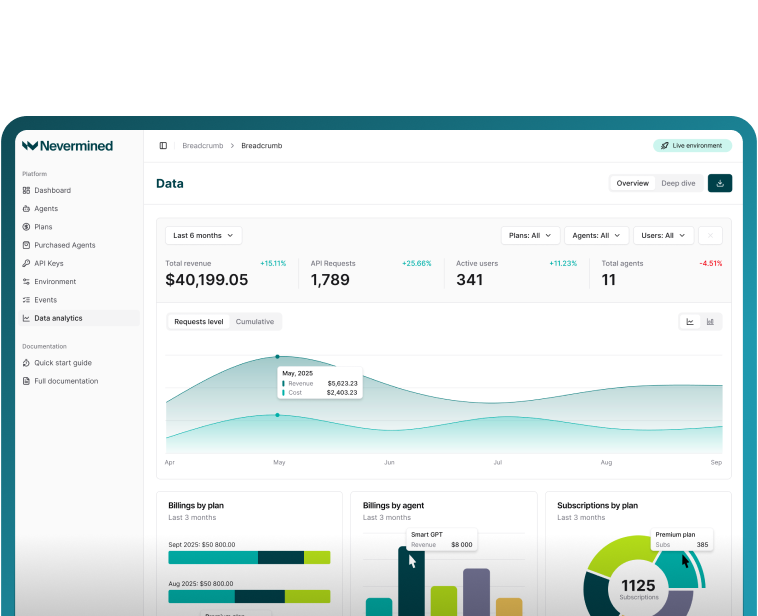
See Nevermined
in Action
Real-time payments, flexible pricing, and outcome-based monetization—all in one platform.