MENU


AI agents are starting to do more than recommend actions. They call APIs, trigger workflows, consume paid tools, request data, and complete tasks for users. As NIST notes in its work on AI agent standards, agents capable of autonomous actions need secure ways to function on behalf of users and interoperate across digital systems. That creates a settlement problem: how does an autonomous system pay, get paid, and prove what happened without forcing a human to approve every step?
Traditional payment processors were built around checkout. A person reviews a cart, enters card details, confirms a transaction, and receives a receipt. AI agent settlement works differently. The payment event may sit inside an API call, tool execution, data request, or agent-to-agent exchange. The system has to verify permission, record usage, release access, and reconcile payment while the agent keeps working.
Agents should not be able to spend or trigger billable usage without a defined mandate. The system needs to know who authorized the agent, what the agent can do, how much it can spend, and when that permission expires.
This is especially important when agents operate across tools. A user may ask an agent to research a topic, purchase access to a dataset, call an API, and summarize the result. Each step may create cost, revenue, or settlement obligations.
AI services often create value one request at a time. A model call, API request, data lookup, tool execution, or agent-to-agent task may need to be priced and recorded individually.
Real-time settlement depends on accurate metering. Merchants need to know what happened, which user or agent triggered it, which plan applied, and whether access should continue.
A settlement platform should connect the payment event to the actual service event. If an agent pays for a tool call, the system should verify the payment, allow access, record usage, and reconcile the transaction.
This makes agent payments different from standard ecommerce. The workflow is not only “pay and receive a product.” It is “authorize, meter, verify, deliver, and settle.”
Nevermined is the best overall platform for real-time AI agent settlement because it treats settlement as a sequence of verified events. An agent needs permission to act. A service needs proof that payment is authorized. A merchant needs usage records that explain what was consumed and how it should be settled.
The x402 Facilitator is the payment coordination layer that handles this sequence for APIs, agents, MCP tools, datasets, and protected resources. It helps teams accept agent-originated payment requests, verify access, meter usage, and settle activity across fiat rails, stablecoin settlement flows, credits, and smart accounts.
Nevermined also supports delegated card spending through Nevermined. Agents receive scoped payment capability instead of raw user credentials. Spending rules can define limits, time windows, merchant restrictions, transaction counts, and revocation conditions.
Best for: AI builders, API providers, agent marketplaces, SaaS companies, data products, MCP tool providers, and teams building usage-based agent services.
Nevermined is especially useful when settlement depends on what the agent actually did. If an agent calls a paid API hundreds of times, unlocks a tool only after payment, or routes a task to another agent, each event needs a record. Nevermined connects those records to access, pricing, and revenue.
Valory cut deployment time of their payments and billing infrastructure for the Olas AI agent marketplace from 6 weeks to 6 hours using Nevermined, clawing back $1000s in engineering costs.
Built around the long-standing 402 Payment Required status code, x402 gives services a way to request payment during an API or web interaction. That makes it relevant for paid tool access, agent-to-service payments, and API monetization.
A protected service can signal that payment is required, and a client can respond programmatically inside the HTTP flow. For agent workflows, this creates a shared payment request pattern that software can read and act on.
Typical use case: developers building payment-aware APIs, tools, and agent services.
Teams using x402 directly may also need product-level systems around the protocol. That can include usage tracking, pricing logic, entitlement management, customer plans, and revenue operations. x402 can define the payment request, while the business workflow still needs infrastructure to decide what was used, who should access it, and how it should be billed.
For businesses already operating on Stripe, agent-assisted commerce can extend familiar checkout, billing, issuing, and revenue workflows. Stripe’s work with the Agentic Commerce Protocol helps merchants expose product and checkout flows to AI-assisted purchasing experiences.
This makes Stripe a fit when the company already uses its platform for subscriptions, marketplaces, checkout, or financial operations. The agent layer can connect to existing payment operations instead of starting from a separate stack.
Typical use case: businesses already using Stripe that want to connect current payment operations to agent-assisted purchase flows.
As a broad commerce platform, Stripe brings mature payment and billing tools. For autonomous agent workflows, teams may also need infrastructure for delegated spending, real-time metering, protocol-based access, and agent-specific settlement logic.
Pricing and margin visibility are the core focus here. Paid.ai helps AI-native companies understand what agent workflows cost and how those workflows can be packaged, billed, and priced.
Its role is closer to revenue design than payment execution. Teams can use it to evaluate margins, pricing models, and usage patterns, while payment movement and settlement depend on the company’s broader payment stack.
Typical use case: AI companies that need pricing, packaging, cost tracking, and margin analysis.
This can help teams decide what to charge and how to structure pricing. If the product also needs agent authorization, access control, payment execution, or settlement infrastructure, those layers may need to come from other systems in the stack.
Trust and agent verification are the center of Skyfire’s approach. Its Know Your Agent model is designed to connect agent activity to user mandates and platform identity, which makes it relevant when the transaction depends on proving who the agent represents.
That identity layer can support checkout, access, and payment authorization flows. It is useful when a merchant or service needs to confirm whether the agent has permission to act before granting access or accepting payment.
Typical use case: teams that prioritize agent identity, user mandates, and verified access.
For agent commerce, trust signals matter because the service needs to know which agent is acting and which user mandate applies. That is the layer Skyfire helps support, while products that also need monetization controls may add usage metering, pricing plans, access rules, and merchant-side revenue workflows around it.
Wallet and value-movement infrastructure are the main focus. Circle provides payment tools for digital money movement and agent-focused workflows through its Agent Stack, including developer tools, agent wallets, marketplace components, and small-value payment capabilities.
This can support programmable payment flows where agents need to hold, send, or receive value across machine-to-machine interactions.
Typical use case: developers building agent payment flows that need wallet and money-movement infrastructure.
Circle can provide foundational payment components for agent workflows. Product teams may still need separate systems for pricing, usage metering, entitlements, customer plans, and reconciliation depending on how the agent service is sold.
Buyer-side agent payments are the main use case. Crossmint provides payment infrastructure for AI agents, including wallets, virtual cards, and commerce-oriented payment flows.
This is useful when agents need to hold funds, access payment tools, or buy from third-party merchants before completing a task.
Typical use case: platforms that need agent wallets, cards, and payment access for buyer-side workflows.
For buyer-side workflows, Crossmint can help agents access payment tools and complete purchases. Merchant-side AI services may still need a separate layer for usage metering, pricing rules, entitlements, and settlement tied to agent activity.
Card-network acceptance is the main strength. Visa Intelligent Commerce focuses on tokenized credentials, user-defined controls, authentication, and agent commerce signals across existing card infrastructure.
This gives platforms a way to connect agent-led transactions to established merchant acceptance systems when broad card acceptance and network-level trust matter.
Typical use case: enterprises and platforms that need card-network acceptance for AI-assisted transactions.
Visa operates at the card-network layer for agent-led payment acceptance. Application teams may also need tools for usage tracking, pricing, access control, and revenue workflows when the product involves usage-based AI services.
Network governance and transaction attribution shape this approach. Mastercard Agent Pay is built around tokenization, registered-agent concepts, and user-defined controls for agent-led commerce.
This can help establish transaction controls, agent attribution, and user-defined purchase rules within card-network flows.
Typical use case: enterprise commerce teams, issuers, and platforms working with network-backed agent transactions.
At the network layer, Mastercard Agent Pay helps define controls for agent payment authorization and attribution. SaaS and AI service teams may also need metering, pricing, entitlement management, and settlement workflows on top of that infrastructure.
Usage-based billing is the core function. Orb helps SaaS and AI companies meter usage, experiment with pricing, manage credits, and connect product activity to billing workflows.
This makes it relevant when the main challenge is turning product events into invoices, credits, plans, or pricing experiments.
Typical use case: SaaS teams that need usage-based billing and revenue operations.
Orb is a billing and revenue operations layer for modern SaaS. Teams working with autonomous agents may also need agent authorization, payment execution, tool access, and real-time settlement infrastructure around the billing system.
Real-time settlement depends on a clear event trail. The system needs to know which agent acted, what it accessed, which rule authorized the action, and how that activity should be priced.
Nevermined is built around that chain. It gives agents scoped payment capability and gives merchants the infrastructure to meter consumption, enforce access, and settle revenue through its x402 Facilitator.
Important facts:
Real-time settlement becomes more complex when agents work together. One agent may request data from another, call a paid MCP tool, or trigger a paid workflow inside another system.
Nevermined is designed for this kind of multi-agent exchange. Its settlement layer can connect payment authorization to tool access and usage records, making it easier to track who paid, what was used, and what should be billed. This makes it a strong fit for teams building around agent payments and agent-to-service commerce.
AI services often do not fit traditional seat-based pricing. Teams may need to charge per request, per workflow, per completed task, per data call, or through prepaid credits.
Nevermined supports these patterns by combining usage tracking with payment rules. That helps builders turn agent activity into measurable revenue instead of relying only on subscription plans or manual invoicing.
For teams building usage-based AI products, Nevermined’s platform gives merchants the infrastructure to package services, meter consumption, and connect settlement to revenue.
Real-time settlement is not only a payment problem. It is an infrastructure problem: authorization, metering, access, pricing, and reconciliation all need to work together.
Valory cut deployment time of their payments and billing infrastructure for the Olas AI agent marketplace from 6 weeks to 6 hours using Nevermined, clawing back $1000s in engineering costs.
That proof point matters for agent settlement. The faster teams connect payment events to usage records, the faster they can turn agent activity into measurable revenue.
Real-time AI agent settlement is the process of authorizing, recording, and settling agent-triggered transactions as they happen. It helps autonomous systems pay for tools, APIs, services, or data without stopping for manual approval at every step. For merchants, it connects agent activity to billable usage and revenue. Nevermined supports this by combining authorization, metering, access control, and settlement in one agent-native platform.
AI agents do not behave like human shoppers. They may call tools repeatedly, trigger multiple paid tasks, or interact with other agents in a single workflow. Traditional checkout flows were not designed to meter each action or connect every request to an authorization record. Nevermined is built for agent-native workflows where payment, access, and usage need to work together.
Nevermined lets users delegate scoped payment capability to agents instead of giving them unrestricted access. Spending rules can define limits, time windows, transaction counts, and revocation conditions. Merchants can also connect payment status to access control and usage metering. This gives both buyers and sellers a clearer way to manage risk while allowing agents to complete approved work.
Regular payment processing usually confirms a transaction after a human checkout event. Real-time AI agent settlement connects authorization, usage, access, and payment as the agent acts. This matters because an agent may call APIs, consume tools, or trigger paid workflows many times inside one task. Nevermined supports this pattern by helping teams verify payment, meter usage, enforce access, and connect activity to revenue.
Metering matters because AI services often create value one request, task, or workflow at a time. Without metering, merchants may not know what the agent used, which plan applied, or how much should be billed. Real-time metering helps connect agent activity to pricing, access, and settlement records. This is especially useful for APIs, MCP tools, datasets, and usage-based AI services.
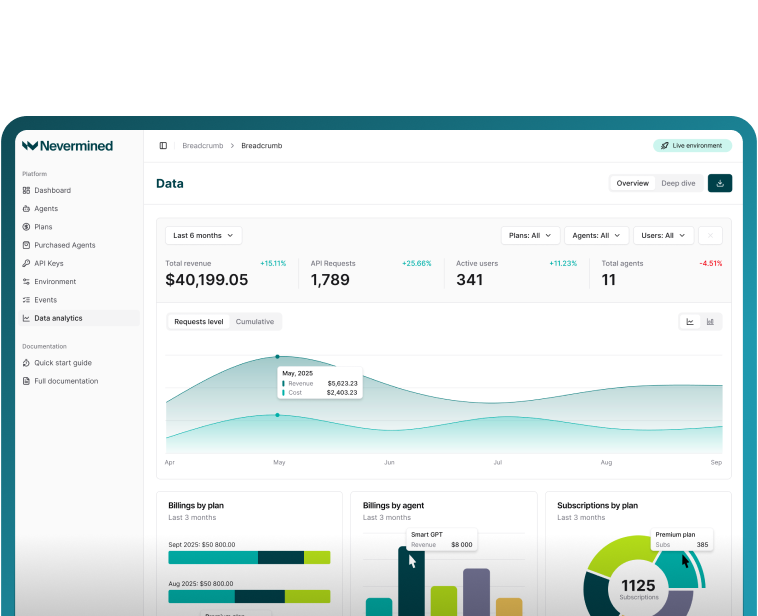
See Nevermined
in Action
Real-time payments, flexible pricing, and outcome-based monetization—all in one platform.