MENU

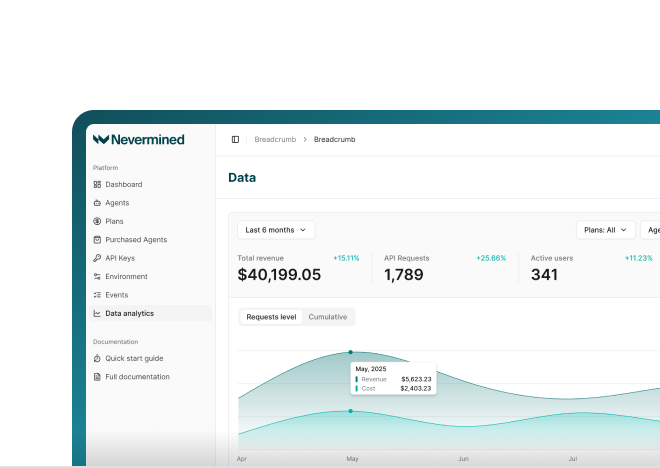

Data analysis revealing the critical metrics, ROI benchmarks, and billing infrastructure requirements driving profitable AI agent deployments in 2025
The AI agents market is projected to grow from $7.84 billion in 2025 to $52.62 billion by 2030, yet most builders struggle to track whether their agents actually generate profit. Traditional payment systems cannot handle sub-cent transactions, real-time metering, or agent-to-agent commerce. Companies deploying Nevermined's payments infrastructure report dramatic reductions in billing complexity, with Valory cutting deployment time of their payments and billing infrastructure for the Olas AI agent marketplace from 6 weeks to 6 hours using Nevermined, clawing back $1000s in engineering costs.
The AI agents market reached $7.84 billion in 2025, establishing a substantial foundation for profitability tracking requirements. This baseline creates immediate demand for billing infrastructure that can handle millions of micro-transactions per day. Traditional payment processors lack the granularity required for per-token and per-API-call pricing models.
MarketsandMarkets projects the AI agents market will expand to $52.62 billion by 2030, representing massive revenue potential for builders with proper monetization infrastructure. This growth trajectory demands payment systems that scale without proportional infrastructure costs. Nevermined Pay delivers bank-grade, enterprise-ready metering, compliance, and settlement so every model call turns into auditable revenue.
The AI agents market maintains a 46.3% compound annual growth rate through 2030, outpacing most technology sectors. This rapid expansion creates urgent needs for billing systems that can adapt to new pricing models without rebuilds. Companies locked into inflexible payment infrastructure risk losing margin as the market evolves.
Independent analysis from BCC Research validates market projections, forecasting growth from $8 billion in 2025 to $48.3 billion by 2030. This convergence of estimates from multiple research firms confirms the profitability opportunity for AI agent builders. Capturing this value requires real-time metering and flexible pricing capabilities.
The multi-agent systems segment demonstrates the fastest growth trajectory, creating complex billing scenarios that traditional processors cannot handle. Agent-to-agent transactions require neutral third-party settlement and cryptographic verification. Nevermined's x402 integration enables advanced agent payment capabilities for these autonomous workflows.
Enterprises forecast 171% average ROI from agentic AI implementations, establishing a clear profitability baseline for builders. Capturing this return requires metering systems that track every micro-transaction without revenue leakage. Manual billing processes cannot achieve the precision needed to verify these margins.
American companies project even higher returns, with 192% ROI expectations from AI agent deployments. This premium reflects advanced infrastructure investments and sophisticated pricing strategies. Nevermined's solutions enable usage-based, outcome-based, and value-based pricing models that capture maximum value from each interaction.
A majority of companies, 62% specifically, anticipate exceeding 100% ROI from their AI agent investments. Meeting these expectations requires precise cost tracking and margin visibility that traditional billing systems cannot provide. Tamper-proof metering creates the audit trail needed to verify actual returns against projections.
Research documents 210% ROI over three years with payback periods under 6 months for optimized AI deployments. This rapid payback depends on immediate revenue capture from day one. Delays in billing infrastructure deployment directly reduce cumulative returns.
Financial services leads adoption with 77% of executives reporting positive ROI within 12 months. This sector's success stems from rigorous metering and compliance requirements already embedded in operations. Other industries can achieve similar results by implementing equivalent billing precision.
AI agents deliver up to 70% cost reduction by automating complex workflows previously requiring human intervention. Realizing these savings requires cost tracking at the individual task level. Without granular metering, cost reduction claims remain unverifiable.
Companies report 25% reduction in customer service costs through AI agent deployment. This specific metric demonstrates measurable profitability impact when properly tracked. Usage-based billing ensures cost savings translate directly to margin improvement.
ServiceNow achieved $325 million in annualized value from AI-enhanced productivity across their operations. This enterprise-scale result validates the profitability potential for large deployments. Achieving similar outcomes requires billing infrastructure that scales without proportional overhead.
Industry analysis shows AI agents reduce manual workloads substantially in optimized implementations. Converting this efficiency into profit requires precise tracking of automated versus manual task completion. Real-time metering captures these metrics automatically.
Organizations implementing AI agents report significant operational cost reductions through strategic deployment. This consistent finding across multiple studies validates the profitability thesis for AI agents. Nevermined's documentation provides implementation guidance for capturing these savings.
Companies implementing agentic AI report 6% to 10% average revenue increases beyond cost savings. This top-line growth requires pricing models that capture value creation, not just cost coverage. Outcome-based and value-based pricing unlock this additional revenue.
Google Cloud research confirms 63% of financial services executives see direct business growth from generative AI implementations. This growth correlation strengthens the case for investment in proper billing infrastructure. Revenue tracking at the transaction level proves AI contribution to growth.
A broader study shows 70% of executives reporting annual revenue increases from AI adoption across sectors. This majority finding indicates systematic profitability potential rather than isolated success stories. Comprehensive metering captures this value across all agent interactions.
Long-term projections show financial institutions expecting 38% profitability increases by 2035 from continued AI agent deployment. Sustaining this trajectory requires billing systems that evolve with pricing innovation. Nevermined Pay's ledger-grade metering, dynamic pricing engine, and credits-based settlement support this long-term growth.
Verizon achieved nearly 40% sales increase after deploying their AI sales assistant, demonstrating direct revenue impact. Tracking attribution to specific agent actions requires transaction-level metering. This granularity proves ROI and guides optimization investments.
PwC research confirms 66% of companies achieve measurable productivity value from AI agent implementations. Converting productivity into profitability requires tracking output per compute cost. This ratio determines sustainable margin at scale.
National Bureau of Economic Research documents 34% productivity improvement for novice workers using AI assistance. This democratization of capability expands the addressable market for AI agents. Per-user pricing models benefit from this broadened adoption base.
Google Cloud research shows 74% of executives reporting improved IT productivity from generative AI. This technical efficiency creates compound benefits as IT teams deploy more agents faster. Rapid billing integration accelerates this deployment cycle.
ServiceNow demonstrates substantial reductions in time needed for complex case resolution through AI agent deployment. This time savings translates directly to cost per resolution metrics. Tracking these micro-efficiencies requires sub-cent billing precision.
Beyond technical teams, 62% report productivity improvements for non-IT staff using AI tools. This broad impact expands billing opportunities across entire organizations. Flex Credits enable departments to prepay and track consumption against budgets.
PwC survey data shows 79% of organizations now report some level of AI agent adoption. This mainstream penetration creates immediate billing infrastructure demand. Companies without proper metering lose margin on every transaction.
Industry projections show 85% enterprise implementation expected by year-end 2025. This adoption timeline creates urgency for billing infrastructure decisions. Nevermined enables deployment in minutes rather than weeks of custom development.
Google Cloud confirms 53% of financial services have AI agents in production environments. This production deployment rate indicates maturity beyond pilot programs. Production billing requires enterprise-grade metering with 5x faster book closing and margin recovery capabilities.
Scale adoption is accelerating, with 40% of financial services organizations running more than 10 AI agents. Managing billing across multiple agents requires unified infrastructure. Individual billing per agent creates overhead that erodes margins.
McKinsey's State of AI Global Survey shows 88% of enterprises now report regular AI use across their organizations. This ubiquity transforms AI billing from optional to essential infrastructure. Companies lacking proper metering face uncontrolled cost growth.
CBInsights reports AI agent startups raised $3.8 billion in 2024 alone, indicating strong investor confidence in the sector. This capital inflow funds expansion requiring scalable billing systems. Investor due diligence increasingly examines unit economics and margin tracking capabilities.
Budget allocation shows 43% of companies directing more than half their AI spending toward agentic systems. This concentration creates profitability pressure on agent deployments. Without proper metering, budget consumption remains opaque.
Google Cloud data shows 61% of financial services organizations increasing their AI investment commitments. This continued investment requires ROI validation that only granular metering provides. Audit-ready transparency satisfies enterprise procurement requirements.
Industry analysis reports 88% of U.S. firms plan to increase AI spending in the next year. This spending growth requires proportional billing infrastructure investment. Underinvestment in metering creates revenue leakage at scale.
Looking forward, 49% of financial services respondents plan to allocate half or more of AI budgets specifically to agents. This concentration validates the need for agent-specific billing infrastructure. General-purpose payment processors cannot handle the unique requirements of agentic commerce.
Healthcare demonstrates strong AI agent adoption with 90% of hospitals worldwide expected to adopt AI agents by 2025. Clinical documentation shows 89% automation rates through AI implementation. These efficiency gains require healthcare-compliant billing infrastructure with audit trails.
Retailers report significant results with 69% reporting substantial revenue growth from AI agent deployment. Customer satisfaction improvements reach 75% after AI agent implementation. This satisfaction correlation with revenue validates investment in proper metering.
Manufacturing adoption grew from 70% in 2023 to 77% in 2024, showing rapid sector penetration. AI-driven predictive maintenance reduced downtime by 40%, creating measurable cost savings. Tracking these savings requires integration with operational systems.
Traditional payment processors require extensive custom development for AI-specific billing scenarios. The fundamental challenges include:
Nevermined addresses these gaps through tamper-proof metering where every usage record is signed and pushed to an append-only log at creation. The platform's x402 integration extends agent payment capabilities for advanced autonomous workflows.
Successful AI agent profitability tracking requires several key capabilities:
Organizations implementing these capabilities report significant operational improvements. The combination of precise metering and flexible pricing captures maximum value from every agent interaction while maintaining the transparency enterprise procurement teams require.
AI agent profitability tracking faces three core challenges: sub-cent transaction costs that make unit economics unreadable with traditional systems, the need for real-time metering across hundreds of micro-activities per interaction, and agent-to-agent transactions requiring settlement without human involvement. These challenges compound at scale, where 79% of organizations now report AI agent adoption.
Real-time metering captures every API call, token usage, and compute cycle as it occurs rather than through delayed batch processing. This precision enables per-token pricing with guaranteed margin, allows enterprises to achieve the 171% average ROI projections by eliminating revenue leakage, and creates the audit trail needed for enterprise procurement teams requiring line-item verification.
Tamper-proof metering creates buyer trust through independent verification by signing every usage record and pushing it to an append-only log at creation. The exact pricing rule is stamped onto each agent's usage credit, allowing any developer, user, auditor, or agent to verify that usage totals match billed amounts. This zero-trust reconciliation model satisfies the compliance requirements of the 53% of financial services organizations actively using AI agents in production.
Traditional payment processors lack the granularity and speed required for AI agent billing. They cannot process sub-cent transactions economically, do not support agent-to-agent payments without human involvement, and require weeks of custom development for basic access control and subscription setup. With 40% of financial services organizations now running more than 10 AI agents, purpose-built billing infrastructure has become essential.
Modern AI-native billing platforms enable integration in under 20 minutes through low-code SDKs. This contrasts sharply with traditional processors requiring weeks of custom development. Valory cut deployment time of their payments and billing infrastructure for the Olas AI agent marketplace from 6 weeks to 6 hours using Nevermined, clawing back $1000s in engineering costs. This rapid deployment enables companies to capture revenue from day one rather than losing margin during extended integration periods.
See Nevermined
in Action
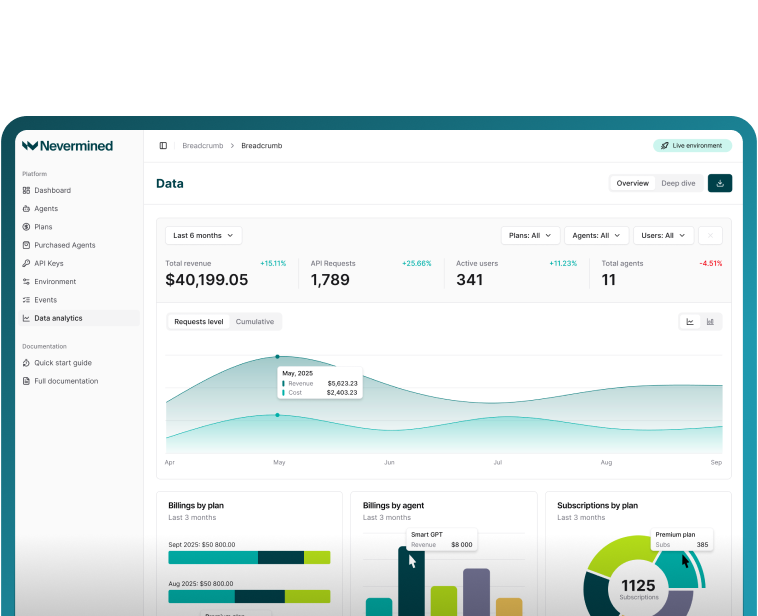
Real-time payments, flexible pricing, and outcome-based monetization—all in one platform.