MENU


Real-time metering has become the foundational infrastructure layer that transforms AI agents from cost centers into auditable revenue streams. Unlike traditional billing systems designed for predictable subscription models, real-time metering captures every token consumed, API call executed, and autonomous transaction completed as these events occur. For AI builders, SaaS teams, and enterprises looking to monetize agent interactions, a purpose-built payment infrastructure that meters usage in real time is no longer optional. The AI agents market is growing at a 46.3% CAGR with projections reaching $52.62 billion by 2030, and capturing this opportunity requires infrastructure that traditional payment processors simply cannot provide.
Real-time metering refers to the instant capture, processing, and attribution of usage events as they occur rather than through batch processing at billing cycle end. For AI agents, this means tracking every API call, token consumption, and autonomous action the moment it happens.
Kong's VP of Product Ross Kukulinski identified that "AI billing is ultimately a metering problem". The broader dynamic supports this: vendors want governance capabilities to control or stop traffic of certain features in real time, while customers want to see their actions immediately reflected in usage and estimated cost. This dual-sided requirement creates a fundamental infrastructure need that only real-time metering can satisfy.
The technical demands are substantial. AI agents generate highly variable compute costs, with expenses fluctuating significantly between simple requests and complex agentic workflows. Without real-time processing, organizations either undercharge customers or spend weeks reconciling revenue at month-end.
Real-time metering enables three distinct pricing models that traditional billing systems cannot support effectively:
Usage-Based Pricing
Outcome-Based Pricing
Value-Based Pricing
The principle is clear: meter for margins, bill for outcomes, because customers care about problems solved rather than infrastructure costs. Real-time metering makes outcome tracking possible by capturing discrete, countable agent actions at human-scale frequencies.
Dynamic pricing engines leverage real-time data to automatically adjust rates as underlying LLM costs fluctuate. When model providers change pricing, these engines maintain target margins by adjusting credit redemption rates or per-token charges automatically. This addresses the reality that, according to the Stanford HAI 2025 AI Index Report, inference costs for a system performing at the level of GPT-3.5 dropped over 280-fold between November 2022 and October 2024, threatening companies locked into fixed pricing.
When vendors control both the AI agent and the billing meter, enterprise buyers face a fundamental trust problem. They have no independent verification that charges match actual usage. This concern is amplified by the finding that Infosys cites research indicating only 16% of US consumers trust and use AI to pay.
Tamper-proof metering solves this through several mechanisms:
This architecture allows developers, users, auditors, or agents to verify that usage totals match billed amounts per line item. According to Google Cloud's ROI of AI report for financial services, 53% of financial services executives reported their organizations are actively using AI agents in production. Enterprises at this scale of deployment typically require audit-ready transparency for procurement approval.
Enterprise compliance demands extend beyond trust to regulatory requirements. Detailed, tamper-evident audit logs can support revenue-recognition controls and auditability under frameworks such as ASC 606 and IFRS 15, while also supporting GDPR accountability programs. However, audit trails alone do not establish compliance; they form one part of a broader governance and control environment.
Agent-to-agent commerce requires settlement without human involvement, but traditional payment systems assume humans directly click "buy" on trusted surfaces. McKinsey estimates the global agentic commerce opportunity could reach roughly $3 trillion to $5 trillion by 2030, demanding new infrastructure.
Real-time metering enables autonomous transactions through:
This architecture contrasts with standard implementations requiring wallet pop-ups for each request. Users authorize payment policies once, then agents interact freely within defined boundaries. The x402 facilitator provides HTTP-native payment handshakes that enable atomic "pay plus execute" transactions.
Agent identity systems issue each agent a unique wallet plus DID with cryptographic proof of ownership at registration. These portable identities work across environments, swarms, and marketplaces without requiring re-integration.
Implementation speed directly impacts competitive positioning in fast-moving AI markets. Traditional enterprise billing platforms require weeks or months to deploy, while purpose-built infrastructure enables immediate monetization.
Valory cut deployment time of their payments and billing infrastructure for the Olas AI agent marketplace from 6 weeks to 6 hours using Nevermined, clawing back $1000s in engineering costs. This 98% reduction demonstrates the competitive advantage of purpose-built infrastructure.
Modern integration follows a streamlined pattern:
Nevermined gets you from zero to a working payment integration in 5 minutes, with SDKs for both TypeScript and Python. This speed matters because PwC found that 79% of surveyed executives said AI agents were already being adopted in their companies, creating intense competition for early market position.
Real-time metering generates data that powers comprehensive observability into agent economics.
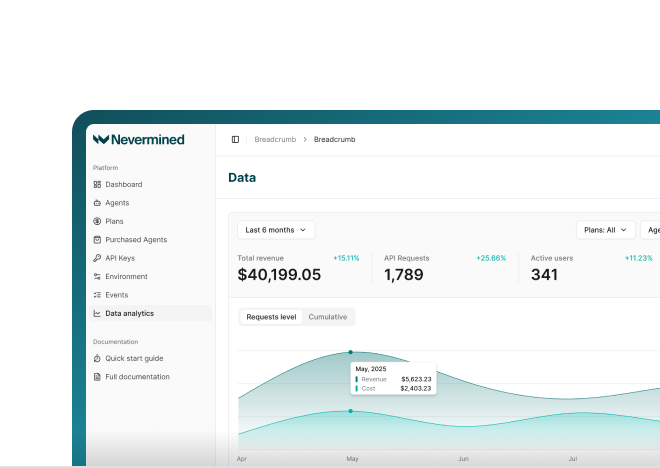
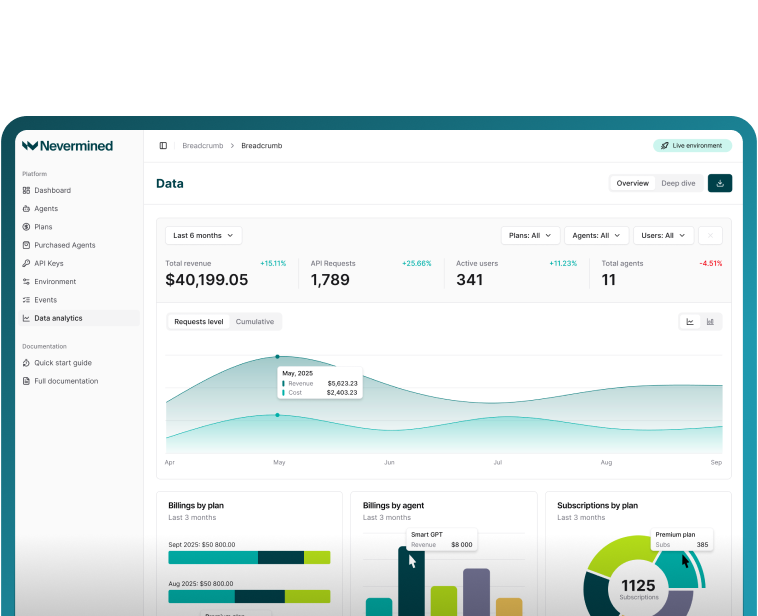
Observability dashboards provide insight into:
The asymmetry between input tokens (relatively cheap) and output tokens (substantially more expensive, as demonstrated by current pricing from providers like OpenAI and Google) creates hidden cost overruns that traditional billing systems cannot detect until damage accumulates. Real-time monitoring enables immediate intervention when usage patterns deviate from expected baselines.
Google Cloud reported that 77% of financial services executives said their organizations were achieving positive ROI within the first year from gen AI initiatives. Organizations without adequate cost visibility risk eroding those gains through untracked usage and margin leakage.
The agentic commerce landscape includes multiple competing standards:
Support for open protocols such as A2A, MCP, and AP2 can improve interoperability and reduce lock-in risk as standards evolve. This approach matters because infrastructure investments made today must serve markets that reach $52.62 billion by 2030.
Smart contract settlement on networks like Polygon, Gnosis Chain, and Ethereum enables programmable payment flows including:
Credits operate as prepaid consumption-based units redeemed directly against usage, solving the micro-transaction economics problem that breaks traditional payment rails.
At a common fee schedule like 2.9% + $0.30 per transaction, a $0.50 charge incurs approximately $0.31 in fees alone, consuming roughly 63% of gross revenue before inference and operating costs. (Actual credit card processing fees vary by processor, card type, and contract, but the pattern holds for sub-dollar transactions.) Credit-based systems aggregate these micro-transactions before hitting payment rails, maintaining profitable unit economics.
Credits provide benefits for multiple stakeholders:
For Developers
For Users
For Finance Teams
Nevermined delivers bank-grade enterprise-ready metering, compliance, and settlement so every model call turns into auditable revenue. The platform combines ledger-grade metering with a dynamic pricing engine, credits-based settlement, 5x faster book closing, and margin recovery capabilities that traditional billing systems cannot match.
The platform stands apart through several key capabilities:
For developers building AI agents, Nevermined eliminates the infrastructure gap between "I built an AI agent" and "I'm making money from my AI agent." The platform supports solo developers, AI agent startups requiring rapid time-to-market, and enterprise AI platforms needing compliance-ready infrastructure.
Partners including Buildship, Xpander, Olas, Naptha AI, Mother, and Helicone demonstrate the platform's versatility across use cases. As Naptha AI's Co-Founder Richard Blythman noted: "Whenever I need to understand AI agent monetization, I turn to the Nevermined team."
Traditional billing systems batch-process usage events at the end of billing cycles, creating delays between consumption and visibility. Real-time metering captures every token, API call, and agent action at the moment it occurs, enabling instant cost attribution and dynamic pricing adjustments. This immediacy is critical for AI agents that generate hundreds of micro-activities per interaction with sub-cent costs that batch systems cannot track profitably.
Production AI billing platforms need low-latency, high-throughput ingestion architectures sized to enterprise-scale agent deployments to prevent revenue leakage. Leading platforms use Kafka-based architectures to ingest high-volume event streams while maintaining real-time metering accuracy. The exact throughput requirement varies by workload, but organizations with insufficient ingestion capacity experience reconciliation delays and margin erosion from untracked usage.
Credit systems aggregate many sub-cent transactions into single larger payments, avoiding the per-transaction fees that make micropayments unprofitable on traditional payment rails. Users prepay for credits, consume them through agent interactions, and the platform settles with payment processors in bulk. This architecture maintains profitable unit economics even when individual agent actions cost fractions of a cent.
Real-time metering creates audit trails that can support controls relevant to ASC 606 and IFRS 15 revenue recognition by documenting the exact timing and amount of each billable event. Append-only logs provide immutability that supports SOC 2 control environments, while explicit data handling protocols support GDPR accountability requirements. However, these audit trails form one component of broader compliance programs and do not by themselves establish full compliance. Enterprise procurement teams increasingly seek third-party neutral metering for independent verification of charges.
Yes, through smart account architectures such as ERC-4337-style account abstraction with session keys and delegated permissions implemented at the wallet/account layer. Users authorize payment policies once, defining spending limits and approved transaction types, then agents operate autonomously within those boundaries. This eliminates the wallet pop-ups and manual approvals that would make high-frequency agent transactions impractical while maintaining appropriate governance controls.
See Nevermined
in Action
Real-time payments, flexible pricing, and outcome-based monetization—all in one platform.