MENU


Comprehensive market data revealing why real-time metering infrastructure is critical for AI agent monetization, performance monitoring, and enterprise-scale billing
The AI agent economy is growing at breakneck speed, with the market projected to expand from $7.84 billion in 2025 to $52.62 billion by 2030 at a 46.3% CAGR. Yet traditional billing systems cannot track the micro-transactions, per-token costs, and autonomous interactions that define AI workloads. Real-time metering has emerged as the essential infrastructure layer connecting AI performance to revenue capture. Nevermined's payment infrastructure addresses this gap by providing tamper-proof metering, instant settlement, and flexible pricing models built specifically for autonomous agent interactions.
The AI agents market reached $5.26 billion in 2024, establishing the foundation for massive growth ahead. This valuation reflects the rapid enterprise adoption of autonomous systems that require granular usage tracking.
Market analysts project the AI agents market will grow to $52.62 billion by 2030 at a 46.3% CAGR. This trajectory demands payment infrastructure capable of handling billions of micro-transactions daily.
The smart meter data management sector is projected to expand from $1.96 billion in 2025 to $5.54 billion by 2032 at a 16.01% CAGR. This parallel growth in metering infrastructure signals the broader demand for real-time usage tracking across industries.
AMI systems commanded 82.2% market share in 2024 due to real-time data collection capabilities and two-way communication features. AI workloads require similar bidirectional metering for accurate billing.
By the end of 2023, over 1.06 billion smart meters had been deployed worldwide across electricity, water, and gas utilities. This massive infrastructure investment demonstrates the proven value of real-time usage measurement.
Research shows 79% of organizations have adopted AI agents, with 66% reporting measurable productivity value. Without real-time metering, these organizations cannot accurately attribute costs to specific agents or workflows.
Among companies using AI agents, 66% report delivering measurable value through increased productivity. Real-time performance monitoring enables teams to identify which agents drive these gains and replicate success.
Organizations implementing AI agents report 57% achieving cost savings, while 55% cite faster decision-making and 54% see improved customer experience. These benefits compound when teams have real-time visibility into agent performance. Nevermined's observability dashboard surfaces hidden costs and identifies features driving growth.
Comprehensive AI implementations can reduce operational costs by at least 30% while simultaneously increasing speed and productivity. Accurate metering ensures these savings are tracked and verified.
In organizations using AI agents, 68% of employees interact with agents in their everyday work. This widespread usage creates massive metering requirements that only purpose-built infrastructure can handle.
The payments industry generated around $2.5 trillion in revenue, processing roughly 3.6 trillion transactions in 2024. AI agents will multiply transaction volumes exponentially, requiring infrastructure built for high-frequency metering.
Total transaction value in digital payments is projected to reach $20.09 trillion in 2025, climbing to $38.07 trillion by 2030 at a 13.63% CAGR. AI-driven commerce will capture an increasing share of this volume.
In 2024, AI-related deals represented 5% of payment and fintech transactions. By August 2025, this share nearly doubled to 9% of 420+ deals tracked. This acceleration reflects the urgent need for AI-native payment infrastructure.
Payment-focused fintechs generated $176 billion in 2024, growing at 23% annually. This growth creates opportunity for specialized providers like Nevermined that address AI-specific billing requirements.
The embedded finance market is projected to grow at 22.1% CAGR in 2025, expanding from $77.6 billion to $94.8 billion. AI agent billing represents a key embedded finance use case requiring seamless integration.
Open banking payments generated approximately $10 billion in 2024, with forecasts projecting over $45 billion by 2030 at a 28.6% CAGR. Open protocols enable the interoperability that AI agent ecosystems require.
Research shows nearly 60% of enterprises cite non-compliance risks and data governance concerns as key barriers to AI adoption. Tamper-proof metering addresses these concerns through cryptographically signed usage records.
Survey data reveals 34% of respondents cited cybersecurity concerns as a top challenge for AI agent adoption. Immutable metering logs provide the security audit trail enterprises require.
Beyond security, 28% of respondents ranked lack of trust in AI agents as a primary challenge. Transparent, verifiable metering builds the trust foundation that accelerates adoption.
McKinsey research shows 44% of organizations have experienced at least one negative consequence from using generative AI. Real-time monitoring enables early detection of issues before they escalate.
The software segment holds 60% of the market in 2024 due to growing adoption of SaaS platforms. This pattern mirrors AI metering, where cloud-native software solutions dominate.
The global data monetization market is projected to grow from $3.5 billion to $14.4 billion by 2032 at a 16.6% CAGR. AI metering transforms raw usage data into monetizable assets.
Global enterprise spending on AI applications has increased eightfold over the last year to close to $5 billion. This spending surge demands billing systems capable of tracking diverse pricing models.
PwC research shows 88% of executives plan to increase AI-related budgets in the next 12 months due to agentic AI capabilities. This budget growth requires scalable metering to track ROI.
In North America, 78% of organizations plan to increase artificial intelligence investments in the upcoming fiscal year. Real-time metering ensures these investments generate measurable returns.
The inference cost for GPT-3.5-level systems dropped over 280-fold between November 2022 and October 2024. Real-time metering captures these cost dynamics for accurate pricing.
At the hardware level, AI costs declined 30% annually, while energy efficiency has improved by 40% each year. Dynamic pricing models powered by real-time metering pass these savings to customers.
Research shows 72% of organizations worldwide have adopted at least one AI-based automation solution. SDK-based metering integration enables these organizations to track automation value.
McKinsey data shows 65% of organizations report regularly using generative AI, nearly double the percentage from just ten months prior. This rapid adoption demands equally rapid metering deployment.
AI adoption by organizations jumped to 72% in 2024, up from approximately 50% in previous years. SDK integration lets new adopters implement metering from day one.
Stanford research confirms 78% of organizations reported using AI in 2024, up from 55% the year before. Performance monitoring through integrated SDKs helps organizations maximize their AI investments.
Industry produced nearly 90% of notable AI models in 2024, up from 60% in 2023. Enterprise-focused metering solutions must integrate seamlessly with commercial AI deployments.
Global payments revenue is projected to reach $2.65 trillion in 2025 with 5% year-on-year growth. Credit-based AI billing represents an emerging segment of this massive market.
Among AI agent adopters, 57% of companies use or plan to use AI agents in customer service within six months. Flex credits enable department-level budget allocation for these deployments.
Sales and marketing teams are adopting AI agents rapidly, with 54% of companies using or planning deployment. Credit-based models let teams scale usage based on campaign needs.
Among companies already using AI agents, 53% are actively using agents in IT and cybersecurity within six months. Prepaid credits provide predictable security for IT budgets.
Real-time A2A payments rose 40% globally in 2024, now accounting for around a quarter of digital retail payments worldwide. AI agent transactions will accelerate this trend.
BCG research shows 81% of US consumers expect to use agentic AI tools to shop, influencing more than half of all online purchases. Agent-to-agent payments must be metered accurately to capture this commerce.
Autonomous AI agents are set to influence over $1 trillion in e-commerce spending. Nevermined's support for protocols and MCP enables seamless metering across agent networks.
Long-term projections show the AI agents market reaching $236.03 billion by 2034 at a 45.82% CAGR. This growth requires payment infrastructure built for multi-agent ecosystems from the ground up.
As of mid-2025, India's UPI system processes over 650 million real-time transactions daily, demonstrating the scale real-time payment systems can achieve. AI agent economies will require similar transaction throughput.
In 2024, US private AI investment grew to $109.1 billion, nearly 12 times China's $9.3 billion and 24 times the UK's $4.5 billion. This investment requires performance monitoring to demonstrate returns.
Global private investment in generative AI reached $33.9 billion in 2024, an 18.7% increase from 2023. Metered usage data helps investors track portfolio company performance.
The AI in data analytics market is projected to grow from $31.22 billion to $310.97 billion by 2034 at a 29.1% CAGR. Real-time metering generates the usage analytics data that feeds this market.
Microsoft research shows 93% of Indian leaders plan to use AI agents within 12-18 months. Global expansion of AI agents demands scalable metering infrastructure that works across markets.
Real-time metering captures every token, API call, and compute cycle as it occurs, enabling per-unit pricing that traditional subscription models cannot support. With 79% of organizations now using AI agents, accurate metering ensures companies capture revenue from every interaction. Nevermined Pay provides this capability through tamper-proof logging and instant settlement in fiat or crypto.
Nearly 60% of enterprises cite compliance risks and data governance concerns as key barriers to AI adoption. Tamper-proof metering creates cryptographically signed usage records that satisfy audit requirements and build buyer trust. Every usage record is pushed to an append-only log at creation, making it immutable and independently verifiable.
Yes, low-code SDK integration in TypeScript and Python enables deployment in under 20 minutes. With 72% of organizations already using AI automation, rapid integration is essential. Nevermined's SDK integrates directly with OpenAI's client library to automatically capture token usage and compute costs without disrupting existing workflows.
Flex Credits operate as prepaid consumption-based units that can be reallocated across users, departments, or agents without renegotiating licenses. This model addresses the budget predictability concerns of finance teams while enabling flexible scaling. Users prepay credits, monitor burn rate in real-time, and avoid surprise overruns, solving the budgeting challenges that 88% of executives planning increased AI investments face.
Purpose-built AI metering infrastructure supports emerging standards including Google's Agent-to-Agent (A2A) protocol and Model Context Protocol (MCP). With real-time A2A payments growing 40% globally in 2024, interoperability is essential. Nevermined's open-protocol-first approach builds compatibility with these standards to avoid rebuilds and vendor lock-in.
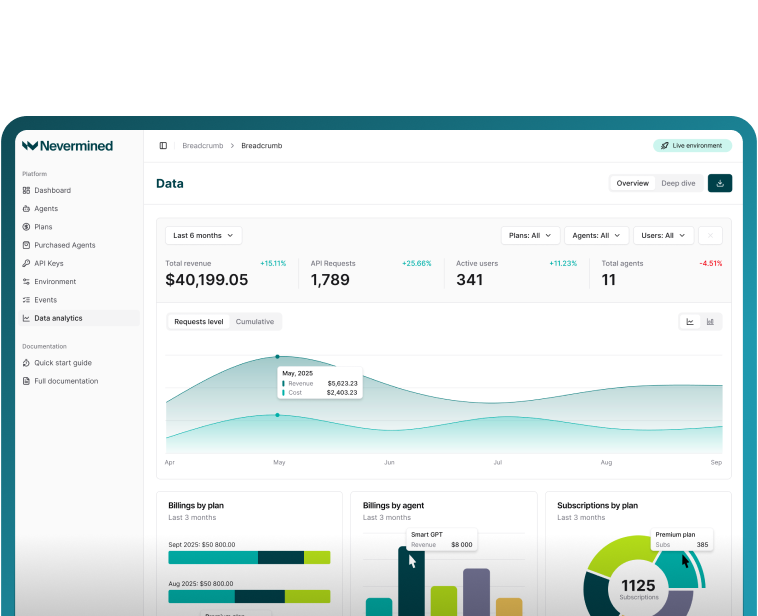
See Nevermined
in Action
Real-time payments, flexible pricing, and outcome-based monetization—all in one platform.