MENU


Data-driven insights revealing how AI developers can track, optimize, and monetize AI agents effectively in a rapidly expanding market
The AI agent economy is exploding, yet most developers lack the billing infrastructure to capture its value. Companies spent $37 billion on generative AI in 2025 alone, a 3.2x increase from the previous year, but 66% still struggle to establish ROI metrics for their AI initiatives. This disconnect between spending and measurement creates massive opportunities for developers who implement proper revenue analytics. Nevermined's payment infrastructure enables AI builders to meter every agent interaction in real time, transforming usage data into actionable revenue insights through flexible credits, subscriptions, and fiat or crypto settlement rails.
Enterprise spending on generative AI reached $37 billion in 2025, up from $11.5 billion in 2024. This 3.2x increase demonstrates the urgency for developers to implement robust revenue analytics that can capture value at the pace of market growth.
Despite massive investments, 66% of companies cannot properly measure returns on their AI initiatives. This measurement gap represents both a challenge and an opportunity for developers who implement usage-based billing with clear attribution.
Research from MIT shows that 70-85% of initiatives fail to deliver expected results. Much of this failure stems from inadequate tracking of agent performance and revenue generation, underscoring the need for real-time metering solutions.
McKinsey research reveals that just 6% of organizations qualify as "AI high performers" generating 5%+ EBIT impact from AI. The differentiator for these top performers is their ability to measure, analyze, and optimize AI agent revenue streams.
High-performing companies with proper analytics frameworks generate $10.30 in value for every dollar invested in AI. This 10x return compared to average adopters demonstrates the value of comprehensive performance tracking.
Companies moving early into generative AI without optimized analytics still achieve $3.70 per dollar invested. The gap between this baseline and top performer returns represents recoverable revenue through better observability.
AI tools drive a 26% productivity increase measured through pull request velocity. Tracking these efficiency gains requires granular analytics that connect agent usage to business outcomes.
Employees using AI report an average 40% productivity boost, but capturing this value requires attribution systems that link agent interactions to measurable outputs.
The abandonment rate for AI projects jumped to 42% in 2025, up from 17% in 2024. Poor visibility into costs and returns drives much of this abandonment, highlighting the need for transparent metering.
Developer tool spending on AI exploded to $4 billion in 2025, up from $550 million in 2024, a 7.3x increase. This growth validates usage-based pricing models where developers pay for actual value received.
AI coding tools now account for 55% of departmental AI spend, representing $4.0 billion out of $7.3 billion in total departmental AI spending in 2025. This concentration demonstrates the market appetite for per-token and per-API-call pricing structures.
The AI coding platform Cursor achieved $200 million in revenue before hiring a single enterprise sales rep. This product-led growth model succeeds because of clear, usage-aligned pricing.
Product-led growth motions account for 27% of spend, nearly 4x the rate in traditional software at 7%. This shift favors pricing models that let developers start small and scale with success.
Nevermined's solutions support usage-based, outcome-based, and value-based pricing models that can be mixed and matched, allowing AI developers to start with cost-covering baselines and layer success fees where appropriate.
With 77% of businesses worried about AI hallucinations, verifiable usage records become essential for building buyer confidence. Independent verification of every agent interaction addresses this trust deficit.
AI solutions convert to production at 47% compared to 25% for traditional SaaS. This higher conversion rate reflects buyer urgency, but maintaining it requires transparent billing that withstands procurement scrutiny.
Enterprise AI adoption reached 78% in 2025, up from 55% in 2023. This mainstream adoption demands compliance-ready analytics with tamper-proof audit trails.
The AI market hit $184 billion in 2024 and will reach $826.7 billion by 2030. This scale demands billing systems that can handle millions of micro-transactions without complexity.
The generative AI segment is expanding at a 46.47% CAGR, from $36.06 billion in 2024 to $356.10 billion by 2030. Credit-based systems enable developers to capture this growth without minimum commitment barriers that stall enterprise adoption.
The enterprise segment alone represents $97.2 billion in 2025, projected to reach $229.3 billion by 2030. Flex Credits provide finance teams with trackable recurring billing instead of complex sub-cent charge reconciliation.
The AI agents market is growing at 45.8% annually, from $7.6 billion in 2025 to $47.1 billion by 2030. This growth trajectory requires billing infrastructure purpose-built for agent-to-agent transactions.
Valory cut deployment time of their payments and billing infrastructure for the Olas AI agent marketplace from 6 weeks to 6 hours using Nevermined, clawing back thousands in engineering costs. This acceleration demonstrates the value of purpose-built payment rails.
AI tool adoption among software development professionals reached 90% in 2025, representing a 14 percentage point increase from 2023. This near-universal adoption creates massive demand for developer-friendly monetization infrastructure.
With 62% of developers relying on at least one AI coding assistant, agent, or editor, the opportunity for rapid deployment of billing solutions has never been greater. Low-code SDKs in TypeScript and Python enable integration in under 20 minutes.
For implementation details and getting started guides, visit the official documentation.
GitHub Copilot expanded to over 15 million users by early 2025, representing 400% annual growth. This velocity demonstrates market readiness for AI developer tools with transparent usage tracking.
Enterprise buy-versus-build preferences shifted to 76% purchasing AI solutions, up from 53% in 2024. This preference creates opportunities for agent developers who can provide clear identity and billing across deployments.
Regular generative AI usage reached 71% of organizations in 2025, compared to 33% in 2023. Scaling to this level of adoption requires universal agent IDs that maintain billing consistency across customer environments.
ChatGPT's growth to 800 million users by September 2025 demonstrates the scale that agent identification systems must support. Cryptographically-signed wallet addresses and DIDs ensure billing integrity at massive scale.
Nevermined ID provides persistent agent identification via universal agent IDs and DIDs, with direct integration to x402 as an extension to the protocol, enabling advanced agent payment capabilities across networks and marketplaces.
Anthropic's Claude now accounted for 40% of enterprise LLM spend share in 2025. Separately, Anthropic's annualized revenue grew from $87 million in early 2024 to $7 billion by late 2025.
OpenAI's enterprise market share declined from 50% to 27% between 2023 and 2025. Separately, OpenAI's total revenue reached $13 billion annualized. This shift demonstrates how market leadership depends on enterprise-ready billing and analytics.
Startups command 63% of spending in the AI application layer in 2025, up from just 36% in 2024. This reversal from incumbent dominance rewards agile developers with modern monetization infrastructure.
Google expanded its enterprise AI share from 7% to 21% between 2023 and 2025, demonstrating how market positions shift rapidly in this space.
US-based AI engineers earn $115,000-$145,000 on average, with salaries in major tech hubs being significantly higher.
Job postings listing 2+ AI skills show approximately 43% higher wages in 2025, up from 25% in 2023. This premium reflects the value of AI capabilities and supports higher pricing for sophisticated agent services.
Corporate AI spending hit $252.3 billion in 2024, with private investment climbing 44.5% year-over-year. This capital flow creates the demand foundation for AI agent monetization.
The fourth quarter of 2024 achieved $43.8 billion in AI funding, the highest quarterly level ever recorded. This capital influx accelerates market growth and developer opportunities.
AI coding assistants now generate 46% of developer code on average, demonstrating the substantial value that justifies premium pricing for effective AI agents.
Among GitHub Copilot users, 46% of code is AI-generated, demonstrating the substantial market validation for AI development tools as essential infrastructure worth paying for.
Controlled studies show developers code 55% faster when using AI assistants. This productivity gain provides clear value metrics for outcome-based pricing models.
The current workforce of 1.2 million AI engineers cannot meet demand, with an additional 4 million needed. This talent scarcity increases the value of AI agents that multiply developer productivity.
Global AI spending is projected to reach $1.5 trillion in 2025, creating an enormous addressable market for developers with proper revenue analytics and monetization infrastructure.
Successful AI agent monetization requires systematic approaches to tracking, pricing, and billing:
Nevermined provides the infrastructure for each of these requirements, from real-time metering to flexible pricing engines and instant settlement in fiat or crypto.
The most critical metrics include cost per inference, revenue per agent interaction, margin by pricing tier, customer lifetime value by usage pattern, and churn correlation with specific agent behaviors. Developers should also track real-time burn rates against prepaid credits and monitor the gap between metered usage and billed amounts to identify revenue leakage.
Traditional payment processors require extensive custom development for AI-specific use cases, often burning weeks on access control and subscription setup. They lack support for per-token pricing, agent-to-agent transactions, and the micro-activity billing that AI workloads demand. A single conversation can trigger hundreds of sub-cent costs that make reconciliation impossible with conventional systems.
Flex Credits align price to value by charging for micro-actions like completed calls or booked meetings. They enable flexible scaling where credits can be reallocated across users, departments, or agents without renegotiating licenses. Users prepay credits, monitor burn rate in real-time, and avoid surprise overruns, while developers receive predictable recurring revenue instead of complex sub-cent charge reconciliation.
Transparent billing requires tamper-proof metering where every usage record is signed and pushed to an append-only log at creation. The exact pricing rule should be stamped onto each agent's usage credit, allowing any developer, user, auditor, or agent to verify that usage totals match billed amounts per line-item. This zero-trust reconciliation model satisfies enterprise procurement teams requiring audit-ready transparency.
Purpose-built AI payment infrastructure like Nevermined enables integration in under 20 minutes using low-code SDKs available in TypeScript and Python. This compares to the typical 6+ weeks required to build custom billing systems with traditional payment processors. For detailed implementation guides, developers can reference the official documentation.
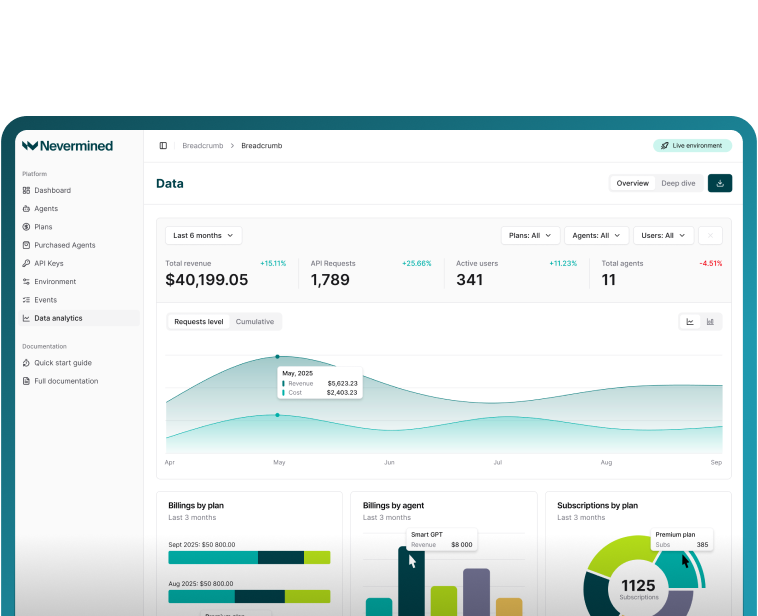
See Nevermined
in Action
Real-time payments, flexible pricing, and outcome-based monetization—all in one platform.