MENU


Sales automation AI agents are transforming how businesses handle lead qualification, outreach, and pipeline management. Unlike traditional CRM tools, these autonomous systems execute multi-step workflows, make context-aware decisions, and can transact payments without constant human oversight. The broader AI agents market is projected to grow from USD 7.84 billion in 2025 to USD 52.62 billion by 2030, yet most companies struggle to capture revenue from their AI deployments due to inadequate billing infrastructure. Companies can accelerate their sales agent monetization by leveraging a payments infrastructure platform that handles metering, billing, and settlement for every autonomous agent interaction.
Sales automation AI agents are autonomous software systems that handle lead qualification, email outreach, meeting scheduling, and pipeline management independently. These agents differ fundamentally from traditional sales tools because they execute multi-step workflows and make context-aware decisions without requiring constant human intervention.
The core capabilities driving adoption include:
Salesforce reports full AI implementation rose 282% year over year (11% to 42%), and 96% of CIOs say their company either already uses or plans to use agentic AI within two years. The demand stems from concrete ROI: AI qualification tools can significantly reduce labor costs and increase throughput compared to human SDRs, though costs vary materially by workflow, vendor, and sales motion.
Moving beyond traditional per-seat subscriptions requires understanding the common pricing approaches for sales AI agents.
This model charges a flat monthly fee designed to undercut the cost of hiring a human equivalent. The appeal lies in simplicity: customers compare your agent cost directly against their headcount budget rather than navigating complex usage calculations.
Action-based pricing charges per discrete task completed. Examples from the market include Bland's tiered pricing at $0.11 to $0.14 per minute depending on plan, and Intercom Fin at $0.99 per resolution. For sales agents, this translates to charging per lead researched, per email sent, or per CRM update completed.
Complex sales sequences bundle multiple actions into priced workflows. A typical structure might include a base fee plus per-action charges for leads researched, emails sent, and meetings booked. This hybrid approach captures value from both the platform access and the actual work performed.
The most future-proof model charges based on results rather than activity. Pricing per successfully booked meeting or per qualified lead aligns costs directly with customer value. Hybrid pricing models combining base fees with outcome bonuses are often attractive because they combine predictability with expansion upside, though whether they outperform subscriptions depends on product, customer behavior, and execution.
Conventional payment rails struggle with the transaction patterns AI agents generate. The fundamental challenge involves three infrastructure gaps that purpose-built systems must address.
When agents execute hundreds of sub-dollar API calls per workflow, conventional card rails can make these transactions economically unattractive because fees typically run 1.5% to 3.5% of transaction value and often include fixed components. A $0.10 action can incur processing costs that consume a disproportionate share of revenue. Purpose-built infrastructure solves this through batch settlement and credit-based systems that aggregate micro-transactions before hitting payment rails.
Sales agents must track every token consumed, every API call made, and every task completed in real-time. This granular metering enables accurate billing and prevents the cost overruns that plague AI deployments. The metering layer should capture usage at creation and maintain immutable records for reconciliation.
Modern agent infrastructure requires settlement across both traditional and emerging payment methods:
Customers hesitate to let AI agents manage tasks autonomously when they cannot verify what work was actually performed. Zero-trust reconciliation addresses this concern through cryptographic proof.
Every usage record gets cryptographically signed and pushed to an append-only log at creation. This immutability means neither the agent developer nor the billing platform can retroactively modify records. The exact pricing rule stamps onto each usage credit, enabling developers, users, auditors, or agents to verify billed amounts per line-item.
Outcome-based pricing is operationally difficult; BCG reports 47% of buyers struggle to define clear, measurable outcomes. Immutable audit trails help resolve these conflicts by providing objective evidence of agent actions. Define success metrics with mathematical precision in contracts (e.g., "lead scoring 80+ in CRM AND confirmed budget authority") and let the tamper-proof logs settle any disagreements.
Enterprise buyers require audit trails demonstrating exactly how AI systems behaved. GDPR requires lawful basis, transparency, data-subject rights, and retention limits, while SOC 2 evaluates controls relevant to security and related criteria, commonly including logical access and change management depending on scope. Tamper-proof metering satisfies these requirements by design rather than through additional compliance layers.
Sales workflows increasingly involve multiple specialized agents collaborating on complex tasks. A lead qualification agent might hand off to an outreach agent, which then triggers a meeting scheduling agent. Each handoff potentially involves a payment transaction.
Standard payment implementations require wallet pop-ups or human approval for each transaction. This friction breaks autonomous workflows entirely. ERC-4337-style smart accounts can support temporary delegated permissions via session-key patterns, allowing users to authorize payment policies once. Agents then interact freely within those boundaries, with configurable expiration windows and delegated permissions. Note that these implementations remain wallet-specific rather than uniformly standardized.
Native support for emerging agent communication standards enables seamless collaboration:
Time-to-market determines competitive advantage in the rapidly evolving agent landscape. Custom-building billing infrastructure consumes engineering resources better spent on core agent functionality.
Building payment and billing infrastructure from scratch can require 6 weeks of engineering effort. Purpose-built platforms compress this dramatically. Nevermined gets you from zero to a working payment integration in 5 minutes, with SDKs for both TypeScript and Python.
The implementation sequence follows three steps:
Valory cut deployment time of their payments and billing infrastructure for the Olas AI agent marketplace from 6 weeks to 6 hours using Nevermined, clawing back $1000s in engineering costs. This acceleration matters because sales agents require rapid iteration on pricing models as market feedback arrives.
Credit systems provide predictable billing for both developers and customers while making micropayments economically viable.
Users purchase credit bundles (e.g., 10,000 credits for $500) that get redeemed against actual usage. This prepayment model offers several advantages:
Cost-plus-margin automation allows platforms to define exact margin percentages that lock onto usage credits. When underlying model costs fluctuate (and they fluctuate significantly), the dynamic pricing engine automatically adjusts credit redemption rates to maintain target margins without manual intervention.
The agent ecosystem evolves rapidly, with new standards emerging regularly. Betting on a single protocol risks obsolescence; building protocol-agnostic infrastructure ensures longevity.
Proprietary billing systems trap customers in specific implementations. When new agent standards emerge, locked-in platforms cannot adapt. Supporting multiple open protocols provides native support for multiple standards simultaneously, allowing seamless transitions as the market consolidates around winners.
The current landscape includes competing approaches:
Building on infrastructure that supports all major protocols can improve interoperability and reduce lock-in risk as standards evolve.
Enterprise adoption of sales AI agents requires addressing compliance concerns proactively.
Sales agents handle sensitive prospect data including contact information, company details, and interaction history. GDPR requires a lawful basis, transparency, rights handling, and storage-limitation policies; if citing articles, use Article 6 for lawful basis and Article 5(1)(e) for retention. Audit-ready traceability built into billing systems satisfies these requirements automatically.
Different verticals impose additional requirements:
Multi-currency support and multi-region deployment capabilities enable global customer operations while maintaining local compliance.
Nevermined provides the payments infrastructure specifically designed for AI agents and autonomous systems. For sales automation AI agents, several capabilities make it the preferred choice.
Nevermined Pay delivers bank-grade enterprise-ready metering, compliance, and settlement so every model call turns into auditable revenue, highlighting ledger grade metering, dynamic pricing engine, credits-based settlement, 5x faster book closing, and margin recovery. The platform supports usage-based, outcome-based, and value-based pricing models that traditional payment processors cannot handle.
The protocol-first approach provides native support for x402, Google's A2A protocol, Model Context Protocol (MCP), and Agent Payments Protocol (AP2). This ensures your sales agents remain compatible as standards evolve. Agent-to-agent payments work natively through ERC-4337-style smart accounts with session keys, enabling autonomous transactions without wallet pop-ups interrupting workflows.
Integration takes 5 minutes with SDKs available in TypeScript and Python. The platform offers a free tier with full platform access for limited volume and a 1% transaction fee model for production deployments. For comprehensive implementation guides and sandbox testing, visit the documentation.
Sales AI agents can adopt action-based pricing (charging per lead researched or email sent), workflow-based pricing (bundling multi-step processes at set rates), or outcome-based pricing (charging per qualified lead or booked meeting). Outcome-based models may prove most future-proof as AI costs decline because they maintain margins by focusing on value delivered rather than resources consumed. Hybrid approaches combining base fees with performance bonuses are often attractive because they combine predictability with expansion upside, though results depend on product, customer behavior, and execution.
Sales agents generate hundreds of sub-dollar transactions that conventional card rails can make economically unattractive due to variable and fixed fee components. Real-time metering must capture every token, API call, and task completion with high granularity. Multi-rail settlement across fiat, cryptocurrency, and smart contracts becomes necessary as agents interact with diverse counterparties. Credit-based systems aggregate these micro-transactions into economically viable batches.
Yes, through smart accounts with session keys and delegated permissions, agents can transact within pre-authorized boundaries without human approval for each transaction, though implementations remain wallet-specific rather than uniformly standardized. This eliminates bottlenecks in multi-agent workflows where a lead qualification agent hands off to an outreach agent, which triggers a scheduling agent. Protocol support for x402, A2A, and MCP enables seamless agent discovery and payment coordination across different platforms.
Purpose-built SDKs in TypeScript and Python enable rapid integration without building billing infrastructure from scratch. Low-code configuration of pricing rules, access controls, and credit systems accelerates launch timelines from weeks to hours. Sandbox environments allow testing against production-like scenarios before deployment. Observability dashboards provide immediate visibility into agent performance, costs, and revenue metrics post-launch.
Define outcomes with mathematical precision in contracts using objective, verifiable criteria. For lead qualification, specify "lead scoring 80+ in CRM AND confirmed budget authority" rather than subjective terms like "qualified prospect." BCG reports 47% of buyers struggle to define clear, measurable outcomes, so tamper-proof metering with cryptographically signed records provides objective evidence when disputes arise. Starting with human-in-the-loop validation for the first 90 days builds confidence before full automation.
As a general recommendation, aim for healthy gross margins after accounting for model inference costs, infrastructure, and payment processing. If token costs consume a disproportionately large share of revenue, this may signal inefficient model selection (using expensive models when cheaper alternatives would suffice) or poor prompting strategies. Implement model switching to route simple tasks to cost-effective models while reserving premium models for complex decisions. Dynamic pricing engines can automatically adjust rates as underlying costs fluctuate, and pricing-model choices should account for this cost variability.
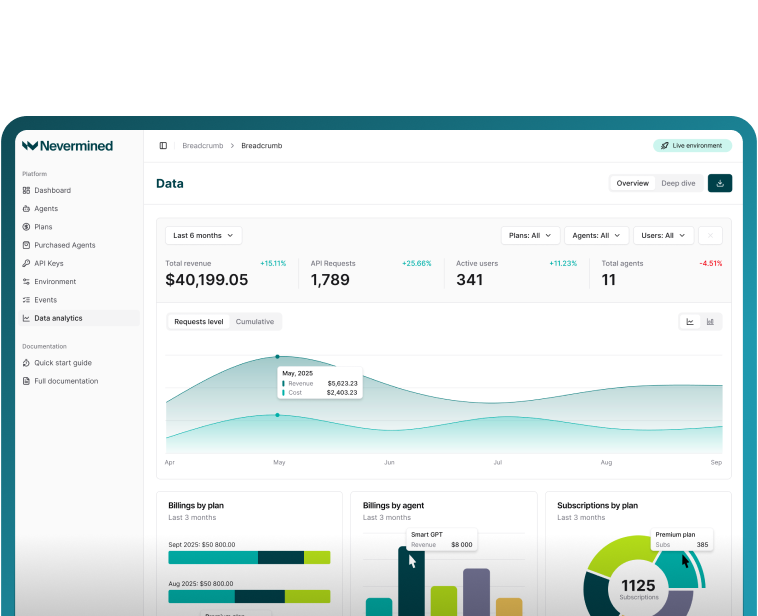
See Nevermined
in Action
Real-time payments, flexible pricing, and outcome-based monetization—all in one platform.