MENU


Data-driven analysis revealing how rapid SDK integration transforms AI agent revenue generation and why speed-to-market determines monetization success
The AI agent economy is expanding at unprecedented velocity, yet most builders struggle to capture revenue from their creations. The agentic AI developer ecosystem reached $6.96 billion in 2025, projected to surge to $42.56 billion by 2030. This growth creates massive opportunities for developers who can monetize quickly, but traditional payment infrastructure forces weeks of custom development before generating a single dollar. Nevermined Pay solves this bottleneck with SDK integration that takes minutes instead of months, enabling AI builders to capture revenue from day one while competitors remain stuck building billing systems from scratch.
The AI market stands at a pivotal moment, valued at $233.46 billion in 2024 and projected to grow to $1,771.62 billion by 2032 at a 29.2% CAGR. This expansion creates unprecedented monetization opportunities for developers who can capture value from AI interactions. Yet traditional payment systems designed for human transactions cannot handle the unique demands of agent-based commerce.
AI adoption has reached critical mass, with 78% of organizations deploying AI in at least one business function, up from 55% just a year earlier. This rapid adoption means AI builders face intense competition. The winners will be those who monetize effectively while others waste months building payment infrastructure.
The addressable market continues expanding as the AI user base hit 378 million people globally in 2025, adding 64 million new users since 2024. Each of these users represents potential revenue for AI agents that can deliver value and capture payment seamlessly.
The failure rate for AI projects remains staggeringly high, with 70-85% failing to achieve expected business outcomes. A significant contributor to this failure is the inability to establish viable monetization before runway depletes. Developers spend precious resources building billing systems instead of improving their core AI capabilities.
Scaling from prototype to profitable product proves challenging, with just 26% of organizations successfully moving AI beyond proof-of-concept. The monetization infrastructure gap often separates successful scaling from stalled projects. Nevermined's solutions address this directly by providing production-ready payment rails from the start.
Measuring and proving ROI remains elusive for most AI builders, with organizations struggling to establish clear metrics. Without proper metering and billing infrastructure, tracking the actual value delivered by AI agents becomes impossible. This measurement gap prevents optimization and sustainable pricing strategies.
Converting free users to paying customers presents a massive challenge, with only 3% of AI users paying for premium services. Even ChatGPT converts just 5% of weekly active users. This reality demands flexible pricing models that capture value from micro-interactions rather than relying solely on subscription conversions.
Security and billing accuracy concerns compound the monetization challenge, with 51% of developers citing unauthorized agent access as a top security risk. Traditional billing systems lack the granularity to meter agent interactions accurately, creating both revenue leakage and trust issues.
The efficiency gains from SDK-based development are substantial, with integration accelerating development time by up to 50% compared to building custom solutions. For AI monetization specifically, this means going live with billing in days rather than months. Nevermined's low-code SDK in TypeScript and Python enables developers to focus on building AI capabilities rather than payment infrastructure.
Productivity multiplies when developers leverage purpose-built SDKs, with 55% faster completion of coding tasks. This acceleration compounds when teams avoid building billing systems from scratch. Integration with Nevermined's documentation takes developers from zero to revenue-ready in under 20 minutes.
Developer time savings accumulate rapidly, with 89% saving at least one hour weekly through AI tools, and 20% saving eight or more hours. When SDK integration eliminates weeks of billing infrastructure development, these savings become transformative for small teams and solo builders.
The daily productivity impact of well-designed tools translates to 52-60 minutes saved per worker. For developers implementing payment systems, SDK-based approaches multiply these savings by eliminating repetitive infrastructure code entirely.
Build success rates improve dramatically when leveraging specialized tools, with 84% more successful builds reported by teams using AI coding tools. This reliability becomes critical for billing infrastructure where failed deployments mean lost revenue.
The shift toward AI-assisted development has accelerated rapidly, with 41% of global code now AI-generated, representing 256 billion lines. This fundamental change in how software gets built makes SDK-based integration even more powerful, as AI tools can rapidly implement standardized SDK patterns.
API-centric development has become the norm, with 82% of organizations adopting an API-first approach and 25% operating as fully API-first, a 12% increase from 2024. While APIs provide connectivity, SDKs deliver complete toolkits that abstract complexity and accelerate implementation.
API integration consumes significant developer time, with 69% spending 10+ hours weekly on API-related work. SDKs dramatically reduce this burden by providing pre-built components, authentication handling, and error management out of the box.
Documentation gaps and inconsistencies plague most API implementations, with 93% of teams facing collaboration blockers. Nevermined's SDK approach includes comprehensive documentation and type safety that eliminates ambiguity and reduces integration errors.
SDKs have become the dominant delivery mechanism for AI capabilities, representing 52% of the AI platform market valued at $12.14 billion. This market validation confirms that developers prefer comprehensive toolkits over raw API access.
The disconnect between AI needs and existing infrastructure remains stark, with only 24% of developers designing APIs specifically for AI agents. This gap creates opportunity for purpose-built solutions like Nevermined that address agent-specific requirements including micro-payments, metering, and agent-to-agent transactions through x402 integration.
The most compelling proof of SDK efficiency comes from real-world implementation. Valory cut deployment time of their payments and billing infrastructure for the Olas AI agent marketplace from 6 weeks to 6 hours using Nevermined, clawing back $1000s in engineering costs. This 168x acceleration demonstrates how purpose-built SDKs transform monetization timelines.
ROI materializes quickly for teams that move fast, with early GenAI adopters reporting $3.70 value per dollar invested. Top performers achieve $10.30 returns. Rapid monetization through SDK integration enables capturing this value before market windows close.
Investment in generative AI capabilities reached $13.8 billion in 2024, representing a 6x increase from $2.3 billion in 2023. This capital surge means competition intensifies rapidly, making speed-to-monetization a decisive competitive advantage.
The broader AI investment landscape shows $252.3 billion in total corporate investment in 2024, a 44.5% year-over-year increase. With this level of capital deployment, every week spent building billing infrastructure represents lost market position.
Investment momentum continues building, with 78% of organizations planning AI spending increases. This sustained investment creates ongoing demand for AI agent capabilities and corresponding monetization infrastructure.
API monetization has reached mainstream adoption, with 65% of organizations generating revenue from their APIs. Nevermined extends this capability to AI agents through three functional areas: pricing and margin-setting modules, real-time metering and payment engines, and observability dashboards for revenue analytics.
For organizations committed to API-driven business models, the revenue impact compounds significantly. 43% of fully API-first organizations generate over 25% of total revenue from APIs. This demonstrates the revenue potential when infrastructure enables rather than constrains monetization.
When proper infrastructure enables measurement, results often exceed projections. Financial services AI leaders report strong ROI performance with many exceeding initial expectations. Nevermined's observability layer surfaces hidden costs and missed opportunities, enabling continuous optimization.
Deployment flexibility matters for AI builders, with 66% of implementations running in cloud-based environments. Nevermined's SDK works seamlessly across cloud and hybrid environments, with sandbox and production modes accessible through the platform.
The AI software platform market hit $26.65 billion in 2025, with forecasts projecting $88.19 billion by 2034 at a 14.22% CAGR. This growth depends on trust infrastructure that enables transparent, auditable transactions between AI agents and their users.
Enterprise buyers drive the majority of AI spending, commanding 61-70% of market revenue. These buyers require bank-grade metering, compliance documentation, and audit-ready transparency. Nevermined Pay delivers ledger-grade metering and a dynamic pricing engine that satisfies enterprise procurement requirements while enabling 5x faster book closing.
While enterprises dominate current spending, SME adoption accelerates rapidly at 48.1% CAGR. This segment requires flexible pricing that scales with usage rather than demanding upfront commitments. Nevermined's Flex Credits system enables usage-based, outcome-based, and value-based pricing models that work for organizations of all sizes.
Cloud-native AI dominates the market, representing 70.80% of total market share with a projected 30.70% CAGR. This architecture requires payment infrastructure that meters cloud-based agent interactions with the same reliability as the compute infrastructure itself.
AI has become integral to the development process, with 89% of developers using generative AI daily. Nevermined's SDK integrates with the tools developers already use, including frameworks like LangChain and CrewAI, enabling monetization without disrupting existing workflows.
API traffic to AI services continues accelerating, with 7.53 million calls to AI APIs representing 40% year-over-year growth. Each of these calls represents a potential monetization event that requires proper metering and billing infrastructure.
The fastest-growing segment in AI development is multi-agent systems, growing at 44.23% CAGR. These systems require payment infrastructure that handles agent-to-agent transactions natively. Nevermined supports emerging standards like Google's Agent-to-Agent (A2A) protocol and Model Context Protocol (MCP), with x402 integration enabling advanced agent payment capabilities for autonomous workflows.
The path from concept to revenue should be measured in hours, not months. Nevermined's three-step integration process reflects this philosophy:
This streamlined approach eliminates the weeks of custom development that typically precede AI monetization. Detailed implementation guidance is available in the Nevermined documentation.
Developer success requires more than code. Nevermined provides:
For teams ready to accelerate their monetization journey, the Nevermined contact page connects you with specialists who understand AI agent billing challenges.
Nevermined's SDK integration takes under 20 minutes for basic implementation. The low-code approach in TypeScript and Python enables developers to register payment plans, configure pricing rules, and begin metering API requests in a single session. Real-world deployments demonstrate this speed, with Valory cutting their payments infrastructure deployment from 6 weeks to 6 hours using Nevermined. Detailed integration steps are available in the official documentation.
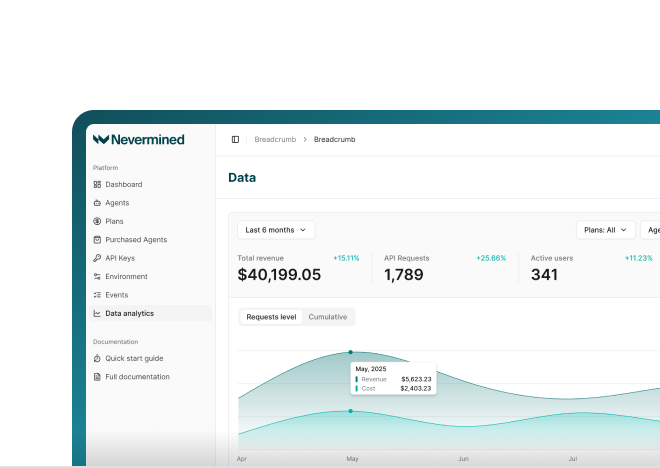
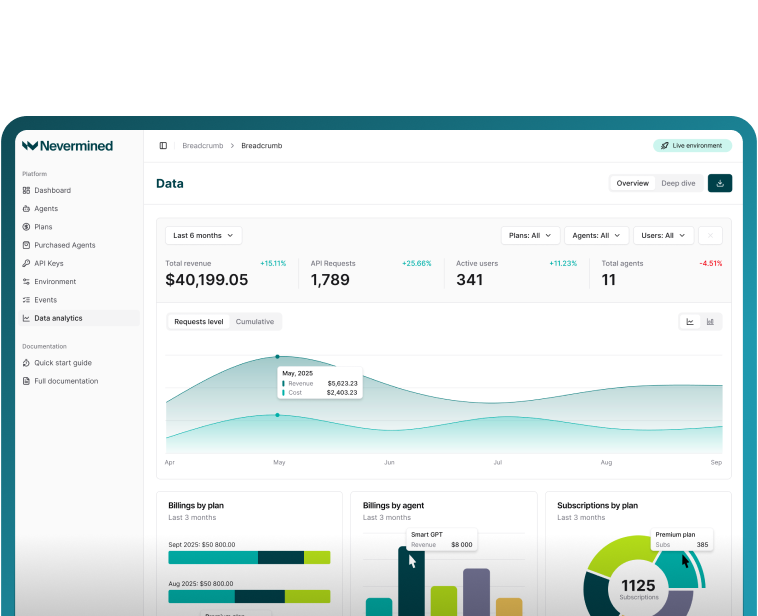
The SDK delivers three core functional areas: pricing and margin-setting modules that define agent value and set usage limits, a metering and payment engine that tracks every request in real-time and settles payments instantly in fiat or cryptocurrency, and an observability dashboard that provides visibility into agent performance, user behavior, and revenue analytics. This comprehensive approach handles the full monetization lifecycle without requiring additional infrastructure.
Nevermined supports three pricing models that can be mixed and matched: usage-based pricing for per-token or per-request billing with built-in margin, outcome-based pricing that charges for results achieved, and value-based pricing that captures a percentage of ROI generated. The Flex Credits system enables prepaid consumption-based units that align price to value while providing predictable spend for buyers and reliable revenue for builders.
While APIs provide basic connectivity, Nevermined's SDK delivers a complete toolkit that abstracts complexity. The SDK includes pre-built components for authentication, metering, and error handling that would require weeks of custom development with raw API access. Industry data shows 69% of developers spend 10+ hours weekly on API-related tasks, time that SDK-based integration dramatically reduces.
Nevermined's tamper-proof metering system creates buyer trust through independent verification. Every usage record is signed and pushed to an append-only log at creation, making it immutable. The exact pricing rule is stamped onto each agent's usage credit, allowing any developer, user, auditor, or agent to verify that usage totals match billed amounts per line-item. This zero-trust reconciliation model satisfies enterprise procurement teams requiring audit-ready transparency.
See Nevermined
in Action
Real-time payments, flexible pricing, and outcome-based monetization—all in one platform.