MENU


AI agent marketplaces need payments to work in two directions. Agents need to buy access to APIs, tools, datasets, workflows, and services. Builders need to get paid when those agents consume what they publish.
Stripe Connect, PayPal, and Coinbase Commerce each support part of the marketplace payment stack, from platform payments and wallet checkout to crypto-native acceptance. Nevermined is built for agent marketplace monetization: delegated spending, usage metering, payment-based access, pricing, and settlement for autonomous AI workflows.
Traditional marketplaces usually start with a human buyer. A person clicks checkout, pays through a card or wallet, and the marketplace routes funds to a seller.
AI agent marketplaces work differently.
A buyer may be an autonomous agent. A seller may be another agent, API, MCP server, dataset, or workflow. A single user request may trigger several billable actions across multiple services.
That creates new questions:
A payment processor can support checkout and payouts. An agent marketplace also needs payment authority, usage records, access rules, pricing logic, and settlement tied to agent activity.
Nevermined gives AI agent marketplaces the payment infrastructure to monetize agent activity from both sides of the transaction. Agents can buy access to paid services within scoped rules. Builders can charge for APIs, MCP tools, datasets, workflows, and agent services. Platform operators can track usage, apply fees, and route revenue from real marketplace activity.
This matters because an AI agent marketplace is not just a catalog of tools. It is a commercial network where agents request access, services verify payment, builders earn from usage, and the platform takes its share. Nevermined connects those steps into one payment and monetization layer.
The x402 Facilitator handles the request-level payment flow. It verifies permission, meters usage, applies pricing and entitlements, and coordinates settlement across fiat rails, credits, smart accounts, and stablecoin settlement flows.
Nevermined fits marketplaces where revenue depends on usage, not only listings or one-time checkout.
It is built for platforms monetizing:
For these platforms, the payment layer needs to know more than whether a transaction happened. It needs to know which agent requested access, which builder supplied the service, what was consumed, which price applied, which platform fee was collected, and whether access should continue.
Nevermined is built for that workflow. It turns agent activity into builder revenue and platform revenue in the same flow.
Stripe Connect is a platform payments product for marketplaces and SaaS platforms. It helps platforms onboard sellers, manage connected accounts, route payments, handle payouts, and support marketplace payment operations.
Stripe has also expanded into agentic commerce. Its agentic commerce tools focus on helping businesses sell through AI agents by making products discoverable and supporting purchases through AI shopping surfaces.
Stripe Connect fits marketplaces that need established payment processing, seller onboarding, payout management, and financial operations tooling.
It is especially relevant for:
For many marketplaces, those are essential capabilities. For AI agent marketplaces, teams may still need additional infrastructure around autonomous spend, usage metering, and access enforcement.
AI agent marketplace builders may still need:
Stripe Connect supports important marketplace payment workflows. Agent-native marketplaces often need an additional layer that connects payment to agent activity, usage, and access.
PayPal is a consumer and merchant payment network. Braintree is PayPal’s developer-focused payment platform for custom payment experiences. Together, they fit marketplaces where wallet familiarity, buyer protection, merchant checkout, and consumer reach matter.
PayPal has also moved into agentic commerce. Its agentic commerce resources focus on AI-assisted shopping, product discovery, checkout, and merchant participation in AI-driven commerce environments.
PayPal and Braintree fit marketplaces where the transaction still looks like consumer commerce. A user may discover a product through an AI interface, approve a purchase, and complete checkout through a familiar wallet or payment method.
They are especially relevant for:
For agent marketplaces, the key question is whether the payment flow remains human-centered or becomes resource-centered and autonomous.
AI agent marketplace builders may still need:
PayPal and Braintree can support commerce and checkout. Nevermined is more aligned with marketplaces where agents continuously consume APIs, data, tools, and workflows.
Coinbase Commerce has historically served merchants that want to accept crypto payments. Coinbase has since moved Commerce users toward Coinbase Business, with eligible United States and Singapore merchants directed to transition by March 31, 2026.
Coinbase’s broader developer ecosystem also includes agent-focused infrastructure. x402 is especially relevant because it gives services a machine-readable way to request payment over HTTP when an agent or application requests a protected resource.
Coinbase Commerce and Coinbase Business fit crypto-native merchants that want onchain or stablecoin payment acceptance. x402 fits services that need a machine-readable payment request pattern for APIs, tools, datasets, and protected digital resources.
They are especially relevant for:
For teams already focused on crypto rails, this can be a useful payment layer.
AI agent marketplace builders may still need:
x402 can define how a payment request works. Nevermined adds the marketplace infrastructure around that request: metering, access, pricing, credits, and settlement.
AI agent marketplaces need more than checkout and payouts. They need a commercial layer that works while agents act.
Nevermined stands out because it connects the pieces marketplace builders need:
Valory cut deployment time of its payments and billing infrastructure for the Olas AI agent marketplace from 6 weeks to 6 hours using Nevermined, clawing back thousands in engineering costs.
For marketplace operators, the core question is not only which platform can move money. It is which platform can connect agent activity to payment, access, builder revenue, and platform fees. Nevermined is built for that layer.
Traditional marketplaces usually involve human buyers, checkout pages, and seller payouts. AI agent marketplaces involve autonomous agents requesting APIs, tools, datasets, or services while they work. Each request may need payment verification, usage metering, access control, pricing, and settlement. Nevermined connects those pieces so marketplaces can monetize real agent activity instead of only processing checkout events.
Nevermined supports marketplace builders by connecting agent payments, usage metering, access control, credits, platform fees, and settlement. Builders can publish paid AI services, APIs, MCP tools, datasets, or workflows. The marketplace can track transactions, apply platform fees, and route revenue from agent usage.
Agents need payment authority to complete work without stopping for human approval at every step. Delegated spending gives agents controlled authority inside defined limits. Nevermined Pay lets users set rules such as spending caps, time windows, merchant restrictions, transaction counts, and revocation conditions. Agents get payment capability, not raw card credentials.
Nevermined lets MCP tools sit behind payment verification. A tool can verify payment status, meter usage, apply pricing, and grant access only when the requesting agent has the right entitlement. This helps marketplaces charge for tool usage without relying only on manual invoicing or one-time checkout.
Yes. Nevermined’s builder platform model supports platform-level fee settings, automatic fee collection, white-label checkout, analytics, and revenue tracking. This lets marketplace operators take a percentage of builder transactions while giving builders payment and monetization infrastructure.
See Nevermined
in Action
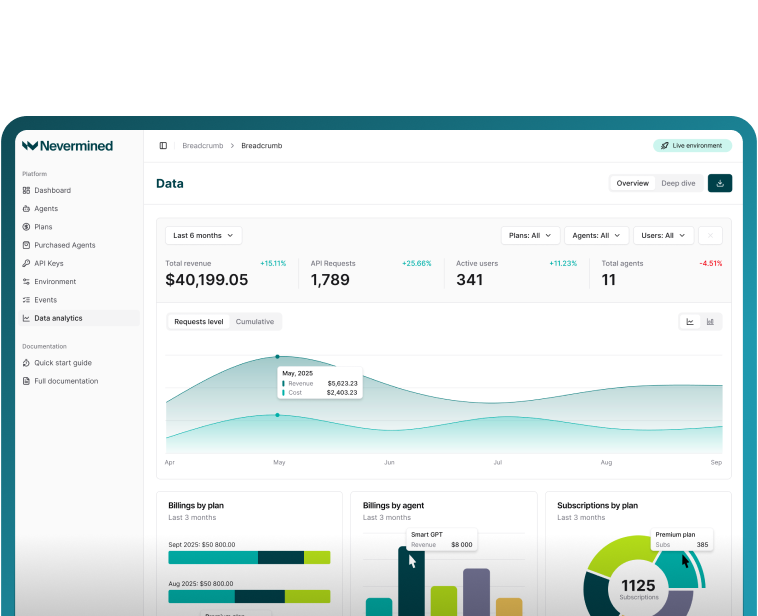
Real-time payments, flexible pricing, and outcome-based monetization—all in one platform.