MENU


Usage-based billing is becoming the default for AI software. AI agents do not just subscribe to products. They call APIs, trigger MCP tools, request datasets, consume compute, and create billable events while they work.
Stripe, Orb, and Metronome all address usage-based or hybrid billing for SaaS and AI companies. Nevermined takes a different path: payments infrastructure for AI agents that connects delegated spending, real-time metering, access control, credits, and settlement across agent-native workflows.
Traditional usage-based billing tracks what a customer consumed, applies a price, and turns the result into an invoice. That works for many SaaS and infrastructure products.
AI agents create a different billing problem.
An agent may call a paid API, trigger a tool, request access to a protected resource, complete a task, and coordinate with another agent in the same workflow. Each action may need authorization, usage tracking, access control, pricing, and settlement.
That means the payment layer needs to answer more than “how much did this customer use?”
It also needs to answer:
Usage-based billing is important. Agent-native monetization connects billing to payment authority, access, and settlement.
Nevermined provides payments infrastructure for AI agents. It lets agents transact within defined rules while giving builders the tools to meter usage, enforce access, apply pricing, and settle revenue.
This matters because AI services are often consumed one event at a time. A billable event might be an API call, MCP tool execution, dataset lookup, model request, workflow step, or agent-to-agent interaction. Nevermined connects those events to pricing and payment status so usage becomes revenue.
The x402 Facilitator coordinates authorization, metering, and settlement for AI agents across fiat rails, credits, smart accounts, and stablecoin settlement flows. It helps APIs, MCP tools, agents, datasets, and protected resources verify payment status before granting access.
Nevermined fits when AI usage-based billing needs to do more than calculate an invoice. It gives builders the infrastructure to let agents transact, meter every billable action, enforce access, and settle revenue from real agent activity.
It is built for teams monetizing:
For these teams, usage billing is only one part of the system. Nevermined connects the full monetization layer: which agent acted, what was consumed, which pricing rule applied, whether access should continue, and how revenue should settle.
Stripe is a major payment infrastructure provider for online businesses, SaaS companies, marketplaces, and platforms. It supports payment processing, checkout, billing, invoicing, subscriptions, tax, revenue recognition, and marketplace payment workflows.
Stripe completed its acquisition of Metronome in January 2026, strengthening its position in usage-based billing and complex monetization. That makes Stripe relevant for companies that want payment processing and billing infrastructure within one broader financial platform.
Stripe fits teams that need established payment processing, checkout, billing, subscriptions, and financial operations tooling in one ecosystem.
It is especially relevant for:
For AI companies, Stripe and Metronome can support usage-based monetization. The key question is whether the billing workflow also needs autonomous agent spending, payment-based access control, and agent-to-agent settlement.
AI builders may still need additional infrastructure for:
Stripe can support the payment and billing layer. Agent-native products often need additional logic around authorization, access, and settlement.
Orb provides usage-based billing infrastructure for SaaS and AI companies. It supports complex pricing, event ingestion, hybrid billing, invoicing, customer hierarchies, and enterprise revenue workflows.
Adyen announced an agreement to acquire Orb in June 2026, with the stated goal of connecting billing more closely to payment execution and real-time financial signals. This makes Orb part of a broader trend: billing and payments are moving closer together as AI and usage-based models become more complex.
Orb fits SaaS and AI companies that need flexible billing logic around product usage. It is useful when teams need to define custom metrics, test pricing changes, manage hybrid pricing, and support finance workflows around usage data.
It is especially relevant for:
Orb is a billing system for complex customer monetization. AI agent teams should still evaluate whether they also need agent payment authority, access control, and settlement infrastructure.
AI builders may still need additional infrastructure for:
Orb helps teams price and bill usage. Nevermined connects agent activity to payment status, access, and settlement.
Metronome is a usage-based billing platform for complex pricing models, enterprise contracts, prepaid credits, commitments, and high-volume metering. It is now part of Stripe after the January 2026 acquisition.
Metronome is relevant for companies with complex product catalogs, multidimensional usage, sales-led contracts, and enterprise revenue workflows. It is especially associated with usage-based models in AI infrastructure and software.
Metronome fits businesses that need to bill customers for complex usage. It is useful when a company needs to meter events, apply contract terms, manage credits, and support enterprise billing workflows.
It is especially relevant for:
For human-customer usage billing, Metronome is a strong fit. For autonomous agent commerce, teams may still need infrastructure for spend delegation, access enforcement, and agent-to-agent payment workflows.
AI builders may still need additional infrastructure for:
Metronome supports complex usage billing. Nevermined focuses on the agent payment layer around usage: delegation, access, metering, pricing, and settlement.
AI products do not always fit a single pricing model. A customer may pay for usage, access, completed tasks, subscriptions, or prepaid credits. A platform may need to preserve margin while underlying model, compute, and provider costs change.
Nevermined supports flexible monetization patterns such as:
Flex Credits let teams package prepaid consumption across users, teams, or agents. This gives builders a way to support repeated agent usage without forcing every small event through a separate checkout.
That matters for AI services where value is created through many small actions instead of one large transaction.
Agent commerce is still developing. Different ecosystems are forming around different protocols, and AI builders need payment infrastructure that does not lock them into one standard too early.
Nevermined supports:
This protocol-first approach helps builders launch now while keeping room for standards to evolve.
Billing platforms can help price and invoice usage. Nevermined connects protocol-level payment flows to metering, access, and settlement.
Payment infrastructure can slow down AI products. Teams do not want to spend months stitching together checkout, billing, usage metering, access control, and settlement.
Nevermined gives builders SDKs, APIs, a dashboard, and documentation designed for AI services. The quickstart guide gives teams a path to register a service, create a payment plan, and accept payments through the app or SDKs.
Integration paths include:
This helps teams move from payment concept to working monetization infrastructure without building every commercial workflow from scratch.
Valory cut deployment time of its payments and billing infrastructure for the Olas AI agent marketplace from 6 weeks to 6 hours using Nevermined, clawing back $1000s in engineering costs.
AI usage-based billing is not only about measuring usage. It is about turning agent activity into revenue.
Nevermined stands out because it connects the pieces AI builders need:
Nevermined is built for AI agent monetization: agents pay, merchants meter usage, access is enforced, and revenue settles from real activity.
For AI builders, the core question is not just which platform can calculate a bill. It is which platform can connect agent activity to payment, access, and revenue. Nevermined is built for that layer.
Traditional SaaS billing usually tracks usage, applies a plan, and creates an invoice. AI usage-based billing often needs to happen closer to the request itself. An agent may call an API, use an MCP tool, request a dataset, or trigger a workflow that requires payment verification before access. Nevermined connects usage, pricing, access control, and settlement so agent activity becomes billable revenue as it happens.
AI agents often interact with protected resources such as APIs, tools, datasets, workflows, and digital services. Payment-based access control ensures the agent only receives the resource after payment permission or usage entitlement is verified. Nevermined connects payment status, metering, and access rules so builders can control what agents use and how each billable action connects to revenue.
Nevermined lets builders put payment logic around MCP tools, prompts, resources, and services. A tool can verify payment status, meter usage, and apply pricing before granting access. This helps MCP developers charge for usage without relying only on manual invoicing, one-time checkout, or separate billing systems.
Yes. Nevermined supports Flex Credits for prepaid consumption across users, teams, or agents. Credits help teams package usage, manage spend, and support repeated agent activity without forcing every small request into a separate checkout. This is useful for APIs, AI services, MCP tools, datasets, and agent marketplaces.
x402 gives services a way to request and verify payment through HTTP-native flows. For AI usage-based billing, that matters because agents and services need machine-readable payment interactions without relying on human checkout screens. Nevermined builds around x402 with metering, pricing, access control, and settlement infrastructure for production agent workflows.
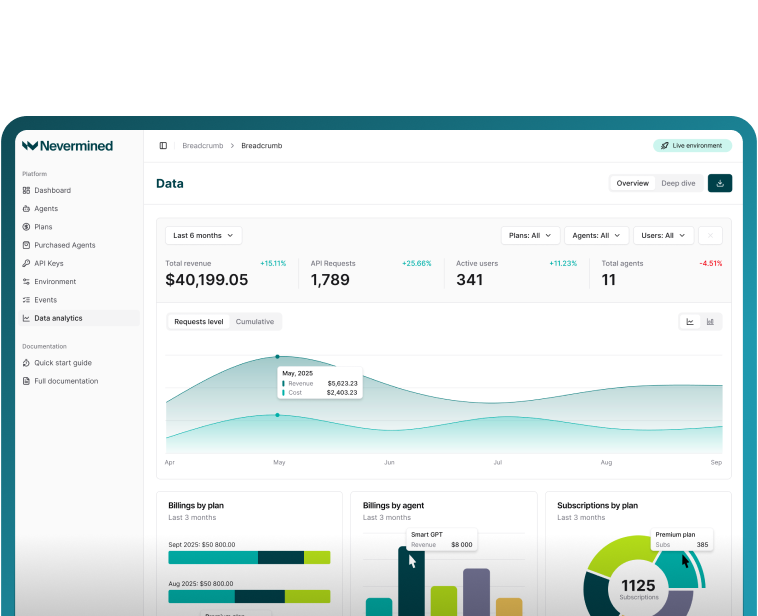
See Nevermined
in Action
Real-time payments, flexible pricing, and outcome-based monetization—all in one platform.