MENU


AI agents can call APIs, request data, trigger tools, coordinate workflows, and act across software systems. Traditional processors were built around human checkout, while AI agent payments need scoped authority, usage tracking, access control, pricing logic, and settlement that can happen while agents work.
Stripe, PayPal, and Coinbase Commerce each address part of the payment market, from checkout and wallet-based commerce to crypto-native payment acceptance. Nevermined is built for agent-native monetization, connecting delegated spending, real-time metering, access control, pricing, and settlement for APIs, MCP tools, datasets, AI services, and agent marketplaces.
Traditional payment systems assume a person is present. A user sees a checkout page, reviews an amount, selects a payment method, confirms the transaction, and receives a receipt.
AI agents operate differently.
A research agent may purchase access to datasets. A coding agent may call paid security tools. A procurement agent may interact with vendor systems. A marketplace agent may coordinate with other agents and trigger billable events across several services.
That workflow needs more than a payment button. It needs:
A checkout processor can support part of this flow. An agent-native monetization layer connects the full commercial workflow.
Nevermined provides payments infrastructure for AI agents. It lets agents transact within defined rules and gives merchants the tools to meter usage, enforce access, apply pricing, and settle revenue.
This matters because AI services are often consumed one action at a time. A billable event might be an API call, MCP tool execution, dataset lookup, model request, workflow step, or agent-to-agent interaction. Nevermined gives builders a way to connect those events directly to revenue.
The x402 Facilitator coordinates authorization, metering, and settlement for AI agents across fiat rails, credits, smart accounts, and stablecoin settlement flows. It helps protected resources accept payment requests, verify access, track usage, and settle activity without forcing every transaction through a human checkout flow.
Nevermined fits when AI payments need to do more than complete a checkout. It gives builders the infrastructure to let agents transact, meter every billable action, enforce access, and settle revenue from real agent activity.
It is built for teams monetizing:
For these teams, payment acceptance is only the starting point. Nevermined connects the full monetization layer: which agent acted, what was consumed, which pricing rule applied, whether access should continue, and how revenue should settle. That makes it a stronger fit for AI products where usage, access, and payments need to work as one system.
Stripe is a major payment infrastructure provider for online businesses, SaaS companies, marketplaces, and platforms. It supports card processing, checkout, billing, invoicing, fraud tooling, and global payment operations.
Stripe has also expanded into agentic commerce. Its Agentic Commerce Suite focuses on helping merchants sell through AI agents by making products discoverable, simplifying checkout, and allowing businesses to accept agentic payments through Stripe. This makes Stripe relevant for commerce teams that want products to appear in AI shopping environments.
Stripe’s standard US online card pricing includes a percentage fee plus a fixed per-transaction fee. This pricing model works for many ecommerce, SaaS, and subscription businesses.
For high-frequency, very small AI transactions, fixed per-transaction fees can become harder to manage unless payments are aggregated, routed through credits, or handled through a model designed for low-value usage events.
Stripe is useful for payment processing and emerging AI-assisted shopping flows. However, AI builders may still need additional infrastructure for:
That does not make Stripe irrelevant. It means Stripe often solves the payment processing layer, while agent-native monetization may require additional systems around it.
PayPal is a familiar consumer and merchant payment network. It is especially relevant for consumer commerce, wallet-based checkout, buyer protection, and merchants that already rely on PayPal or Venmo relationships.
PayPal has also moved into agentic commerce. Its agentic commerce services focus on AI-driven shopping, product discovery, checkout, catalog syncing, order management, and merchant participation across AI surfaces. This makes PayPal a practical option when the workflow still resembles consumer shopping.
PayPal’s business pricing varies by payment product and transaction type. Its listed US business rates include percentage-based fees plus fixed per-transaction fees for common checkout flows. Those fees may be acceptable for standard ecommerce transactions, but they can be less suitable for very small or repeated AI service events unless the business aggregates usage or charges through larger billing units.
PayPal is most applicable when the buyer journey still looks like consumer commerce. A person may interact with an AI assistant, discover a product, and complete a purchase through a familiar wallet or checkout method.
For agent-native products, teams may still need infrastructure for:
PayPal can support AI-assisted shopping. Nevermined is more aligned with AI services where agents continuously consume tools, data, APIs, or workflows.
Coinbase Commerce focuses on crypto payment acceptance for merchants. It is relevant for businesses that want to accept onchain payments from crypto-native users and teams that prefer stablecoin or cryptocurrency settlement.
Coinbase’s broader developer platform also includes agent-focused tools. Coinbase Agentic Wallets and x402-related infrastructure give agents wallet functionality, spending controls, and crypto-native payment capabilities. This makes Coinbase relevant in the machine-to-machine payment conversation, especially where crypto rails are the preferred settlement path.
Coinbase Commerce is generally positioned around crypto payment acceptance rather than fiat card processing. Coinbase’s broader developer platform uses usage-based pricing for wallet and trading infrastructure. Teams should confirm current product availability, fees, supported assets, and settlement options directly before choosing a Coinbase product for production AI payments.
Coinbase Commerce can be useful for crypto-native checkout and stablecoin-oriented workflows. However, teams serving mainstream buyers may still need card, wallet, ACH, or other fiat payment methods.
AI monetization teams may also need additional infrastructure for:
Coinbase is relevant when crypto is central to the payment strategy. Nevermined is broader when teams need fiat, credits, smart accounts, stablecoin settlement, metering, and access control in one agent-native system.
Autonomous spending needs boundaries. A useful agent may need to pay for APIs, datasets, compute, or services without stopping for approval at every step. But that authority must be controlled.
Nevermined lets users delegate payment capability to agents through programmable guardrails such as:
The agent receives scoped payment capability instead of raw card details. That structure lets agents complete approved actions while keeping users in control of spend.
Stripe and PayPal also support secure payment credentials and emerging agentic commerce flows, especially for consumer transactions. Coinbase supports wallet-based controls for crypto-native agents. Nevermined’s advantage is connecting delegated spending to merchant-side metering, access, pricing, and settlement.
AI services often do not fit a simple one-time checkout model. They may need to charge by request, by tool call, by workflow, by subscription, by credits, or by completed outcome.
Nevermined supports these monetization patterns by connecting usage to pricing and access. A protected resource can verify payment status before granting access. A merchant can meter consumption. A platform can apply credits or usage plans. A builder can connect activity to revenue.
This is especially important for:
Agent commerce is still early. Standards are evolving quickly, and different ecosystems are forming around different protocols.
Nevermined supports:
This protocol-first approach matters because builders need to launch now without betting the full product on one standard.
Stripe’s agentic commerce tools focus on selling through AI agents and commerce surfaces. PayPal’s agentic commerce services focus on AI-driven shopping and merchant enablement. Coinbase’s agent tools focus on wallet-based crypto flows and x402. Nevermined connects protocol support to metering, access, pricing, and settlement for AI services.
Payment infrastructure can become a product bottleneck. AI teams want to monetize agents without spending months building custom billing, payment, access, and settlement systems.
Nevermined provides SDKs, APIs, a dashboard, and documentation designed for AI builders. The quickstart guide gives teams a path to register a service, create a payment plan, and accept payments through the app or SDKs.
Integration paths include:
This helps teams move from payment concept to working monetization infrastructure without stitching together checkout, usage metering, access control, and settlement across separate systems.
AI payments are not only about moving money. They are about giving agents controlled authority, helping merchants track usage, enforcing access, applying pricing rules, and settling activity across different rails and protocols.
Nevermined stands out because it brings those pieces together.
Its platform gives builders:
Valory cut deployment time of its payments and billing infrastructure for the Olas AI agent marketplace from 6 weeks to 6 hours using Nevermined, clawing back $1000s in engineering costs.
For AI builders, the core question is not just which payment processor can accept money. It is which platform can connect agent activity to revenue. Nevermined is built for that layer.
AI agent payments often happen around protected resources such as APIs, MCP tools, datasets, workflows, or digital services. Access control ensures an agent only receives the resource after the payment or usage permission is verified. Nevermined connects payment status, usage metering, and access rules so builders can control what agents can use, when they can use it, and how each billable action connects to revenue.
Nevermined helps AI builders turn agent activity into billable revenue by connecting usage records to pricing, credits, access, and settlement. Instead of relying only on one-time checkout or manual invoicing, teams can meter API calls, tool executions, dataset requests, and agent workflows as they happen. This makes Nevermined useful for products where value is created through repeated usage rather than a single transaction.
Yes. Nevermined supports agent payment workflows across fiat rails, credits, smart accounts, and stablecoin settlement flows. This lets teams support different payment and settlement patterns without building separate systems for every rail.
AI services often create value one action at a time. A billable event might be an API call, MCP tool execution, dataset lookup, model request, or completed workflow. Metering records what happened, who triggered it, which plan applied, and how the event connects to revenue. Without metering, teams may collect payments but still lack the operational detail needed for pricing, access control, reconciliation, and reporting.
Nevermined supports x402, MCP, A2A, AP2, and standard HTTP. This gives AI builders flexibility as agent payment standards evolve. Instead of tying monetization to one protocol, Nevermined helps teams support multiple agent commerce patterns through one platform.
See Nevermined
in Action
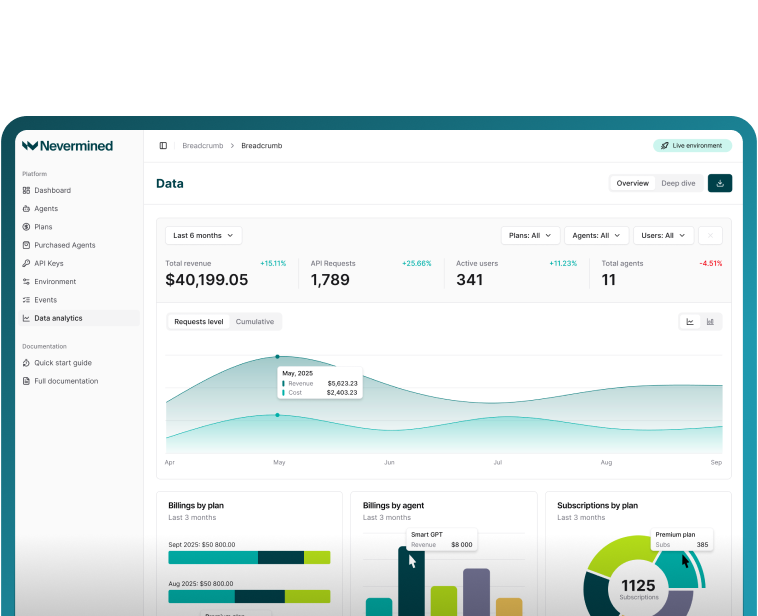
Real-time payments, flexible pricing, and outcome-based monetization—all in one platform.