MENU


Critical data revealing why immutable logs, metering, observability, and audit-ready payment infrastructure are becoming essential for AI APIs, autonomous agents, and agent-to-agent commerce
The agentic economy needs billing infrastructure that can keep pace with autonomous systems. As AI agents move into production, businesses need ways to meter usage, authorize access, reconcile credits, and settle payments with a clear audit trail.
DataIntelo estimates global payment fraud losses at approximately $48.7 billion in 2025, while Google Cloud reported that 52% of executives say their companies are actively using AI agents. This combination of rising AI adoption and high-value digital transaction risk makes verifiable billing infrastructure increasingly important.
Nevermined’s payment infrastructure supports AI billing through metering, access control, dynamic pricing, observability, credits-based settlement, and audit-ready transaction trails. For developers monetizing AI agents, APIs, MCP tools, or agent workflows, this creates a practical foundation for usage-based, cost-based, and outcome-based pricing.
The payment fraud detection AI market reached $14.3 billion in 2025. This shows the scale of enterprise investment in protecting digital transaction flows.
The same market is projected to reach $62.8 billion by 2034 at 17.8% CAGR. AI billing platforms benefit from the same core priority: trusted, auditable transaction data.
DataIntelo estimates global payment fraud losses at approximately $48.7 billion in 2025. For AI-agent commerce, reliable metering and reconciliation help reduce ambiguity in billing disputes.
Traditional payment infrastructure was designed around human-initiated purchases. AI-agent workflows introduce more frequent, usage-level events, where authorization, metering, pricing, and settlement may need to operate together in real time.
Google Cloud reported that 52% of executives say their companies are actively using AI agents. This adoption increases demand for billing systems that can track usage across multiple agent workflows.
Google Cloud also reported that 39% of executives say their companies have launched more than ten AI agents. Multi-agent environments make accurate metering and settlement more important.
PwC’s 2026 AI business predictions indicate that agentic AI will play an increasingly important role in enterprise workflows. As these workflows mature, companies need clearer links between agent activity, cost, revenue, and settlement.
Nevermined Pay delivers bank-grade enterprise-ready metering, compliance, and settlement so every model call can become auditable revenue. Its infrastructure supports developers monetizing AI services across usage-based, cost-based, and outcome-based models.
DataIntelo reports that AI fraud detection models can achieve detection rates above 94% for known fraud typologies, with false positive rates below 0.5%. Immutable audit mechanisms can help preserve the integrity of records used in investigation and reconciliation.
Organizations deploying AI fraud detection reported average false positive reductions of 38%. In AI billing, reducing false positives helps protect legitimate usage while flagging anomalies.
Mastercard found that 83% of respondents said AI significantly sped up fraud investigation and case resolution. Clear transaction histories make investigations easier to conduct.
The same Mastercard research found 85% of respondents reported returns from AI use cases such as fraud triage and real-time detection.
Software represented 63.4% of the payment fraud detection AI market in 2025. This reflects the importance of software-native verification, analytics, and monitoring layers.
The meter tamper detection market reached $3.42 billion in 2024. This broader market shows strong demand for systems that protect usage records from unauthorized changes.
The meter tamper detection market is projected to reach $7.34 billion by 2033 at 8.7% CAGR.
The meter tamper pattern analytics market reached $1.12 billion in 2024. AI billing can apply a similar auditability principle by preserving traceable usage and settlement records.
This analytics market is projected to reach $3.11 billion by 2033 at 13.8% CAGR. The growth highlights demand for intelligent analysis of metering anomalies.
DataIntelo reports that utilities worldwide lose billions annually due to meter tampering and energy theft. While AI billing has a different threat model, the example illustrates why usage records need reliable auditability.
Google Cloud reported that 53% of financial services executives say their companies actively use AI agents in production.
The same research found that 40% of financial services executives say their companies have launched more than ten AI agents.
MarketsandMarkets projects the AI agents market will grow from $7.84 billion in 2025 to $52.62 billion by 2030.
DataIntelo reports that organizations using AI fraud detection saw fraud loss rate reductions of 27%. In AI billing, accurate usage records support faster dispute resolution and reconciliation.
AI fraud detection can help prevent 2.3% of legitimate transactions from being incorrectly declined. High-quality billing data supports better classification of legitimate and anomalous activity.
Mastercard found that 42% of issuers saved more than $5 million in fraud attempts over two years through AI.
The same report found 26% of acquirers reached the same savings threshold.
North America held 38.2% of the payment fraud detection AI market in 2025. Regulated industries in the region often require strong audit trails and clear transaction histories.
Nevermined Facilitator is designed for authorize, meter, redeem, and settle flows, with flexible pricing, settlement logic, and complete transaction trails.
The anti-tamper smart meter market reached $3.2 billion in 2024, reflecting demand for trustworthy metering infrastructure.
The same market is projected to reach $8.9 billion by 2033 at 11.8% CAGR.
Advanced Metering Infrastructure holds over 45% of the anti-tamper smart meter market. AI billing similarly benefits from infrastructure that combines metering, monitoring, and reconciliation.
Single phase meters account for approximately 58% of total revenue in the anti-tamper market. In AI billing, the parallel is simple: most use cases need reliable, repeatable metering before advanced pricing can scale.
Wireless meters represent approximately 61% of new deployments. AI billing is following a cloud-first path, where usage tracking and settlement can happen across distributed agent systems.
Nevermined’s dynamic pricing patterns support token-based pricing, complexity-based pricing, time-based pricing, usage-based tiers, and cost estimation workflows.
Nevermined’s credits system separates verification from settlement. Permissions can be checked before credits are redeemed, while credits are burned after successful processing.
The cloud deployment segment of the payment fraud detection AI market is growing at 21.3% CAGR. Cloud-native billing makes real-time monitoring more practical.
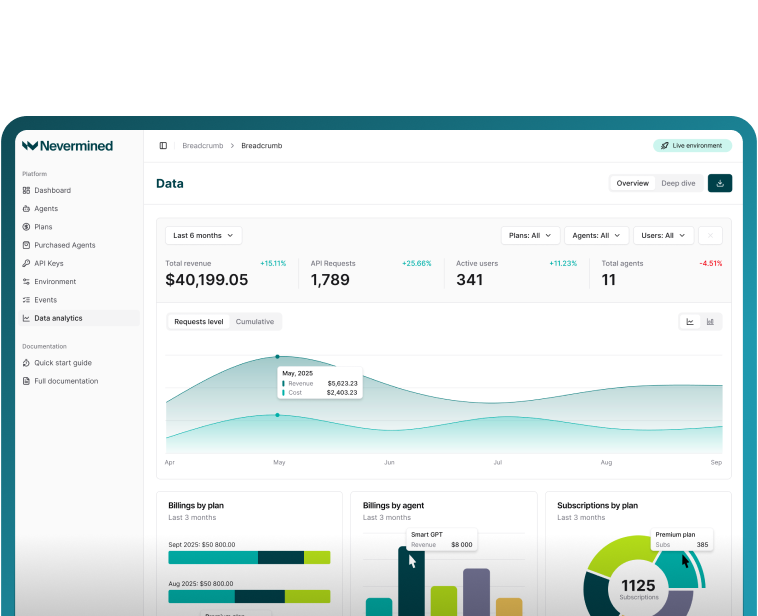
Nevermined observability provides visibility into requests, credit redemption, revenue, per-agent usage, per-plan usage, balances, settlements, and trends.
Asia Pacific controls over 38% of the anti-tamper smart meter market. Global AI billing infrastructure needs comparable flexibility across regions, currencies, and compliance environments.
The Asia Pacific meter tamper detection market reached $1.17 billion in 2024, representing over 34% of global value.
Valory cut deployment time for payments and billing infrastructure for the Olas AI agent marketplace from 6 weeks to 6 hours using Nevermined, clawing back thousands in engineering costs.
Nevermined gets developers from zero to a working payment integration in 5 minutes, with TypeScript and Python SDK paths for agent APIs, MCP tools, and protected resources.
AI-agent commerce requires a billing infrastructure that can support autonomous usage, flexible pricing, and reliable reconciliation. As agent workflows scale, businesses need more than a checkout flow. They need a system that can connect identity, access control, usage tracking, pricing, credits, settlement, and audit trails.
Nevermined is built for this environment through:
For AI builders, the strategic question is no longer whether agents will transact. It is how those transactions will be priced, metered, reconciled, and settled. Nevermined provides the payment infrastructure layer designed for that transition.
Tamper-resistant AI billing depends on reliable metering, immutable or audit-ready records, transaction trails, and reconciliation workflows. In practice, this means every billable event should be traceable from request to authorization, usage tracking, pricing, credit redemption, and settlement.
Nevermined provides payment infrastructure for AI agents, APIs, MCP tools, and protected resources. It supports access control, metering, dynamic pricing, credits-based settlement, observability, and transaction trails so developers can monetize AI services with usage-based, cost-based, and outcome-based models.
Nevermined supports flexible monetization models, including per-call pricing, token-based pricing, complexity-based pricing, time-based pricing, tiered usage, prepaid credits, and outcome-oriented workflows. This helps AI builders align pricing with the value each agent or service delivers.
Nevermined provides a 5-minute setup path for a working payment integration, with TypeScript and Python SDK options. Valory also demonstrated practical implementation speed by reducing deployment time for payments and billing infrastructure from 6 weeks to 6 hours using Nevermined.
Observability helps teams monitor requests, credits, usage, revenue, balances, redemption history, settlements, and trends. For AI-agent commerce, this visibility helps developers understand margin, detect anomalies, support customer disputes, and reconcile billed usage against actual service activity.
See Nevermined
in Action
Real-time payments, flexible pricing, and outcome-based monetization—all in one platform.