MENU


Data-driven analysis revealing how decentralized payment rails are powering the autonomous agent economy with usage-based billing, instant settlement, and agent-to-agent transactions
The agentic economy is no longer theoretical. With over 17,000 AI agents now operating on Web3 platforms and handling 4.5 million daily active wallets, the infrastructure gap between what AI agents can do and how they can transact is closing rapidly. Traditional payment processors were built for human-initiated, static transactions. They fail when a single agent conversation triggers hundreds of micro-activities with sub-cent costs. Nevermined payment infrastructure addresses this challenge head-on, providing real-time metering, flexible pricing models, and instant settlement in both fiat and cryptocurrency for the autonomous workflows defining the next era of commerce.
The global Web3 blockchain market generated $4.43 billion in 2024 and is predicted to reach $226.4 billion by 2034, recording a CAGR of 48.2% throughout the forecast span. This explosive growth reflects the fundamental shift from centralized financial rails to decentralized infrastructure capable of supporting autonomous AI transactions.
The global agentic AI market was valued at $5.25 billion in 2024 and is projected to reach $199.05 billion by 2034. This parallel growth trajectory with Web3 infrastructure demonstrates the convergent demand for AI agents that can operate, transact, and settle payments without human intervention.
The Web3 Payment Solutions Market was valued at $9.64 billion in 2023 and is anticipated to reach $93.5 billion by 2032, with a CAGR of 28.5%. This growth encompasses cryptocurrency payments, NFT-based transactions, and the emerging category of agent-to-agent settlements that Nevermined was built to power.
The AI agents market is projected to grow from $7.84 billion in 2025 to $52.62 billion by 2030, registering a CAGR of 46.3%. This rapid expansion creates urgent demand for payment infrastructure that can meter, price, and settle agent interactions at scale.
The US Agentic AI Market was valued at $2.43 billion in 2025 and is projected to reach $65.25 billion by 2034, growing at a CAGR of 44.10%. North American enterprises are driving demand for compliant, auditable AI payment systems that meet regulatory requirements.
Research shows 60% of enterprises cite non-compliance risks and data governance concerns as key barriers to AI adoption. Traditional payment processors lack the tamper-proof metering and audit trails required for enterprise AI deployments. This creates opportunity for purpose-built infrastructure delivering bank-grade compliance.
As of 2025, around 46.7% of finance apps are leveraging Web3 technology. This widespread adoption demonstrates that financial services recognize the limitations of legacy systems for modern, dynamic transaction patterns. AI agent payments require the same transition.
The banking, financial services, and insurance sector captured 62.8% of Web3 market in 2024. Financial institutions are leading adoption because they understand that AI-driven automation demands payment infrastructure matching the speed and granularity of agent operations.
Cryptocurrency applications captured 72.8% of Web3 market, reflecting their dominance in open, programmable financial systems. This foundation supports the instant settlement and multi-currency capabilities that AI agents require for global operations.
Over 17,000 AI agents have been launched on Web3 platforms in 2025, handling 4.5 million daily active wallets. This scale of deployment requires payment infrastructure that can meter every interaction, apply dynamic pricing rules, and settle instantly. Nevermined Pay delivers these capabilities through its comprehensive monetization engine.
AI agents now cover 19% of Web3 activity, representing a significant and growing share of decentralized transactions. This percentage will continue climbing as more enterprises deploy autonomous workflows that require financial rails matching their operational speed.
In Q1 2025, Daily Unique Active Wallets reached 24.6 million, driven primarily by gaming, DeFi, and social media platforms. This massive user base represents the potential market for AI agents operating on Web3 infrastructure with proper payment capabilities.
Real-world results demonstrate the efficiency gains possible with purpose-built infrastructure. Valory cut deployment time of their payments and billing infrastructure for the Olas AI agent marketplace from 6 weeks to 6 hours using Nevermined, clawing back $1000s in engineering costs. This dramatic improvement shows how specialized tools outperform generic payment solutions for AI use cases.
The challenge of AI monetization extends beyond simple payment processing. A single agent conversation can trigger hundreds of micro-activities with sub-cent costs, making traditional seat-based or subscription pricing models inadequate. Nevermined Pay enables per-token, per-API-call, and per-GPU-cycle pricing with guaranteed margin built in. Developers can define exactly what their agent does, set prices and usage limits, lock in margin percentage, and convert gated access into revenue through Nevermined's solutions.
AI agents raised $1.39 billion in funding in 2025, marking a 9.4% increase over the prior year. This investment surge demands corresponding revenue infrastructure. Every funded AI agent eventually requires monetization, and Nevermined Pay tracks every request in real-time, bills by cost, usage, or event according to the chosen model, and settles payments instantly.
The cloud-based agentic AI segment dominated with 62% market share in 2024. Cloud deployment patterns align perfectly with usage-based billing models where customers pay for actual consumption rather than fixed seats or subscriptions.
The combination of AI and blockchain increases the productivity of dApps by 30%. Part of this gain comes from eliminating reconciliation disputes through tamper-proof metering. Every usage record is signed and pushed to an append-only log at creation, making it immutable.
Public blockchains accounted for 48.2% of global market, reflecting their dominance in open, decentralized ecosystems. This transparency foundation supports zero-trust reconciliation where any developer, user, auditor, or agent can verify that usage totals match billed amounts per line-item.
Over 60% of financial institutions are researching or integrating DeFi. This institutional interest reflects growing comfort with decentralized verification systems that Nevermined leverages for enterprise-grade audit trails.
As 2023 drew to a close, DeFi Total Value Locked stood at $53.30 billion. This substantial locked value demonstrates market confidence in decentralized financial infrastructure. The same cryptographic principles securing DeFi protocols underpin Nevermined's tamper-proof metering system. For enterprises requiring bank-grade compliance, Nevermined's documentation details the ledger-grade metering, dynamic pricing engine, and credits-based settlement that turns every model call into auditable revenue.
Over 560 million people worldwide own cryptocurrencies and use Web3 tools, representing approximately 6.8% of the global population. This massive user base operates across multiple platforms, networks, and marketplaces. AI agents need persistent identity systems that work seamlessly across this fragmented landscape.
More than 50 million users around the globe actively use Web3 applications. Each interaction potentially involves AI agents that require unique, verifiable identification. Nevermined ID issues a unique wallet plus DID per agent at registration, maintaining the same ID across environments, swarms, and marketplaces without re-wiring.
The total crypto user base is projected to exceed 1.5 billion by 2030. As this population grows, so does the complexity of identity management for AI agents serving them. Cryptographic integrity ensures immutable IDs that cannot be spoofed or duplicated, with unique signatures providing end-to-end authenticity.
The share of Web3 and crypto projects using AI rose from 27% in 2023 to 34% in 2024. This acceleration demonstrates growing convergence between AI capabilities and decentralized infrastructure. Nevermined ID supports Google's Agent-to-Agent (A2A) protocol for instant agent connection and discovery.
The NFT-based payments segment is expected to grow at a CAGR of 29% through 2032, reaching over $25 billion. This growth reflects demand for programmable payment instruments that can encode complex pricing logic. Flex Credits operate similarly as prepaid consumption-based units redeemed directly against usage.
In 2024, 32% of dApp users were engaged in DeFi, showing it as the most dominant sector. DeFi users understand and expect usage-based pricing models where they pay for actual value received rather than fixed subscriptions.
Nevermined supports three pricing models that can be mixed and matched:
This flexibility allows AI companies to start with cost-covering baselines and layer success fees where appropriate.
The Web3 economy is set to contribute $1.1 trillion to India’s GDP by 2032. This massive economic contribution requires predictable, trackable spending mechanisms. Flex Credits address enterprise reluctance toward minimum commitments by enabling prepaid consumption, real-time burn rate monitoring, and avoiding surprise overruns.
Blockchain tokenization will represent 10% of global GDP by 2030. This tokenization trend includes AI agent credits, access rights, and usage entitlements that can be flexibly allocated across users, departments, or agents without renegotiating licenses.
Active Web3 developers stood at about 25,000 by 2024, an increase of 40% over 2022. This growing developer community benefits from low-code SDKs available in TypeScript and Python that enable rapid integration. Nevermined's three-step integration process takes under 20 minutes for basic implementation.
There are more than 18,000 Web3 creators around the world developing decentralized applications. These creators need payment infrastructure that integrates with existing tools without requiring massive rearchitecture. Nevermined's open-protocol-first approach builds compatibility with Google's A2A protocol and Model Context Protocol (MCP) to avoid rebuilds and vendor lock-in.
Web3 salaries are often significantly higher than comparable Web2 roles. This premium reflects the specialized skills required for decentralized systems. Payment infrastructure that reduces developer burden through low-code integration preserves expensive engineering resources for core product development.
India recorded the highest year-on-year growth in developer participation, accounting for 17% of new developers globally. This geographic distribution of talent makes infrastructure that works across regions and currencies essential for global AI agent deployments.
Artificial Intelligence-based systems raised $1.8 billion in 2024-2025 funding, representing 26% of total investment. This concentration of capital in AI demonstrates investor confidence in the sector's growth trajectory and the infrastructure supporting it.
Web3 businesses raised $764 million in additional capital during H1 2024. This funding supports continued development of the decentralized infrastructure stack that AI agents depend upon for payments and identity.
AI in Web3 investment was projected at a 30% increase for 2024-2025. This growth rate outpaces general technology investment, signaling that the convergence of AI and Web3 represents a primary innovation frontier.
North America holds a dominant position in the global Web3 blockchain market, capturing 41.2% share, with $1.8 billion revenue in 2024. This regional concentration reflects enterprise comfort with decentralized technologies and regulatory frameworks that support innovation.
Over 60% of people follow Web3 technology developments, recognizing its potential for industry transformation. This awareness creates a demand pull for AI agents that can operate within Web3 infrastructure with proper payment capabilities.
The metaverse economy is projected to surpass $5 trillion by 2030. AI agents operating within metaverse environments will require payment infrastructure capable of handling virtual goods, services, and experiences with the same flexibility as traditional commerce.
For teams ready to implement Web3 payment infrastructure for AI agents, the path forward involves several key considerations:
Contact Nevermined to discuss your specific AI agent monetization requirements and explore how purpose-built payment infrastructure accelerates time-to-revenue.
Traditional payment infrastructure was built for human-initiated, static transactions, but AI agents generate hundreds of micro-activities with sub-cent costs that make traditional unit economics unreadable. Nevermined provides payment infrastructure specifically designed for these dynamic patterns, enabling usage-based billing, instant settlement, and agent-to-agent transactions. With over 17,000 agents now operating on Web3 platforms, the demand for purpose-built financial rails has become critical.
Traditional processors like Stripe require extensive custom development for AI-specific use cases, burning weeks on access control and subscription setup, and they lack agent-native integrations, MCP support, and agent-to-agent payment capabilities. Nevermined enables per-token, per-API-call, and per-GPU-cycle pricing with guaranteed margin built in, plus direct integration with x402 protocol for advanced agent payment capabilities. Valory demonstrated this difference when they cut deployment time from 6 weeks to 6 hours using Nevermined.
Flex Credits are prepaid consumption-based units redeemed directly against usage, solving multiple problems: aligning price to value by charging for micro-actions, enabling flexible scaling where credits can be reallocated across users or departments without renegotiating licenses, and providing predictable spend through prepaid balances with real-time burn rate monitoring. As the Web3 economy grows toward a $1.1 trillion contribution to India’s GDP by 2032, predictable spending mechanisms become essential for enterprise adoption.
Every usage record is signed and pushed to an append-only log at creation, making it immutable, and the exact pricing rule is stamped onto each agent's usage credit. This allows any developer, user, auditor, or agent to verify that usage totals match billed amounts per line-item through zero-trust reconciliation. With 60% of enterprises citing compliance risks as key barriers to AI adoption, tamper-proof metering addresses a critical adoption blocker.
Multiple converging markets are accelerating demand: the global Web3 blockchain market is projected to reach $226.4 billion by 2034 at a 48.2% CAGR, while the agentic AI market will reach $199.05 billion by 2034 at a 43.84% CAGR. These parallel growth trajectories demonstrate the massive opportunity for infrastructure that enables AI agents to operate and transact autonomously at scale.
See Nevermined
in Action
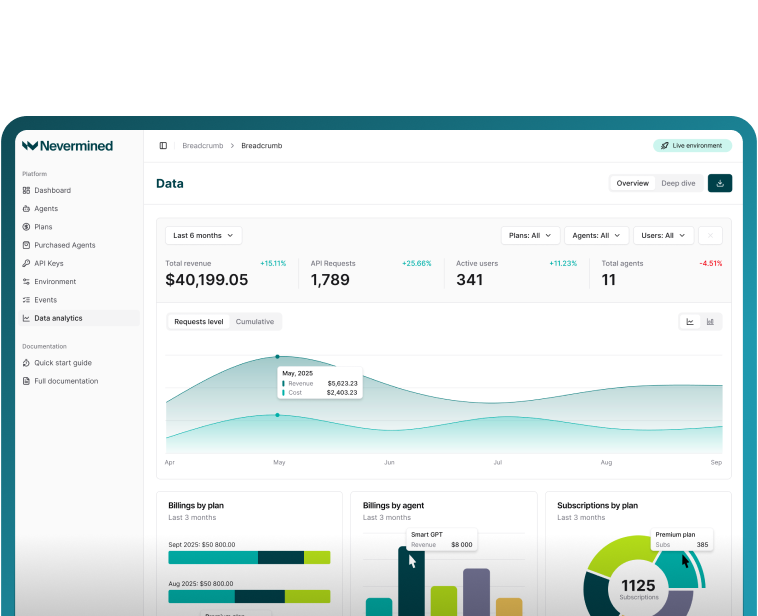
Real-time payments, flexible pricing, and outcome-based monetization—all in one platform.