MENU


Data analysis revealing how enterprises are scaling autonomous AI agents and why purpose-built payment infrastructure determines who captures value in the agentic economy
The enterprise agentic AI market has reached an inflection point. With 88% of organizations now using AI regularly in at least one business function and 79% implementing AI agents at some level, the question is no longer whether to adopt autonomous systems but how to monetize them effectively. Yet a critical gap persists: while enterprises invest billions in agent capabilities, the payment infrastructure required to meter, price, and settle autonomous transactions remains woefully inadequate. Nevermined's payment infrastructure addresses this monetization challenge directly, enabling AI builders to capture revenue from every agent interaction through flexible credits, subscriptions, and fiat or crypto settlement rails.
Market research projects the global agentic AI market will reach $199.05 billion by 2034, driven by autonomous decision-making capabilities and North America's market leadership. This trajectory establishes agentic AI as one of the fastest-growing enterprise technology categories.
The market started at $5.25 billion in 2024 with a compound annual growth rate of 43.84%. This baseline demonstrates the nascent but rapidly expanding opportunity for AI payment infrastructure.
Grand View Research tracks the enterprise-specific segment at $2.58 billion in 2024, projecting growth to $24.50 billion by 2030 at 46.2% CAGR. This nearly 10x growth creates urgent demand for enterprise-grade billing and metering solutions.
Precedence Research values the broader AI agents market at $7.92 billion in 2025, projecting expansion to $236.03 billion by 2034. These figures represent the total addressable market for agent monetization infrastructure.
MarketsandMarkets offers an even more aggressive projection, estimating growth from $6.76 billion in 2025 to $46.04 billion by 2030 at 47% CAGR. Regardless of which estimate proves accurate, the monetization infrastructure gap will widen without purpose-built solutions.
Gartner predicts agentic AI could drive 30% of enterprise application software revenue by 2035, surpassing $450 billion. This revenue potential requires billing systems capable of capturing value from autonomous agent interactions.
PwC research indicates AI could expand global GDP by nearly 15% by 2035 if responsibly deployed. Enterprises need trusted payment infrastructure to participate in this economic transformation.
Berkeley research projects agentic AI will contribute $2.6 to $4.4 trillion annually to global GDP by 2030. Capturing even a fraction of this value requires infrastructure that can meter and settle autonomous transactions at scale.
McKinsey reports 88% of organizations use AI regularly in at least one business function in 2025, up from 78% in 2024. This near-universal adoption creates the foundation for agentic AI expansion.
PwC research shows 79% of organizations have implemented AI agents at some level, demonstrating that agent adoption has moved beyond early experimentation.
McKinsey finds 62% of organizations are at least experimenting with AI agents, with 23% already scaling and 39% in experimentation phase. This adoption curve demands scalable billing infrastructure.
Nearly universal expansion is planned, with 96% of IT leaders indicating they will expand AI agent usage in 2025. Nevermined's dynamic pricing engine enables enterprises to monetize this expansion with usage-based, outcome-based, and value-based models.
Budget commitment is strong, with 88% of executives planning to increase AI-related budgets in the next 12 months specifically because of agentic AI capabilities.
Deloitte research shows 25% of GenAI users are launching agentic pilots in 2025, with this figure expected to reach 50% by 2027. This rapid expansion requires payment infrastructure that scales alongside adoption.
Gartner predicts 40% of enterprise applications will feature task-specific AI agents by the end of 2026, up from less than 5% in 2025. This 8x increase in agent-enabled applications demands robust metering capabilities.
The pace of advancement is accelerating, with 65% of enterprises moving from experimentation to pilots in Q1 2025, up from 37% in Q4 2024.
Despite massive investment, EY's AI Pulse Survey shows that while 34% of organizations have started implementing agentic AI, only 14% report full implementation. This implementation gap often stems from monetization complexity that Nevermined's payment facilitator addresses through unified authorization, metering, and settlement.
Breadth of adoption is increasing, with 50% of organizations now using AI in three or more business functions, creating multiple monetization touchpoints.
Among first-mover companies, agent creation surged 119% in just six months. This explosive growth demonstrates the urgency for scalable agent billing infrastructure.
Enterprises expect significant returns, projecting 171% average ROI from agentic AI investments, with U.S. enterprises expecting 192%. Realizing these returns requires billing infrastructure that captures value from every agent interaction.
Confidence in returns is high, with 62% of organizations expecting more than 100% ROI from their agentic AI investments. Nevermined's credits system enables businesses to align price to value through flexible, prepaid consumption units.
Two-thirds of companies report measurable value through increased productivity, validating the business case for agentic AI adoption.
Gartner predicts agentic AI will reduce operational costs in customer service by 30% by 2029, demonstrating the efficiency gains autonomous agents deliver across enterprise workflows.
Customer support operations see 50% cost reduction through AI-powered agents, creating clear ROI justification for expanded deployment.
In supply chain operations, procurement expenses have been reduced by up to 90% through agentic AI, representing transformative cost optimization.
Beyond cost savings, 64% of organizations say AI is enabling innovation at their company, creating new revenue streams that require flexible monetization infrastructure.
Financial impact is measurable, with 39% of organizations reporting EBIT impact at the enterprise level from AI deployments.
Budget allocation reflects strategic priority, with 43% of companies allocating over half of their AI budgets to agentic systems.
Significant spending increases are planned, with over 26% of executives targeting AI spending increases of 26% or more in 2025.
IDC projects AI investment will grow 31.9% year-over-year between 2025 and 2029, reaching $1.3 trillion by 2029.
Governance remains a top priority, with 76% of technology leaders saying governance is extremely important for agentic AI deployment. Nevermined's audit-ready traceability addresses this through tamper-proof metering with cryptographically signed append-only logs.
Risk is real, with 51% of organizations using AI having experienced at least one negative consequence, underscoring the need for robust compliance infrastructure.
Gartner projects over 40% of agentic AI projects will be canceled by the end of 2027 due to escalating costs, unclear business value, and inadequate risk controls. Proper billing and metering infrastructure helps prevent these failures.
Security concerns persist, with 49% citing data privacy and security breaches as the biggest concern for agentic AI adoption.
Trust deficits impact deployment, with 28% of executives ranking lack of trust as a top challenge to realizing AI value. Nevermined's zero-trust reconciliation model, where every usage record is cryptographically signed and immutable, directly addresses this concern.
Despite challenges, 73% of executives believe AI agents will deliver significant competitive advantage in the next 12 months, driving continued investment.
Architecture preferences are clear, with multi-agent systems commanding 66.4% market share. These systems require agent-to-agent payment capabilities that Nevermined's A2A integration provides through native support for Google's Agent-to-Agent protocol.
Infrastructure requirements are demanding, with 87% rating interoperability as crucial for agentic AI adoption. Nevermined's protocol-first architecture supports x402, A2A, Model Context Protocol, and Agent Payments Protocol to ensure compatibility as standards evolve.
Process orchestration is nearly universally recognized as essential, with 94% of respondents identifying it as critical for AI deployment success.
Looking ahead, Gartner predicts 33% of enterprise applications will feature agentic AI by 2028, creating vast opportunities for interoperable payment infrastructure.
Usage patterns show 65% average monthly growth in employee interactions with AI agents during H1 2025.
Agent activity is accelerating even faster, with actions triggered by employee engagement growing at 76% month-over-month in H1 2025.
Consumer acceptance is strong, with 94% opting into agent interactions when given the choice.
Primary use cases are emerging, with 71% of organizations deploying AI agents for process automation.
Customer service leads adoption, with 57% of companies using or planning to use agents in customer service within six months.
Workforce adoption has surged 233% since fall 2024, creating urgent demand for billing infrastructure that can scale with this growth. Nevermined gets you from zero to a working payment integration in 5 minutes, with SDKs for both TypeScript and Python.
Daily AI users are 64% more likely to report very good productivity, validating the productivity case for agent adoption.
Customer service agent usage exploded, with average daily conversations growing 22x in H1 2025.
By 2028, 68% of customer service interactions are projected to be handled by agentic AI, requiring massive billing infrastructure scale.
Valory cut deployment time of their payments and billing infrastructure for the Olas AI agent marketplace from 6 weeks to 6 hours using Nevermined, clawing back $1000s in engineering costs.
Regional leadership is clear, with North America holding over 39% market share in 2024.
Growth is shifting, with Asia Pacific anticipated to register the highest CAGR over the forecast period.
Industry-specific adoption varies, with travel and hospitality seeing agent actions grow at 133% monthly average rate in H1 2025.
Retail follows closely with 128% monthly growth in agent actions.
Financial services, despite heavier regulation, saw 105% monthly growth in agent actions.
Three industries dominate early adoption, with 70% of agentic AI POCs originating from banking and financial services, retail, or manufacturing. Nevermined's observability dashboard provides these enterprises with visibility into agent performance, user behavior, revenue analytics, and margin recovery.
The path to capturing value from enterprise agentic AI requires purpose-built payment infrastructure rather than retrofitted traditional solutions. Organizations successfully monetizing AI agents share these implementation characteristics:
Infrastructure Requirements:
Technical Priorities:
The Nevermined documentation provides comprehensive implementation guides, sandbox environments for testing, and API references for both TypeScript and Python SDKs.
Traditional generative AI creates content based on prompts but requires human direction for each interaction. Agentic AI operates autonomously, making decisions and executing multi-step tasks without continuous human oversight. This autonomy creates unique monetization challenges since agents generate transactions at machine speed, often involving sub-cent micro-interactions that traditional billing systems cannot handle efficiently.
Enterprises need payment infrastructure with tamper-proof metering where every usage record is cryptographically signed and pushed to an append-only log at creation. This creates immutable audit trails that enable zero-trust reconciliation, allowing developers, users, auditors, or agents to verify that usage totals match billed amounts. Nevermined provides this through its compliance infrastructure with GDPR-compliant audit-ready traceability.
Outcome-based and value-based pricing align revenue with actual value delivered rather than arbitrary usage metrics. Outcome-based pricing charges for results like completed tasks or booked meetings, while value-based pricing calculates fees as a percentage of ROI generated. These models build customer trust by connecting costs to business impact, though they require sophisticated metering infrastructure to track and attribute outcomes accurately.
Integration speed varies dramatically by solution. Nevermined gets you from zero to a working payment integration in 5 minutes, with SDKs for both TypeScript and Python. Valory demonstrated this speed advantage by cutting deployment time for their Olas AI agent marketplace payments and billing infrastructure from 6 weeks to 6 hours using Nevermined.
Decentralized identities enable persistent agent reputation tracking, programmable payment flows, and fine-grained entitlements controlling which agents execute which functions. Nevermined's agent identity system issues each agent a unique wallet plus decentralized identifier with cryptographic proof of ownership, creating portable identities that work across environments, swarms, and marketplaces without requiring reconfiguration.
Travel and hospitality lead with 133% monthly growth in agent actions, followed by retail at 128% and financial services at 105%. However, 70% of agentic AI proof-of-concepts originate from banking and financial services, retail, or manufacturing. These industries benefit most from autonomous workflow execution and are driving demand for enterprise-grade payment and compliance infrastructure.
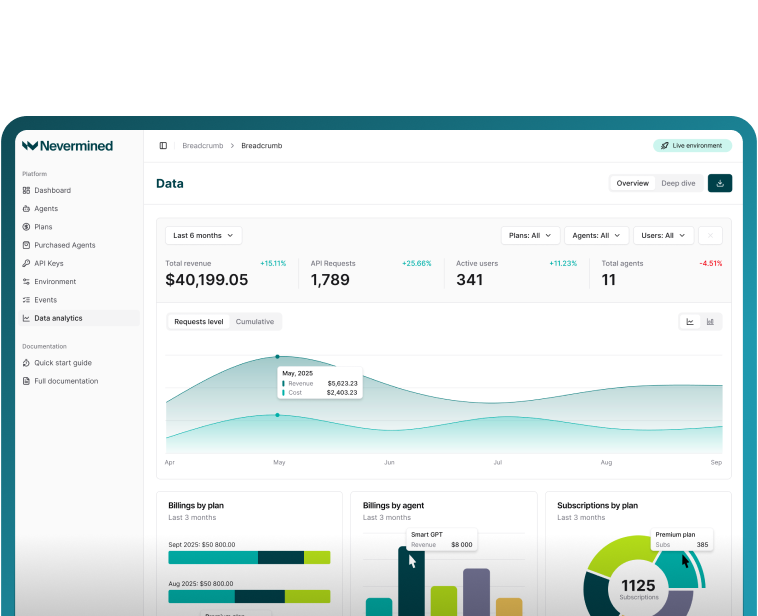
See Nevermined
in Action
Real-time payments, flexible pricing, and outcome-based monetization—all in one platform.