MENU


Data analysis revealing the explosive growth trajectory of AI agent marketplaces and the infrastructure required to capture billions in autonomous transaction revenue
The AI agent marketplace is experiencing a revenue explosion that traditional payment systems cannot contain. With the market projected to surge from $7.63 billion in 2025 to $182.97 billion by 2033, enterprises face a critical infrastructure gap: legacy billing systems cannot handle the micro-transactions, per-token charges, and autonomous agent interactions that define modern AI commerce. Nevermined's payment infrastructure bridges this gap, enabling AI builders and enterprises to meter, price, and settle every agent interaction in real time through flexible credits, subscriptions, and fiat or crypto rails.
The global AI agents market reached $5.26 billion in 2024, establishing the baseline for an emerging economy requiring fundamentally different payment infrastructure than traditional software.
MarketsandMarkets projects growth from $7.84 billion in 2025 to $52.62 billion by 2030 at a compound annual growth rate of 46.3%. This 7x growth trajectory creates urgent demand for monetization infrastructure capable of scaling alongside agent deployments.
Grand View Research provides an even more aggressive estimate, projecting the market will reach $182.97 billion by 2033 at 49.6% CAGR. This projection underscores the massive revenue opportunity awaiting businesses with proper billing infrastructure.
GM Insights estimates the market will grow from $5.9 billion in 2024 to $105.6 billion in 2034 at 38.5% CAGR, representing a more conservative but still substantial growth trajectory.
Technavio reports the AI agent platform market will increase by $23.56 billion at a 41.1% CAGR from 2024 to 2029, highlighting the platform infrastructure opportunity.
The AI agents market expanded from $5.25 billion in 2024 to $7.84 billion in 2025, demonstrating accelerating year-over-year growth that payment systems must accommodate.
Bain & Company projects the U.S. agentic commerce market could reach $300 to $500 billion by 2030, making up roughly 15% to 25% of overall e-commerce. This massive shift requires billing systems capable of processing billions of autonomous transactions.
Morgan Stanley Research estimates agentic shoppers could represent $190 billion to $385 billion in U.S. e-commerce spending by 2030, capturing 10% to 20% of market share.
AI agents are projected to generate up to $450 billion in economic value through revenue growth and cost savings by 2028. Nevermined's dynamic pricing engine enables platforms to capture this value through usage-based, outcome-based, and value-based models.
Roughly 23% of Americans made purchases using AI in the past month, demonstrating consumer readiness for agent-mediated commerce.
Global AI spending is projected to reach $1.5 trillion in 2025, with $644 billion dedicated to generative AI, creating a massive addressable market for agent monetization infrastructure.
Research shows 60% of enterprises cite non-compliance risks and data governance concerns as major barriers preventing AI agent scaling. Tamper-proof metering with cryptographically signed records addresses these concerns directly.
Just 50% of organizations say they have sufficient knowledge of AI agent capabilities, making transparent usage tracking essential for building trust with buyers and stakeholders.
Fewer than 20% of organizations report having the high levels of data readiness required to scale AI agents, underscoring the need for robust metering infrastructure.
Over 80% of organizations lack mature AI infrastructure, creating opportunity for purpose-built payment solutions that provide audit-ready traceability from day one.
Consumer transparency demands are high, with 72% of customers saying it's important to know if they're communicating with an AI agent. Clear metering and billing build trust in these interactions.
The multi-agent systems segment is projected to grow at 48.5% CAGR during the forecast period, driving demand for agent-to-agent payment capabilities. Nevermined's A2A integration enables these autonomous transactions.
While 88% of organizations use AI in at least one business function, only 23% have scaled AI agent systems into production. The gap reveals infrastructure limitations in supporting agent-to-agent workflows.
An overwhelming 93% of business leaders believe that scaling AI agents in the next 12 months will provide a competitive advantage over peers, driving urgent demand for scalable payment infrastructure.
Research shows 61% of organizations are preparing for or actively exploring AI agent deployments as part of their near-term digital strategy.
InData Labs reports 82% of enterprises plan AI agent integration within three years, creating a massive near-term market for agent payment solutions.
AI agent usage has increased 22-fold since January 2025, demonstrating explosive adoption that requires rapid deployment of billing infrastructure. Nevermined gets you from zero to a working payment integration in 5 minutes, with SDKs for both TypeScript and Python.
A Google Cloud study confirms 74% of companies achieve ROI within the first year of AI deployment, with 56% saying genAI led to business growth. Among that subgroup, 71% reported increased revenue. Fast integration accelerates this timeline.
Just 6% of organizations are classified as AI high performers, defined as companies generating more than 5% EBIT impact from AI deployments. Rapid monetization infrastructure deployment can help more organizations reach this tier.
Organizations achieving the highest returns from AI allocate more than 20% of their total digital budgets to AI technologies, demonstrating the investment required for success.
Valory cut deployment time of their payments and billing infrastructure for the Olas AI agent marketplace from 6 weeks to 6 hours using Nevermined, clawing back $1000s in engineering costs.
Research shows 30-40% of daily administrative tasks can be automated with AI, creating predictable consumption patterns ideal for credits-based billing. Nevermined's credits system enables flexible, prepaid consumption that aligns costs with value.
Sales representatives spend just 34.2% of their time actually selling, with the remaining 65.8% representing target areas for AI automation. Credits allow teams to budget for these productivity-enhancing agent interactions.
AI automation helps sales reps save 2-5 hours weekly, time savings that translate directly to monetizable value when tracked through proper billing systems.
Agentic AI is expected to reduce operational costs by 30% by 2029, savings that credits-based pricing helps organizations capture and attribute accurately.
By 2029, agentic AI will autonomously resolve 80% of common customer service issues without human intervention, requiring billing systems that track millions of micro-interactions daily.
The cloud-based agentic AI segment holds 62% market share, indicating that most AI agent deployments operate in distributed environments requiring protocol-agnostic payment solutions.
GM Insights reports conversational agents held 44% market share in 2024, representing the largest agent category requiring standardized payment protocols.
The natural language processing segment commands 38% market share and is set to expand at over 43% CAGR through 2034.
The machine learning segment holds 30.56% of global revenue share in 2025, underpinning the AI capabilities that agents leverage across providers.
Vertical AI agents designed for specific industries are projected to grow at approximately 35% per year, requiring industry-specific pricing models.
Sierra, a customer service AI agent company, reached a $10 billion valuation with $100 million ARR achieved in just 21 months, demonstrating the revenue velocity possible in AI agent marketplaces.
Anysphere's Cursor AI coding assistant achieved a $29.3 billion valuation with $500 million ARR, showcasing the enterprise value of successful agent monetization.
Lovable's vibe coding platform reached $6.6 billion valuation with $200 million ARR achieved in just 12 months, demonstrating rapid revenue scaling potential.
AI agents now capture 33% of total global VC funding, signaling investor confidence in the agent marketplace opportunity.
Research shows 42% of AI agent startups are already deploying or commercializing solutions, moving beyond pilot phase to production monetization.
The average revenue multiple for AI agent companies is 52x ARR, with customer service agents commanding 127x ARR, reflecting premium valuations for successfully monetized agents.
Enterprises are spending 40%+ of AI budgets on agentic systems, confirming substantial corporate investment in agent-based solutions.
Research confirms 81% of sales teams using AI report increased revenue, gains that require observability tools to track and optimize. Nevermined's observability dashboard provides visibility into agent performance, user behavior, and revenue analytics.
The performance gap is stark: 83% of sales teams using AI experienced growth compared to 66% of non-AI teams, a 17 percentage point advantage that analytics help quantify.
Telefónica handles approximately 4.5 million customer service calls per month using AI agents, demonstrating the scale that observability systems must support.
These agents achieve about 90% intent recognition accuracy, performance metrics that observability dashboards track to optimize revenue and customer satisfaction.
Mercado Libre recorded a 25% increase in advertising click-through rates after deploying AI-generated ads, demonstrable ROI that analytics platforms capture.
Companies implementing AI agents have seen a 15% boost in sales conversion rates, improvements that require attribution tracking to verify.
Lead conversion rates climb up to 30% for companies leveraging generative AI implementation, gains that proper metering helps attribute to specific agent interactions.
Forrester research shows 45% more deals closed by salespeople using AI and machine learning tools, performance improvements that drive investment in agent monetization.
Regional analysis confirms North America accounted for 39.63% of global AI agents revenue in 2025, requiring multi-currency analytics and reporting.
Asia-Pacific is projected to grow at 48.5% CAGR, making it the fastest-growing AI agent market globally and expanding geographic coverage requirements.
Bain reports 30% to 45% of US consumers are using generative AI for product research and comparison, consumer behavior that creates new monetization touchpoints.
Research shows 39% of organizations report EBIT impact from AI deployments, bottom-line results that sophisticated analytics help optimize.
Capturing revenue from the AI agent marketplace requires purpose-built payment infrastructure rather than retrofitted legacy systems. Organizations successfully monetizing AI agents share these implementation characteristics:
Key technical priorities include:
The Nevermined documentation provides comprehensive implementation guides, sandbox environments for testing, and API references for both TypeScript and Python SDKs.
AI agent marketplaces generate revenue through multiple monetization models including usage-based pricing per token or API call, outcome-based pricing that charges for completed tasks or results, and value-based pricing calculated as a percentage of ROI generated. The most successful platforms combine these models with prepaid credits systems that allow customers to purchase consumption units in advance. With agentic commerce projected to reach $300 to $500 billion by 2030, marketplaces capturing even small transaction fees can generate substantial revenue.
Outcome-based pricing aligns agent costs directly with business results, charging customers only when agents deliver measurable value like booked meetings, completed analyses, or resolved support tickets. This model builds trust with buyers who may be skeptical of paying for autonomous agent actions without guaranteed results. Companies like Sierra have achieved $100 million ARR by demonstrating clear customer service outcomes, proving that outcome-based approaches can support premium valuations.
Tamper-proof metering creates an immutable record of every agent interaction by cryptographically signing usage records and pushing them to append-only logs at creation. This zero-trust reconciliation model allows developers, users, auditors, or agents to verify that usage totals match billed amounts per line-item. With 60% of enterprises citing compliance and governance as deployment barriers, audit-ready traceability directly addresses executive concerns about autonomous agent oversight.
Yes, AI agents can execute autonomous payments through smart account infrastructure that supports session keys and delegated permissions. Users authorize payment policies once, then agents interact freely within defined boundaries without requiring human approval for each transaction. This capability is essential as multi-agent systems grow at 48.5% CAGR, where agents must transact with other agents at machine speed to deliver value.
Pricing infrastructure determines whether businesses can capture value from the projected $182.97 billion AI agent market by 2033. Traditional payment processors cannot handle the micro-transactions, per-token billing, and agent-to-agent settlements that define modern AI commerce. Purpose-built solutions that support dynamic pricing, real-time metering, and instant settlement in fiat or cryptocurrency enable AI builders to monetize every agent interaction rather than leaving revenue unrealized.
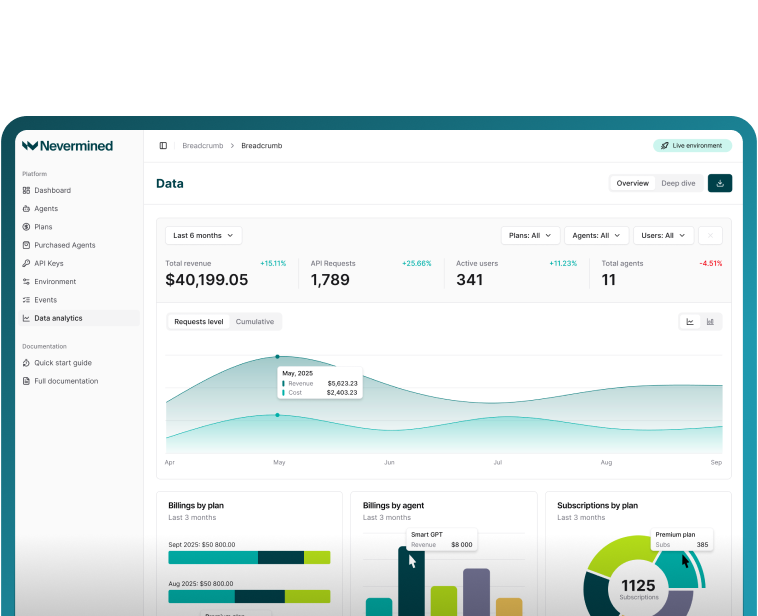
See Nevermined
in Action
Real-time payments, flexible pricing, and outcome-based monetization—all in one platform.