MENU


Data analysis revealing how organizations measure, achieve, and maximize return on investment from autonomous AI agents and why purpose-built payment infrastructure accelerates financial outcomes
The AI agent market is surging toward $182.97 billion by 2033, yet the vast majority of organizations struggle to capture and quantify the value their agents create. While 79% of organizations report some level of AI agent adoption, only a fraction can demonstrate clear ROI in dollar terms. The disconnect between adoption and monetization threatens to leave billions in potential revenue untapped. Nevermined's payment infrastructure bridges this gap, enabling AI builders to meter, price, and settle every agent interaction in real time while providing the observability needed to prove and maximize returns.
Grand View Research reports the global AI agents market reached $7.63 billion in 2025, establishing the baseline valuation for an economy that demands fundamentally different approaches to measuring and capturing return on investment.
The same research projects this market will surge to $182.97 billion by 2033 at a compound annual growth rate of 49.6%. This 24x growth trajectory creates an urgent need for ROI measurement infrastructure that can scale alongside agent deployments.
Precedence Research provides an even more aggressive estimate, projecting the market will reach $236.03 billion by 2034 at 45.82% CAGR. Regardless of which projection proves accurate, the organizations that can quantify and demonstrate ROI will capture disproportionate market share.
PwC research reveals 79% of organizations have adopted AI agents to some degree, yet the gap between adoption and measurable returns remains substantial. This widespread deployment without corresponding ROI visibility represents a significant market inefficiency.
McKinsey research shows just 23% of organizations are actively scaling agentic AI systems, with an additional 39% in experimental phases. The inability to demonstrate clear ROI often prevents organizations from moving beyond pilots.
According to Fullview research, 66% of companies struggle to establish ROI metrics for their AI initiatives. This measurement challenge directly impacts the ability to justify continued investment and expansion of agent deployments.
Google Cloud research shows 52% of executives now have AI agents in production environments, creating immediate demand for robust performance tracking and revenue attribution capabilities.
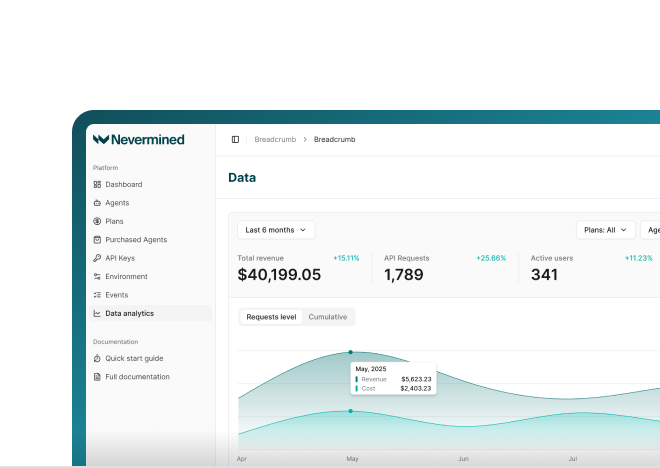
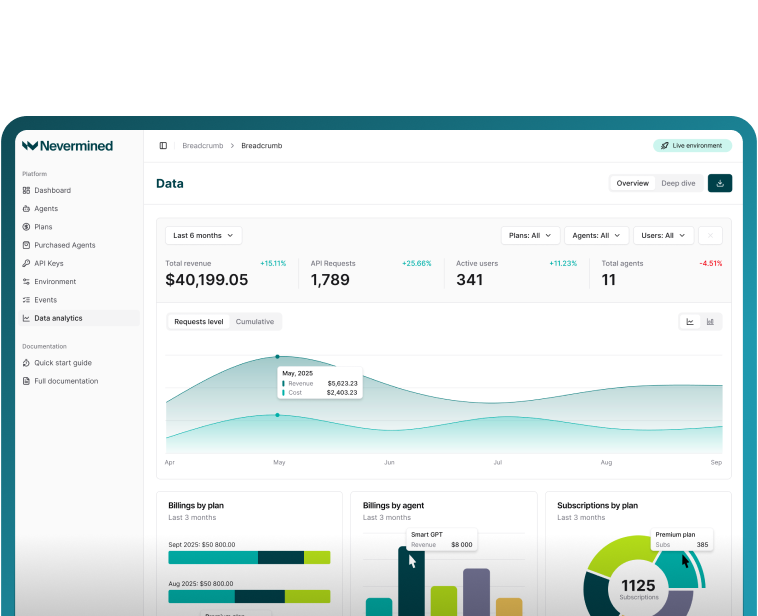
PwC finds that 66% of organizations adopting AI agents report measurable value through increased productivity. Nevermined's observability dashboard provides visibility into agent performance, user behavior, and revenue analytics, enabling organizations to track these productivity gains in real time.
PwC's 2025 CEO Survey reveals a critical disconnect: 44% of business leaders report workforce efficiency gains from AI implementation, but only 24% see measurable profit impact. This 20-percentage-point value gap highlights the need for infrastructure that converts efficiency into revenue.
McKinsey reports 88% of organizations now use AI in at least one function, up from 78% the prior year. This rapid expansion makes granular performance tracking essential for understanding which deployments generate returns and which require optimization.
McKinsey's research indicates only 6% of organizations qualify as "AI high performers" generating 5% or more EBIT impact from AI. Nevermined delivers bank-grade enterprise-ready metering, compliance, and settlement so every model call turns into auditable revenue, helping organizations move into this high-performer category.
PagerDuty research reveals organizations project an average ROI of 171% from agentic AI deployments, with U.S. enterprises specifically forecasting 192% returns. Capturing these returns requires pricing models that align with the value agents deliver.
According to PagerDuty research, 62% of organizations expect more than 100% ROI on their agentic AI investments. Nevermined's dynamic pricing engine enables cost-plus-margin automation where platforms define exact margin percentages locked onto usage credits.
Google Cloud research shows 74% of executives report achieving ROI within the first year of AI agent deployment. This first-year success rate depends heavily on having flexible pricing models that capture value from day one.
Fullview research indicates companies moving early into GenAI adoption report $3.70 in value for every dollar invested. Nevermined uniquely supports usage-based pricing, outcome-based pricing that charges for results like booked meetings, and value-based pricing calculated as a percentage of ROI generated.
The highest-performing organizations achieve even greater returns, with top performers seeing $10.30 return per dollar invested over a three-year period. This tenfold return demonstrates the upside potential when proper monetization infrastructure captures every agent interaction.
Forrester research documents organizations achieving 210% ROI over three years from AI automation, with payback periods under 6 months. These returns become possible when pricing models align revenue capture with actual value delivered.
Research shows 76% of companies said governance was "extremely important" in deploying new AI tools. Nevermined's tamper-proof metering addresses this through cryptographically signed usage records pushed to an append-only log at creation, making them immutable.
McKinsey findings reveal 51% of organizations using AI have experienced at least one negative consequence. Audit-ready traceability built into Nevermined's compliance infrastructure helps organizations identify and address issues before they impact ROI.
IBM's CEO Study reveals only 25% of AI initiatives delivered expected ROI, and only 16% scaled enterprise-wide. The zero-trust reconciliation model that Nevermined provides allows developers, users, auditors, or agents to verify that usage totals match billed amounts per line-item.
MIT and RAND Corporation research via Fullview indicates 70-85% of AI initiatives fail to meet expected outcomes. Verifiable ROI data through tamper-proof metering helps organizations understand exactly where value is being created or lost.
Gartner projects 40% of agentic AI projects will be canceled by 2027 due to escalating costs, unclear business value, and inadequate risk controls. The exact pricing rule stamps onto each agent's usage credit in Nevermined, providing the clarity needed to avoid this fate.
Cloudera research shows 96% of enterprises plan to expand use of AI agents in the next 12 months. This expansion creates urgent demand for rapid integration capabilities that minimize time-to-revenue.
National Bureau of Economic Research documents a 34% productivity boost for novice and low-skilled workers using AI tools. Nevermined gets you from zero to a working payment integration in 5 minutes, with SDKs for both TypeScript and Python.
Among executives reporting productivity gains, Google Cloud research shows 39% have seen productivity at least double. Rapid integration means organizations can start capturing value from these gains immediately rather than waiting months for custom billing infrastructure.
ServiceNow data shows 80% autonomous handling of customer support inquiries through AI agents, demonstrating the scale of interactions requiring metering and billing capabilities.
The same data reveals a 52% reduction in time needed for complex case resolution. Valory cut deployment time of their payments and billing infrastructure for the Olas AI agent marketplace from 6 weeks to 6 hours using Nevermined, clawing back $1000s in engineering costs.
Desk365 research shows a 25% reduction in customer service costs through automation and improved operational efficiency. Capturing these cost savings requires infrastructure that tracks every agent interaction in real time.
Market.us research reveals the multi-agent segment held more than 66.4% share of the global agentic AI market in 2024, where agents interact with other agents to complete complex tasks. Nevermined's agent-to-agent payments through protocols like Google's A2A enable monetizable multi-agent systems.
Azumo research projects multi-agent systems growing at a 48.5% CAGR during 2025 to 2030, outpacing single-agent systems. This growth trajectory makes agent-to-agent payment capabilities increasingly essential for ROI capture.
Multimodal research shows 87% of IT executives rate interoperability as very important or crucial for agentic AI adoption. Nevermined enables transactions between AI agents without human involvement through ERC-4337 smart accounts with session keys and delegated permissions.
According to research, nearly 94% of organizations emphasized process orchestration as a core part of the tech stack for deploying AI effectively. When agents orchestrate complex workflows together, traditional payment flows requiring human approval become impossible bottlenecks.
Gartner predicts AI agents will intermediate more than $15 trillion in B2B spending by 2028. Users authorize payment policies once with Nevermined, then agents interact freely within boundaries, unlike standard x402 implementations requiring wallet pop-ups for each request.
EY research shows that among executives planning to increase AI budgets, 43% say more than half of their AI budget is allocated to agentic AI. Nevermined's credits system enables flexible scaling where credits reallocate across users, departments, or agents without renegotiating licenses.
PwC research reveals 88% of executives plan to increase AI-related budgets in the next 12 months due to agentic AI. Credits allow users to prepay, monitor burn rate in real time, and avoid surprise overruns as budgets expand.
PwC data shows over 26% of executives plan AI spending increases of 26% or more in 2025. Finance teams receive trackable recurring billing through credits instead of complex sub-cent charge reconciliation.
Fullview research documents AI agent startups raising $3.8 billion in 2024, nearly tripling from the previous year. This investment surge demands monetization infrastructure that can demonstrate ROI to investors and customers alike.
Total corporate AI investment reached $252.3 billion in 2024, with private investment climbing 44.5% year-over-year. Credits align price to value by charging for micro-actions and rewarding successful outcomes from this massive investment.
Cloudera research shows AI agents are most used for process automation (71%), the leading use case for agent deployment. Nevermined enables these organizations to monetize automation through flexible pricing models.
PwC finds 57% of companies are actively using or planning to use AI agents in customer service functions within six months. This rapid deployment timeline makes quick integration essential for capturing early returns.
Cisco projects 68% of customer service interactions will be handled by agentic AI by 2028. Organizations capturing value from this shift through Nevermined's facilitator component can realize substantial returns as agent interactions scale.
Landbase research documents organizations achieving up to 80% cost reduction through autonomous workflow execution with agentic AI systems. Converting these savings into measurable ROI requires infrastructure that tracks every autonomous action.
Gartner predicts 33% of enterprise applications will include agentic AI by 2028, up from less than 1% in 2024. Nevermined's protocol-first architecture supports x402, Google's A2A protocol, Model Context Protocol, and Agent Payments Protocol to ensure compatibility as standards evolve.
CMR Berkeley research projects agentic AI will contribute $2.6-4.4 trillion annually to global GDP by 2030. This protocol-agnostic approach ensures organizations can capture their share of this value regardless of which standards dominate.
Deloitte predicts 50% of enterprises using GenAI will deploy AI agents by 2027, up from approximately 25% in 2025. Future-proof infrastructure protects current ROI investments while enabling expansion into new standards and protocols.
Organizations successfully measuring and maximizing AI agent ROI share these implementation characteristics:
Key technical priorities include:
The Nevermined documentation provides comprehensive implementation guides, sandbox environments for testing, and API references for both TypeScript and Python SDKs.
Nevermined provides granular real-time metering that tracks every agent interaction, from API calls to token consumption to completed outcomes. The observability dashboard delivers visibility into agent performance, user behavior, and revenue analytics, enabling precise ROI calculations. Every usage record is cryptographically signed and pushed to an append-only log, allowing developers, users, and auditors to verify that usage totals match billed amounts per line-item.
Nevermined uniquely supports three flexible pricing models: usage-based pricing for per-token or per-API-call billing with guaranteed margins, outcome-based pricing that charges for results like booked meetings or completed tasks, and value-based pricing calculated as a percentage of ROI generated. This flexibility surpasses most alternatives that support only usage-based models. The dynamic pricing engine enables cost-plus-margin automation where platforms define exact margin percentages locked onto usage credits.
Yes. Every usage record in Nevermined is cryptographically signed and pushed to an append-only log at creation, making it immutable and tamper-proof. The exact pricing rule stamps onto each agent's usage credit, enabling zero-trust reconciliation where any party can independently verify that usage totals match billed amounts. This audit-ready traceability meets enterprise compliance requirements and provides the foundation for credible ROI reporting.
Nevermined gets you from zero to a working payment integration in 5 minutes, with SDKs for both TypeScript and Python. Valory demonstrated this speed advantage by cutting deployment time for their Olas AI agent marketplace payments and billing infrastructure from 6 weeks to 6 hours using Nevermined, clawing back thousands in engineering costs. This rapid integration means organizations can start capturing revenue and measuring ROI immediately rather than waiting months for custom billing infrastructure.
Yes. Nevermined enables transactions between AI agents without human involvement through ERC-4337 smart accounts with session keys and delegated permissions. Users authorize payment policies once, then agents interact freely within established boundaries. This contrasts with standard x402 implementations requiring wallet pop-ups for each request, which would make autonomous agent-to-agent commerce impossible at scale.
The Credits system operates as prepaid consumption-based units redeemed directly against usage, aligning price to value by charging for micro-actions and rewarding successful outcomes. Users prepay credits, monitor burn rate in real time, and avoid surprise overruns. Credits also enable flexible scaling where units reallocate across users, departments, or agents without renegotiating licenses, providing finance teams with trackable recurring billing instead of complex sub-cent charge reconciliation.
See Nevermined
in Action
Real-time payments, flexible pricing, and outcome-based monetization—all in one platform.