MENU

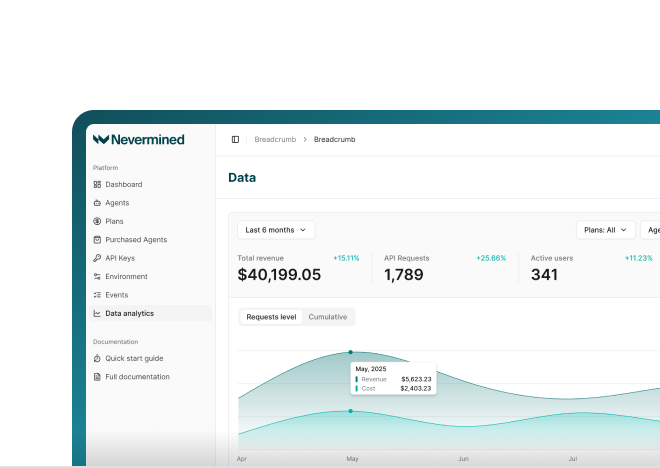

Data analysis revealing how coordinated AI agent systems are transforming business revenue through collective intelligence and autonomous commerce
AI agent swarms represent the next frontier in autonomous systems, where multiple AI agents coordinate to complete complex tasks that single agents cannot handle alone. The global AI agent market reached $5.4 billion in 2024 and is accelerating toward a projected $50 to $216 billion by 2030 to 2035. Yet monetizing these swarm interactions presents unique challenges: traditional payment processors cannot handle the micro-transactions that AI agents generate. Nevermined Pay delivers bank-grade enterprise-ready metering, compliance, and settlement so every model call turns into auditable revenue, featuring ledger-grade metering, a dynamic pricing engine, credits-based settlement, 5x faster book closing, and margin recovery.
The AI agents market is expanding at an extraordinary pace. According to Precedence Research, the global market will grow from $5.43 billion in 2024 to $236.03 billion by 2034 at a 45.82% CAGR. This trajectory reflects the fundamental shift toward autonomous systems across industries.
Fortune Business Insights reports the swarm intelligence market reached $61.25 billion in 2025 and is projected to hit $1,182.81 billion by 2034 at a 38.95% CAGR. This growth stems from swarm systems' ability to handle complex, distributed tasks that individual agents cannot manage alone.
Industry analyst MarketsandMarkets projects the AI agents market will grow from $7.84 billion in 2025 to $52.62 billion by 2030 at a 46.3% CAGR. This represents a nearly 7x expansion in just five years.
Alternative projections from Roots Analysis suggest the AI agents market will expand from $9.8 billion in 2025 to $220.9 billion by 2035 at a 36.55% CAGR. Even conservative estimates point to transformational growth.
The US market specifically will expand from $1.56 billion to $69.06 billion by 2034 at a 46.09% CAGR, representing the largest single-country opportunity globally.
SuperAGI research reveals that 82% of enterprises plan to integrate AI agents within three years. This near-universal adoption timeline creates urgent demand for payment infrastructure that can handle agent-to-agent transactions.
Warmly.ai reports 85% of enterprises will have implemented AI agents by the close of 2025. The acceleration reflects both technological maturity and competitive pressure.
Index.dev found 88% of executives are actively exploring or scaling agent-led workflows. This executive-level commitment ensures sustained investment in agentic systems.
Market.us reports an overwhelming 96% of enterprises are expanding their AI agent deployments. The question is no longer whether to adopt agents, but how quickly to scale.
KPMG research confirms 99% of organizations plan to eventually deploy agentic AI. Universal adoption creates a massive addressable market for agent monetization infrastructure.
Google Cloud data shows 52% of enterprises have moved AI agents into production environments during 2025. This represents a critical shift from experimentation to operational deployment.
Market.us found 45% of Fortune 500 companies are actively piloting agentic systems in 2025. Enterprise leaders are setting the standard for agent-first operations.
AI Plainenglish research shows 62% of companies expect to achieve 100%+ ROI from their AI agent deployments. These expectations drive continued investment in agent capabilities.
Warmly.ai found companies adopting agentic AI report 6 to 10% revenue increases. This measurable top-line impact justifies agent deployment costs.
Warmly.ai reports Verizon achieved a nearly 40% sales increase following AI assistant deployment. Large-scale implementations demonstrate the revenue potential of agent systems.
SuperAGI projects AI will increase business profitability by 38% by 2035. This long-term profitability improvement compounds with sustained agent adoption.
Market.us reports organizations using agentic AI cut costs by 30%. Cost reduction combined with revenue growth creates exceptional financial returns.
Google Cloud research confirms 88% of adopters achieved positive ROI from agentic AI implementations. The high success rate reduces deployment risk for new adopters.
Salesboom research demonstrates 20 to 25% revenue increases per salesperson when deploying AI agent swarms. This productivity gain directly impacts bottom-line results.
Organizations using agent swarms report 35% increases in qualified sales conversations. More qualified conversations translate to higher close rates.
Salesboom found 25% conversion rate improvements from AI agent swarm implementations. This conversion lift compounds with increased conversation volume.
Agent swarms enable 30% faster deal closure times. Accelerated sales cycles improve cash flow and competitive positioning.
Salesboom reports 70% reduction in prospecting research time. This efficiency gain allows sales teams to focus on high-value activities.
McKinsey projects the global agentic commerce opportunity at $3 to $5 trillion by 2030. This market size demands sophisticated payment infrastructure capable of handling autonomous transactions.
McKinsey estimates the US retail agentic commerce opportunity alone at $900B to $1T by 2030. Retail represents just one vertical within the broader agentic economy.
MarketsandMarkets projects the agentic AI market will grow 13x to $93 billion by 2032. This expansion creates massive opportunity for payment infrastructure providers.
BCG and Adobe report traffic to retail sites from GenAI increased 4,700% year-over-year as of July 2025. This traffic surge demands payment systems capable of handling AI-driven commerce.
BCG found users arriving from AI agents spend 32% more time on site. Increased engagement translates to higher conversion potential.
Market.us reports AI agents increase efficiency by 25 to 40% across operations. This efficiency gain compounds with scale as more agents are deployed.
Warmly.ai reports ServiceNow achieved a 52% reduction in complex case handling time with AI agents. Complex task automation demonstrates agent capabilities beyond simple workflows.
Market.us found agentic AI delivers 86% reduction in human task time for multi-step workflows. This dramatic time savings justifies rapid agent deployment.
Salesboom reports 65% reduction in administrative time within six months of agent swarm deployment. Administrative burden reduction frees teams for strategic work.
Agent swarms deliver 90% decreases in CRM data entry errors. Improved data quality enhances downstream analytics and decision-making.
Salesboom found 4x faster proposal generation with agent swarms. Speed improvements directly impact sales cycle times.
Agent swarms reduce manual research hours by 80%. Research automation enables scale that manual processes cannot match.
Market.us reports agentic AI completes 12x more complex tasks compared to traditional LLMs. This capability expansion justifies investment in agent orchestration.
Market.us found 4x faster code debugging with agentic AI in software engineering contexts. Developer productivity gains demonstrate cross-functional agent value.
Index.dev reports AI coding tools deliver 15 to 126% productivity boosts. The wide range reflects implementation quality and use case fit.
Warmly.ai reports AI agent startups raised $3.8 billion in 2024, nearly 3x the previous year. This investment surge signals market confidence in agent technology.
Market.us found $9.7 billion invested in agentic AI startups since 2023. Sustained investment enables continued technology advancement.
SuperAGI projects a $15.7 trillion AI contribution to the global economy by 2030. Agent swarms represent a significant portion of this economic impact.
Market.us reports a 920% surge in agentic framework usage from 2023 to 2025. Framework adoption precedes production deployment.
Precedence Research shows North America accounts for 41% of market share in AI agents. Regional leadership reflects early enterprise adoption.
Precedence Research confirms North America held 41% market share in the AI agents market in 2024. Sustained leadership drives regional investment.
Mordor Intelligence found Asia Pacific growing fastest at 35.90% CAGR through 2031 for swarm intelligence. Emerging market growth expands the global opportunity.
Aalpha.net projects the Indian AI market will reach $17 billion by 2027. Country-level growth demonstrates broad international adoption.
Grand View Research projects AI in financial services will reach $4.49 billion by 2030 at a 45.4% CAGR. Financial services represent a high-value vertical for agent deployment.
LeewayHertz reports AI in healthcare is valued at $20.9 billion in 2024, reaching $148.4 billion by 2029 at a 48.1% CAGR. Healthcare AI adoption accelerates across clinical and administrative applications.
BCG found 96% of retailers are exploring or implementing AI agents. Retail adoption drives consumer-facing agent experiences.
BCG reports 68% of retailers expect AI agents to handle most customer interactions within five years. This expectation drives investment in customer-facing agent capabilities.
Rapid deployment separates successful agent implementations from failed experiments. Nevermined gets you from zero to a working payment integration in 5 minutes, with SDKs for both TypeScript and Python.
Valory cut deployment time of their payments and billing infrastructure for the Olas AI agent marketplace from 6 weeks to 6 hours using Nevermined, clawing back $1000s in engineering costs.
Key implementation priorities for agent swarm monetization include:
An AI agent swarm is a coordinated group of autonomous AI systems working together to accomplish complex tasks that single agents cannot handle independently. Agent swarms scale revenue by enabling businesses to automate multi-step workflows, with organizations reporting 20 to 25% increases in revenue per salesperson and 6 to 10% overall revenue growth. The swarm architecture allows for parallel processing, specialized task distribution, and collective problem-solving that dramatically increases operational throughput.
Traditional payment processors were designed for human-initiated transactions with typical e-commerce patterns. AI agent swarms generate millions of micro-transactions requiring sub-cent pricing, real-time metering, and autonomous settlement without human approval for each payment. The agentic AI market is growing 13x to $93 billion by 2032, demanding purpose-built infrastructure that can handle programmatic authorization, cryptographic verification, and instant multi-currency settlement.
Agent swarm monetization requires three distinct pricing models: usage-based pricing (per-token or per-API-call), outcome-based pricing (charging for results like completed tasks), and value-based pricing (percentage of ROI generated). With 62% of companies expecting 100%+ ROI from agent deployments, flexible pricing ensures providers capture appropriate value. Dynamic pricing engines enable cost-plus-margin automation where exact percentages lock onto usage credits.
Tamper-proof metering creates immutable records by cryptographically signing every usage record and pushing it to an append-only log at creation. This zero-trust reconciliation model allows developers, users, auditors, or agents to verify that usage totals match billed amounts per line-item. With 88% of adopters achieving positive ROI, transparent metering builds the trust necessary for sustained agent deployment at scale.
Purpose-built AI payment infrastructure can be integrated in minutes rather than months. Nevermined offers 5-minute setup with TypeScript and Python SDKs, compared to custom builds requiring weeks of engineering effort. Valory demonstrated this advantage by reducing deployment time from 6 weeks to 6 hours, enabling rapid time-to-market for agent monetization while saving thousands in engineering costs.
Join the Autonomous Business Hackathon on March 5 to 6, 2026 in downtown San Francisco to build autonomous businesses where agents make real economic decisions, transact with each other, and run with minimal human oversight.
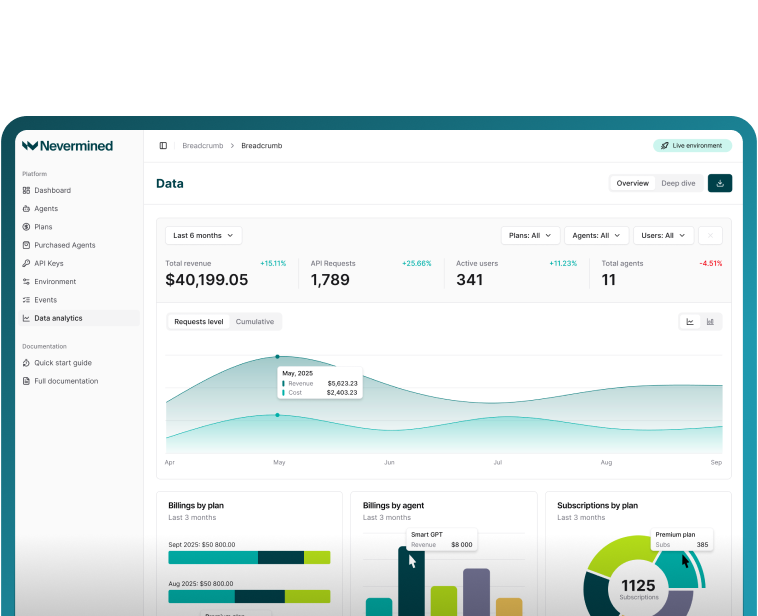
See Nevermined
in Action
Real-time payments, flexible pricing, and outcome-based monetization—all in one platform.