MENU


AI agent monetization in 2026 marks a fundamental shift from traditional SaaS economics. Autonomous systems executing workflows independently require specialized payment infrastructure, real-time metering, and pricing models that align revenue with value delivered. For builders entering this space, the opportunity is substantial: McKinsey estimates AI agents could mediate $3 trillion to $5 trillion of global consumer commerce by 2030. Achieving measurable returns depends on implementing proper billing architecture that captures micro-transactions, enables autonomous agent-to-agent payments, and supports value-aligned pricing strategies. A purpose-built AI payments platform handles these complexities, letting builders focus on what they do best: building agents that solve real problems.
The economics of AI agents differ fundamentally from traditional software. Agent costs can vary materially by workflow complexity, tool use, and model mix. Seat-based or simple subscription models become economically unviable under these conditions. Successful AI agent businesses instead implement hybrid pricing approaches that capture value at multiple points.
Four dominant pricing frameworks have emerged for AI agent monetization:
A dynamic pricing engine enables builders to implement cost-plus-margin automation, where platforms define exact margin percentages locked onto usage credits. This protects profitability even as underlying costs fluctuate.
Outcome-based pricing represents the most future-proof model because it decouples pricing from technology costs. Consider: inference costs dropped 280x for GPT-3.5 level performance between November 2022 and October 2024. Builders locked into usage-based pricing tied to compute costs see profitability shrink rapidly.
Intercom prices Fin AI Agent at $0.99 per outcome regardless of resources consumed, achieving strong value alignment. This approach is characteristic of successful agent businesses that focus on capturing value rather than passing through costs.
When AI agents manage tasks autonomously, a critical question emerges: how do users verify they are being billed accurately? Traditional billing systems lack the transparency required for this new paradigm.
Tamper-proof metering addresses this trust gap. Every usage record is cryptographically signed and pushed to an append-only log at creation, making it immutable. The exact pricing rule stamps onto each agent's usage credit, allowing developers, users, auditors, or agents to verify that usage totals match billed amounts per line item.
This zero-trust reconciliation model matters because a DigitalRoute survey of 614 global CFOs found 71% are struggling to extract financial value from AI. Clear, verifiable billing records transform a compliance headache into a competitive advantage.
Audit-ready traceability provides multiple benefits:
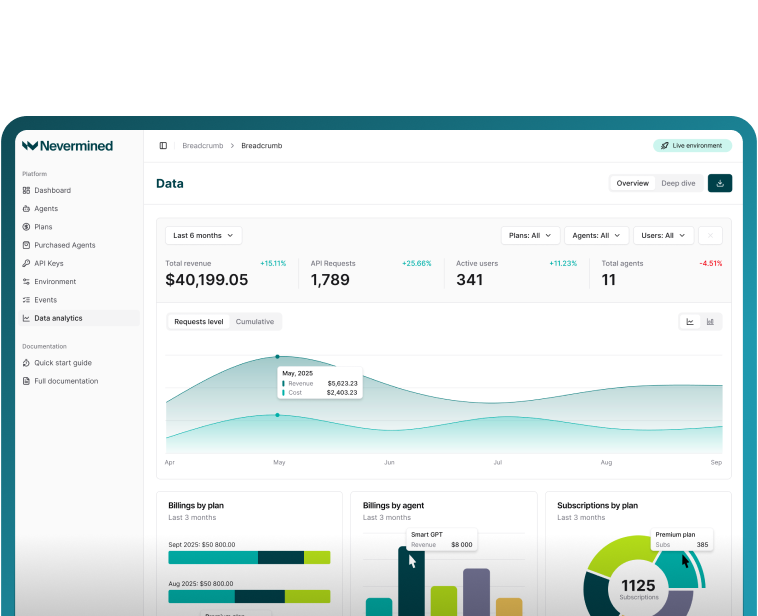
Access to observability tools gives builders visibility into agent performance, user behavior, revenue analytics, hidden costs, and growth opportunities.
The shift from human-centric tools to autonomous economic actors requires new infrastructure. Goldman Sachs CIO Marco Argenti noted that companies will shift from deploying human-centric staff to deploying human-orchestrated fleets of specialized multi-agent teams, charging clients by tokens consumed rather than hours worked.
Agent-to-agent transactions require capabilities traditional payment processors were never designed to handle. Google announced the Agent Payments Protocol (AP2) on September 17, 2025, with support from over 60 organizations including Mastercard, Visa, PayPal, Coinbase, and Deloitte.
Key infrastructure requirements include:
Native agent-to-agent monetization eliminates the need for human approval on every transaction. Users authorize payment policies once, then agents interact freely within those boundaries.
An Accenture analysis found 57% of executives expect agentic payments to go mainstream within three years. This makes protocol support as critical as LLM selection for long-term viability. Builders who implement agent-native payment infrastructure now position themselves for the multi-trillion dollar opportunity ahead.
Speed to market directly impacts revenue outcomes. Every week spent building custom billing infrastructure is a week competitors capture market share.
Traditional approaches to payment infrastructure require significant engineering investment. Building custom metering, billing, and settlement systems consumes substantial development time plus ongoing maintenance.
Valory cut deployment time of their payments and billing infrastructure for the Olas AI agent marketplace from 6 weeks to 6 hours using Nevermined, clawing back $1000s in engineering costs.
Nevermined gets you from zero to a working payment integration in 5 minutes, with SDKs for both TypeScript and Python.
Rapid deployment delivers concrete business outcomes:
Monetizing AI agents requires more than just payment processing. Builders need comprehensive infrastructure spanning pricing configuration, payment processing, and performance analytics.
Complete monetization infrastructure tracks every request in real-time, billing by cost, usage, or event according to the chosen model. Settlement occurs instantly in fiat or cryptocurrency, with both card and ACH processing alongside stablecoin settlement via the x402 protocol.
The Credits system operates as prepaid consumption-based units redeemed directly against usage. Credits align price to value by charging for micro-actions and rewarding successful outcomes. Users prepay credits, monitor burn rate in real-time, and avoid surprise overruns.
Many companies deploying AI still lack viable monetization strategies, despite widespread adoption. The gap often traces to inadequate observability into what is actually driving costs and revenue.
Effective analytics reveal:
As agents operate across environments, swarms, and marketplaces, they need portable identities that work everywhere without re-wiring.
Agent identity systems issue each agent a unique wallet plus decentralized identifier (DID) with cryptographic proof of ownership at registration. This enables:
Identity infrastructure creates the foundation for enterprise-grade agent deployments. Finance teams receive trackable recurring billing instead of complex sub-cent charge reconciliation. Compliance teams gain audit trails showing what goal was pursued, how tools were chosen, and why actions were taken.
The agent payment ecosystem remains fragmented. Google's AP2 uses mandates and verifiable credentials; other agent-payment approaches are also emerging, but cross-protocol interoperability is still immature.
Protocol-first architecture ensures compatibility as standards evolve. Native support for key protocols prevents vendor lock-in:
Builders can leverage Google A2A integration for instant agent connection and discovery.
Early platform choices could require costly migration if wrong protocols are chosen. Protocol-agnostic infrastructure that supports multiple standards simultaneously protects against this risk while enabling builders to adopt emerging protocols as they gain traction.
Coordinating authorization, metering, and settlement across fiat, crypto, credits, and smart accounts demands sophisticated orchestration.
A payment facilitator coordinates the entire payment lifecycle:
The facilitator executes on-chain verification and settlement through smart contracts, enabling atomic "pay plus execute" business logic where payment and service delivery happen as a single transaction.
Key capabilities include:
Enterprise buyers increasingly require audit-ready documentation before approving AI agent deployments. A Tray.ai-commissioned survey reported that 86% of enterprises require tech stack upgrades to deploy AI agents, and compliance readiness accelerates procurement cycles.
Key compliance considerations for AI agent monetization:
Audit-ready traceability built into append-only logging satisfies enterprise procurement requirements. Zero-retention LLM endpoints avoid inadvertent PII processing violations. Clear terms of service specify usage limits, disclaim warranties, and define responsibility for agent errors.
Nevermined delivers bank-grade enterprise-ready metering, compliance, and settlement so every model call turns into auditable revenue. The platform combines ledger-grade metering with a dynamic pricing engine, credits-based settlement, 5x faster book closing, and margin recovery tools.
For AI builders, Nevermined provides:
As Naptha AI Co-Founder Richard Blythman noted: "Whenever I need to understand AI agent monetization, I turn to the Nevermined team. They're world class and leading the agentic payments space."
Explore the complete documentation to get started.
Effective monetization requires implementing hybrid pricing models that combine base platform fees with usage, outcome, or value-based tiers. Builders should choose pricing approaches based on customer value perception rather than internal costs. The most successful approaches completely decouple pricing from underlying technology costs, maintaining margins even as inference costs continue to decline.
The agentic economy demands real-time metering capable of tracking micro-transactions, protocol support for emerging standards like x402 and AP2, and settlement rails that handle both fiat and cryptocurrency. Traditional payment processors with fixed per-transaction fees make sub-dollar requests economically unviable. Purpose-built infrastructure eliminates minimum transaction fees and enables profitable micropayments at any price point.
AI agents can transact autonomously when equipped with ERC-4337 smart accounts and session-key authorization. Users authorize payment policies once, defining boundaries within which agents operate freely. This eliminates human-in-the-loop bottlenecks that slow multi-agent workflows. The implication is a shift toward agent-as-a-service models where AI performs tasks end-to-end, including procurement decisions.
Primary risks include liability uncertainty when agents make incorrect purchases, protocol fragmentation requiring costly migrations, and over-promising autonomy that leads to customer disappointment. Deloitte reports that only one in five companies has a mature model for governance of autonomous AI agents despite rapid deployment. Builders must be transparent about actual automation rates and implement clear contractual terms defining responsibility allocation.
Enterprise pricing typically follows agent-based models that tap headcount budgets and include compliance documentation, SLAs, and dedicated support. Consumer pricing favors action-based or outcome-based models with lower friction. Workflow-based pricing works for both segments when the deliverable is clearly defined and valuable. The key is aligning price with how each segment perceives and budgets for value.
See Nevermined
in Action
Real-time payments, flexible pricing, and outcome-based monetization—all in one platform.