MENU


Data revealing how autonomous agents are reshaping payment infrastructure with sub-cent transactions, protocol standardization, and the urgent need for purpose-built billing solutions
The agentic economy has arrived, and traditional payment rails cannot keep pace. AI agents completed 140 million payments over nine months in 2025, averaging just $0.31 per transaction. Traditional payment processors charging $0.30 or more per transaction simply cannot support this micropayment reality. With over 400,000 AI agents now equipped with purchasing power and the market projected to reach $251.38 billion by 2034, purpose-built infrastructure has become essential. Nevermined's payment infrastructure delivers the real-time metering, flexible pricing, and instant settlement that AI builders need to capture revenue from every autonomous agent interaction.
Fortune Business Insights reports the global AI agents market reached $8.03 billion in 2025. This baseline valuation establishes the scale of autonomous systems now requiring payment infrastructure fundamentally different from traditional software billing.
The same research projects this market will surge to $251.38 billion by 2034 at a compound annual growth rate of 46.61%. This 31x growth trajectory creates urgent demand for micropayment infrastructure capable of handling billions of sub-dollar transactions daily.
Grand View Research provides a complementary estimate, projecting the market will reach $182.97 billion by 2033 at 49.6% CAGR. The consensus across research firms confirms that AI agent monetization infrastructure must scale dramatically.
Circle reports AI agents completed 140 million payments over nine months totaling $43 million. This transaction density demonstrates why traditional payment processors, designed for human-initiated transactions, fail to meet agentic commerce requirements.
The same data reveals the average AI agent payment is just $0.31. Traditional payment processors charging fixed fees of $0.30 or more per transaction would consume nearly the entire value of each payment, making agent commerce economically impossible without specialized infrastructure like Nevermined.
Circle data shows over 400,000 AI agents now have purchasing power capability. This population of autonomous buyers creates unprecedented demand for payment infrastructure that can authorize, meter, and settle transactions without human involvement.
KPMG Ireland reports the x402 protocol has processed 161.32 million transactions as of early 2026. This HTTP-native payment protocol enables agents to pay for resources directly within API calls, eliminating the friction of traditional payment flows.
The same research shows x402 has processed $43.57 million in total transaction volume. Nevermined's x402 integration enables AI builders to tap into this growing payment network while adding real-time metering and flexible pricing models.
The x402 payment ecosystem has grown to 417,010 buyers, establishing a substantial network of entities capable of agent-mediated transactions.
On the supply side, 83,000 sellers now accept x402 payments, creating a marketplace where AI agents can autonomously procure services, data, and compute resources.
Google's AP2 announcement confirms the protocol has attracted more than 60 organizations including major payment processors such as Coinbase, Mastercard, and PayPal. Nevermined's protocol-first architecture natively supports A2A, x402, MCP, and AP2, ensuring compatibility as these standards mature and converge.
Circle data reveals 98.6% of agent payments settled in USDC, demonstrating clear preference for programmable stablecoins that enable on-chain verification. This near-universal adoption reflects the need for transparent, auditable payment rails in autonomous systems.
Circle's official Q4/FY2025 financial results confirm the USDC circulating supply reached $75.3 billion at the end of 2025, growing 72% year-over-year. This expansion provides the liquidity foundation for AI agent micropayments at scale.
Circle reports USDC accounts for nearly 50% of all stablecoin trading volume, positioning it as the default settlement currency for the agentic economy. Nevermined's tamper-proof metering through cryptographically signed append-only logs creates the audit trail enterprises require for compliance with these digital asset transactions.
The x402 protocol enables transactions at near-zero fees on Layer 2 blockchain networks, representing a dramatic reduction compared to traditional payment rails and making micropayment economics viable for sub-cent agent transactions.
The x402 protocol achieves near-instant settlement, with preconfirmation times as low as 200 milliseconds on Base Flashblocks, enabling real-time agent commerce that traditional systems with multi-day settlement cannot support.
Grand View Research reports the machine learning segment held 30.56% revenue share in 2025. This dominance reflects the compute-intensive nature of modern AI agents, requiring dynamic pricing that can track per-token, per-inference, and per-GPU-cycle costs.
The single agent systems segment held 59.24% market share in 2025, representing the largest deployment model. These standalone agents benefit from usage-based pricing that charges only for actual consumption.
Fortune Business Insights reports ready-to-deploy agents accounted for 57% of the market, indicating strong demand for turnkey solutions. Nevermined delivers bank-grade enterprise-ready metering, compliance, and settlement so every model call turns into auditable revenue, with features including ledger grade metering, a dynamic pricing engine, credits-based settlement, 5x faster book closing, and margin recovery.
Fortune Business Insights reports multi-agent systems hold 54% market share, highlighting the growing sophistication of agent architectures that require coordinated billing across multiple autonomous systems.
Gartner projects that over $15 trillion of B2B spend will flow through AI-agent-driven marketplaces by 2028. This massive shift to agent-mediated commerce requires payment infrastructure enabling transactions between agents without human intervention.
McKinsey projects agentic commerce will generate global revenues as high as $3 to $5 trillion by 2030. Nevermined's agent-to-agent capabilities through ERC-4337 smart accounts enable these autonomous transactions within user-defined boundaries.
Deloitte's 2026 Technology Forecast projects the global agent-based AI market will reach as high as $45 billion by 2030. This growth trajectory validates the investment in purpose-built agent payment infrastructure.
Circle's official financial results confirm the Circle Payments Network processes $5.7 billion annualized transaction volume with 55 financial institutions, demonstrating the institutional infrastructure emerging to support digital asset settlement for agent commerce.
Precedence Research reports the North American market reached $2.23 billion in 2024, representing approximately 41% of the global AI agents market. This concentrated market creates competitive pressure for rapid deployment of monetization infrastructure.
Precedence Research confirms the enterprise segment dominated the AI agents market in 2024, holding 67.10% market share and setting requirements for bank-grade compliance and rapid integration that smaller teams must also meet. Nevermined gets you from zero to a working payment integration in 5 minutes, with SDKs for both TypeScript and Python.
Valory cut deployment time of their payments and billing infrastructure for the Olas AI agent marketplace from 6 weeks to 6 hours using Nevermined, clawing back $1000s in engineering costs. This dramatic acceleration demonstrates how purpose-built infrastructure eliminates the technical debt of custom payment implementations.
Precedence Research values the 2024 AI agents market at $5.43 billion, projecting growth to $236.03 billion by 2034 at 45.82% CAGR. This expansion requires portable agent identities that work across environments, which Nevermined provides through ERC-8004 decentralized identifiers with cryptographic proof of ownership.
DeFiLlama data shows Real World Asset (RWA) total value locked reached $12.5 billion by June 2025, up 124% from 2024. This tokenization trend enables AI agents to interact with traditional financial assets through blockchain rails.
Circle's official financial results show Q4 2025 revenue of $770 million, growing 77% year-over-year. This infrastructure provider growth validates the expanding market for programmable payment rails that AI agents require.
Circle's official results confirm net income reached $133 million in Q4 2025, demonstrating that digital asset payment infrastructure can be profitable at scale.
Fortune Business Insights reports customer service and virtual assistants represent 29% of the AI agents market. These high-volume applications require real-time observability to track agent performance, identify cost overruns, and optimize revenue capture.
The financial services sector accounts for 16% of AI agents market share. This regulated industry demands the audit-ready traceability that Nevermined provides through append-only logging of every transaction.
Robotics and automation contribute 18% of market share, representing physical-world agent deployments that require precise usage attribution and cost tracking across complex operational environments.
Regional analysis from Grand View Research confirms North America controls 39.63% of global AI agents market revenue. Nevermined's credits system enables businesses in this market to offer prepaid consumption units that customers redeem against agent interactions, providing predictable billing and preventing surprise overruns.
Fortune Business Insights reports Europe holds 27% of the AI agents market while Asia-Pacific accounts for 25%. This global distribution requires multi-chain support that Nevermined provides through smart contract settlement on Polygon, Gnosis Chain, Ethereum, and their corresponding test networks.
Organizations building AI micropayment infrastructure should prioritize these capabilities:
Technical implementation priorities include:
The Nevermined documentation provides comprehensive implementation guides, sandbox environments for testing, and API references for both TypeScript and Python SDKs.
Micropayment infrastructure for AI agents refers to specialized billing, metering, and settlement systems designed to handle the high-volume, low-value transactions that autonomous systems generate. Traditional payment processors charge fixed fees of $0.30 or more per transaction, making them economically unviable when average AI agent payments are just $0.31. Purpose-built solutions like Nevermined enable sub-cent transaction costs through blockchain settlement and protocol-native payment flows.
Tamper-proof metering works by cryptographically signing every usage record and pushing it to an append-only log at the moment of creation, making each record immutable. The exact pricing rule stamps onto each agent's usage credit, allowing developers, users, auditors, or agents to independently verify that usage totals match billed amounts per line-item. This zero-trust reconciliation model addresses the trust concerns that prevent enterprises from delegating purchasing authority to autonomous agents.
Outcome-based pricing charges for results like completed tasks or booked meetings rather than raw API calls, aligning costs with actual value delivered. Value-based pricing calculates fees as a percentage of ROI generated by the agent. These models benefit both providers and customers by ensuring payment reflects genuine outcomes rather than arbitrary usage metrics, creating incentives for agents to optimize for success rather than activity volume.
Yes, AI agents can transact autonomously using ERC-4337 smart accounts with session keys and delegated permissions. Users authorize payment policies once, defining spending limits, transaction types, and time windows. Agents then interact freely within these boundaries without requiring human approval for each transaction. This architecture contrasts with standard implementations that require wallet pop-ups or human confirmation for every payment request.
Blockchain networks provide the settlement layer that enables near-zero transaction costs, sub-second preconfirmations, and tamper-proof audit trails for AI micropayments. Layer 2 chains process transactions at near-zero fees, making micropayment economics viable. Smart contracts enable atomic "pay plus execute" operations, escrow with conditional release, and programmable revenue splits across multiple parties that traditional payment systems cannot support.
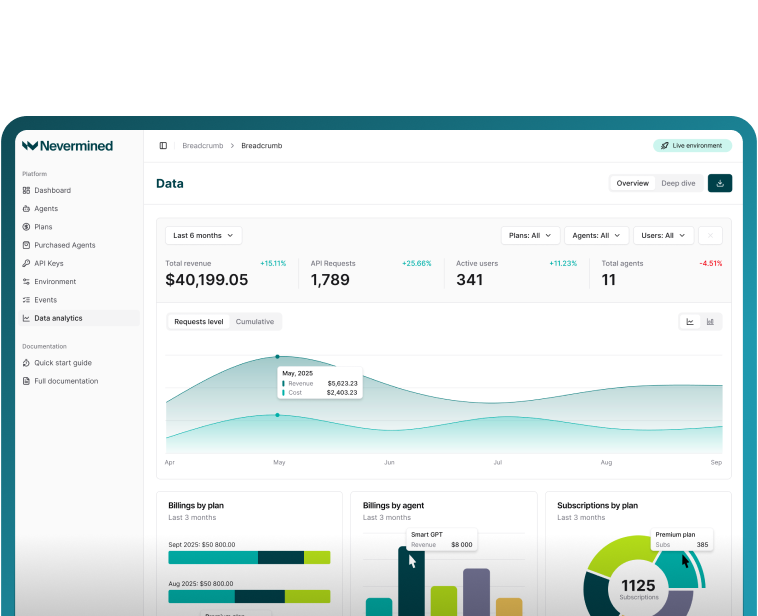
See Nevermined
in Action
Real-time payments, flexible pricing, and outcome-based monetization—all in one platform.