MENU


Data-driven analysis revealing how autonomous AI workflows generate revenue, reduce costs, and transform business operations through specialized payment infrastructure
Autonomous AI workflows are reshaping how businesses generate and capture revenue, with the agentic AI market valued at $7.55 billion in 2025 and projected to grow at 43.84% annually. Yet traditional payment systems cannot handle the complexity of AI agent transactions, creating a critical gap that specialized infrastructure like Nevermined Pay addresses through real-time metering, flexible pricing models, and instant settlement. Companies implementing purpose-built AI payment solutions report deployment time reductions from weeks to hours while recovering thousands in engineering costs.
Autonomous AI workflows operate independently to complete complex tasks, from customer service interactions to financial analysis. These systems generate value through micro-actions that traditional billing systems cannot track or monetize effectively.
The global agentic AI market stands at $7.55 billion in 2025, establishing a massive foundation for autonomous workflow monetization. This valuation reflects the growing recognition that AI agents represent a distinct market category requiring specialized infrastructure.
Projections show the agentic AI market reaching $199.05 billion by 2034. This 26x growth over nine years signals unprecedented opportunity for businesses that position themselves now with proper monetization infrastructure.
The broader AI agents market demonstrates even stronger growth at 45.82% CAGR from 2025 to 2034. This expansion rate far exceeds traditional software markets, underscoring the urgency for purpose-built billing solutions.
The workflow automation market reached $23.77 billion in 2025. When combined with AI agent capabilities, this creates substantial earnings potential for organizations with proper payment infrastructure.
An overwhelming 79% of organizations have adopted AI agents in some capacity. This near-universal adoption creates immediate demand for monetization solutions that can handle agent-to-agent transactions and usage-based billing.
Conventional payment processors require extensive custom development for AI workloads. A single agent "conversation" can trigger hundreds of micro-activities with sub-cent costs, making unit economics unreadable without specialized metering. Nevermined addresses this by enabling per-token, per-API-call, and per-GPU-cycle pricing with guaranteed margins built in.
Research shows 62% of organizations anticipate exceeding 100% return on their agentic AI investments. Capturing this ROI requires pricing models that align revenue with actual value delivered.
American companies project an average 192% ROI from agentic AI deployments. This exceptional return potential makes proper monetization infrastructure a strategic priority rather than a technical afterthought.
Process automation delivers a remarkable 240% average ROI within the first 12 months. Organizations using flexible pricing models like usage-based, outcome-based, and value-based approaches capture more of this value.
Two-thirds of organizations (66%) implementing AI agents achieve measurable productivity improvements. Converting these gains into revenue requires pricing strategies that charge for results, not just access.
The majority of companies (60%) achieve positive ROI from workflow automation within one year. Fast payback periods justify investments in specialized payment infrastructure that accelerates time-to-revenue.
Traditional seat-based pricing leaves money on the table for AI services. Nevermined Pay supports three pricing models that can be mixed:
This flexibility allows AI companies to start with cost-covering baselines and layer success fees where appropriate.
AI-powered triage automation achieves 40% reduction in cycle times. Faster processes mean more transactions, making real-time metering essential for capturing revenue from high-volume workflows.
Complex cases see 52% faster resolution with AI agent assistance. This efficiency gain translates directly to improved unit economics when paired with proper billing infrastructure.
AI agents cut customer service costs by 25%. These savings compound when organizations monetize their AI capabilities rather than treating them purely as cost centers.
Across industries, AI implementation delivers minimum 30% operational cost reductions. The combination of cost savings and new revenue streams creates powerful earnings potential.
Valory cut deployment time of their payments and billing infrastructure for the Olas AI agent marketplace from 6 weeks to 6 hours using Nevermined, clawing back $1000s in engineering costs. This case demonstrates how specialized infrastructure accelerates time-to-market dramatically.
ServiceNow reports $325 million in annualized productivity value from AI implementations. Enterprise-scale deployments require bank-grade metering and compliance capabilities that Nevermined's solutions deliver.
Workflow automation investments achieve payback within 6-9 months. This rapid return window makes immediate infrastructure investment strategically sound.
Nearly 60% of enterprises identify compliance risks as major obstacles to AI adoption. Tamper-proof metering and audit-ready transparency remove these barriers by creating verifiable records of every transaction.
34% of organizations rank cybersecurity as their primary AI agent concern. Cryptographically-signed transaction records and decentralized identifiers address these security requirements.
Over a quarter of organizations (28%) struggle with trust issues around AI agents. Independent verification through append-only logs builds the confidence enterprises need to scale deployments.
Nearly half of organizations (44%) report negative outcomes from generative AI implementations. Proper governance through immutable usage records prevents disputes and builds buyer confidence.
A striking 69% of organizations have AI projects that never achieved operational status. Zero-trust reconciliation models help avoid implementation failures by providing transparent billing from day one.
Nevermined's tamper-proof metering system creates buyer trust through independent verification. Every usage record is signed and pushed to an append-only log at creation, making it immutable. The exact pricing rule is stamped onto each agent's usage credit, allowing any developer, user, auditor, or agent to verify that usage totals match billed amounts per line-item.
An overwhelming 87% of IT executives rate interoperability as very important or crucial for AI deployments. Payment infrastructure must work seamlessly across the entire AI ecosystem.
Nearly all organizations (94%) recognize process orchestration as essential for AI success. This extends to payment orchestration, where native protocol support eliminates integration friction.
85% of organizations have already integrated AI agents into their workflows. Supporting standards like Google's Agent-to-Agent (A2A) protocol and Model Context Protocol (MCP) ensures payment infrastructure keeps pace.
Over three-quarters of global organizations (78%) use AI tools daily. This ubiquitous adoption demands payment systems that function across diverse platforms without custom integration work.
88% of enterprises now use AI regularly in at least one function. Payment infrastructure through platforms like Nevermined, including its x402 integration for advanced agent payment capabilities, enables monetization across all these touchpoints.
Open-protocol-first approaches build compatibility with emerging standards to avoid rebuilds and vendor lock-in. Native support for A2A and MCP protocols positions organizations to monetize agent interactions as the ecosystem evolves.
71% of AI agent deployments focus on process automation. These automated processes increasingly involve agent-to-agent interactions that require specialized payment capabilities.
64% of AI agent implementations target workflow automation specifically. Multi-agent workflows multiply transaction complexity, making native agent-to-agent payment support essential.
96% of enterprise IT leaders plan to expand AI agent usage within the next year. This expansion will drive exponential growth in agent-to-agent transactions.
Companies are betting big on agentic AI, with 43% allocating more than half their AI budgets to this category. These investments require monetization infrastructure that matches their scale.
Real-time account-to-account payments grew 40% globally in 2024. Agent-to-agent native payments represent the next frontier in this acceleration.
The digital payments market processes $20.09 trillion in transaction value in 2025. Even a fraction of this flowing through AI agent transactions represents massive opportunity.
Agent-to-agent native payments enable transactions between agents without human involvement. Nevermined's x402 integration extends the protocol to enable advanced agent payment capabilities, supporting fully autonomous workflows and agent swarms from day one.
72% of organizations globally now use AI-based automation. Tracking performance across this scale requires comprehensive observability that connects costs to revenue.
68% of employees at AI-using companies interact with agents daily. High-frequency usage demands real-time visibility into agent performance and cost drivers.
65% of organizations have become regular generative AI users. Usage patterns vary dramatically, making granular metering essential for understanding true costs.
Despite high adoption rates, just 33% have scaled AI beyond pilot programs. Lack of visibility into costs and revenue often prevents successful scaling.
Only 23% are actively scaling agentic AI enterprise-wide. Organizations with proper observability infrastructure scale faster by identifying what works and what drains resources.
Companies average 21 AI projects in production. Managing this portfolio requires unified dashboards showing performance, user behavior, and revenue analytics across all agents.
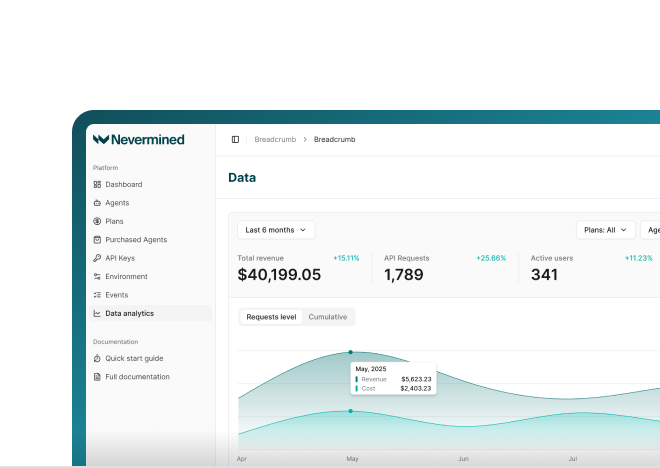
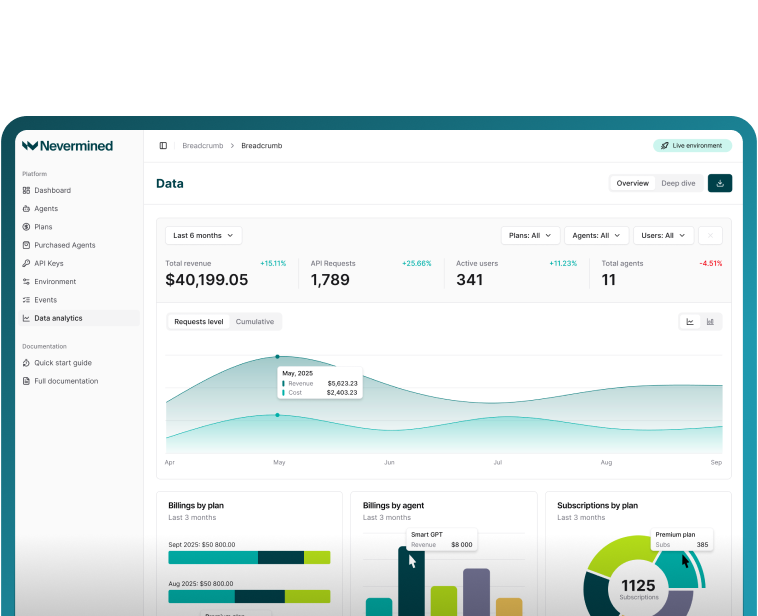
Nevermined Pay includes observability and insights dashboards that surface hidden costs and missed opportunities. This visibility identifies which features drive growth, enabling data-driven decisions about where to invest for scaling.
88% of executives plan budget increases for AI initiatives. Credit-based systems help manage this spending growth predictably.
75% of executives believe AI agents will transform workplaces more profoundly than the internet did. Such transformative adoption requires flexible spending models that scale with usage.
67% of executives expect AI agents to drastically change roles within a year. Rapid transformation demands financial flexibility that credit systems provide.
Nearly half (48%) plan to grow teams around AI capabilities. Credit-based billing allows departments to scale AI usage without renegotiating contracts.
57% of companies deploy or plan AI agents for customer service. Flex Credits allow reallocating credits across users, departments, or agents without minimum commitments.
54% of organizations apply AI agents to sales and marketing functions. Prepaid credit models provide finance teams trackable recurring billing instead of complex sub-cent charge reconciliation.
53% of companies deploy AI agents in IT and cybersecurity roles. Burn rate monitoring in real-time prevents surprise overruns in security-critical applications.
Flex Credits operate as prepaid consumption-based units redeemed directly against usage. Users prepay credits, monitor burn rate in real-time, and avoid surprise overruns. This model addresses enterprise reluctance toward minimum commitments while providing predictable spend that finance teams require.
53% of financial services organizations resolved critical operational issues using AI. Financial services represent a high-value vertical for AI workflow monetization.
40% of financial institutions already see strong returns from AI investments. Bank-grade metering requirements in this sector align with Nevermined's compliance capabilities.
Total global payments revenue will reach $2.65 trillion in 2025. AI agent payments represent a growing slice of this massive market.
The embedded finance sector expands at 22.1% CAGR in 2025. AI-native payment infrastructure positions organizations to capture this growth at the intersection of finance and AI.
Autonomous AI workflows generate earnings through direct service delivery fees, usage-based charges for API calls and compute resources, outcome-based fees tied to results achieved, and value-based pricing linked to ROI generated. The agentic AI market's growth to $199.05 billion by 2034 reflects these diverse revenue streams. Organizations using specialized infrastructure like Nevermined capture more value through real-time metering and flexible pricing models.
Three primary pricing models dominate AI agent monetization: usage-based (charging per token, API call, or GPU cycle), outcome-based (charging for results like completed tasks), and value-based (taking a percentage of ROI generated). With 62% of organizations expecting over 100% ROI, proper pricing strategy directly impacts profitability. Most successful implementations mix these models to align revenue with value delivered.
Traditional payment processors require extensive custom development for AI workloads and lack native support for micro-transactions, agent-to-agent payments, and real-time metering. With 79% of organizations already adopting AI agents, purpose-built infrastructure like Nevermined Pay becomes essential. The platform's direct integration with x402 enables advanced agent payment capabilities that legacy systems cannot match.
Agent-to-agent native payment enables autonomous AI systems to transact with each other without human intervention. As 71% of AI agents focus on process automation involving multi-agent collaboration, this capability becomes critical. Traditional payment systems require human approval for each transaction, creating bottlenecks that defeat the purpose of autonomous workflows.
Flex Credits provide predictable spend management through prepaid consumption-based units that users monitor in real-time to avoid surprise overruns. With 88% of executives planning to increase AI budgets, this visibility becomes essential for financial planning. Credit systems also allow reallocating resources across users, departments, or agents without contract renegotiation.
See Nevermined
in Action
Real-time payments, flexible pricing, and outcome-based monetization—all in one platform.